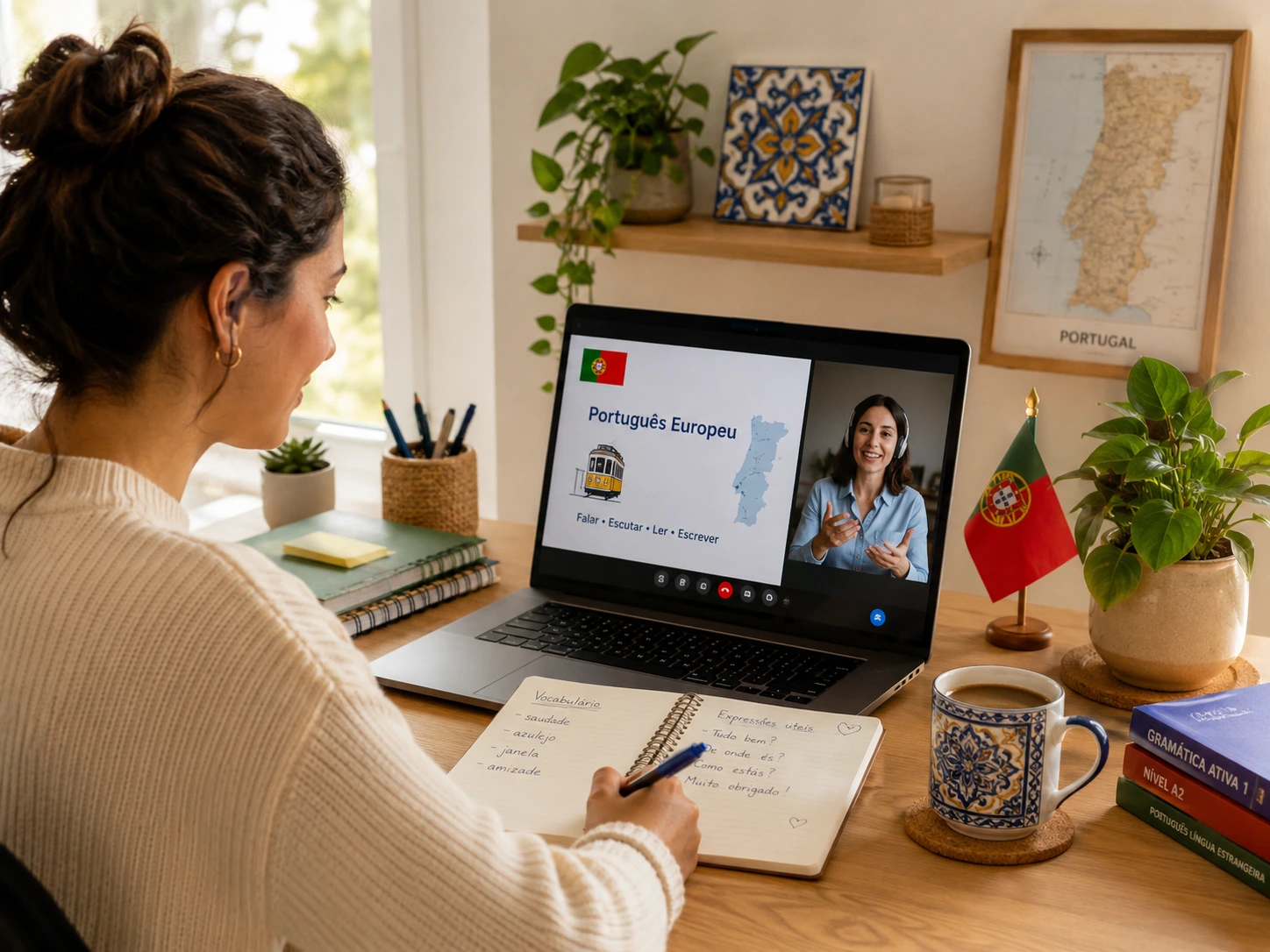
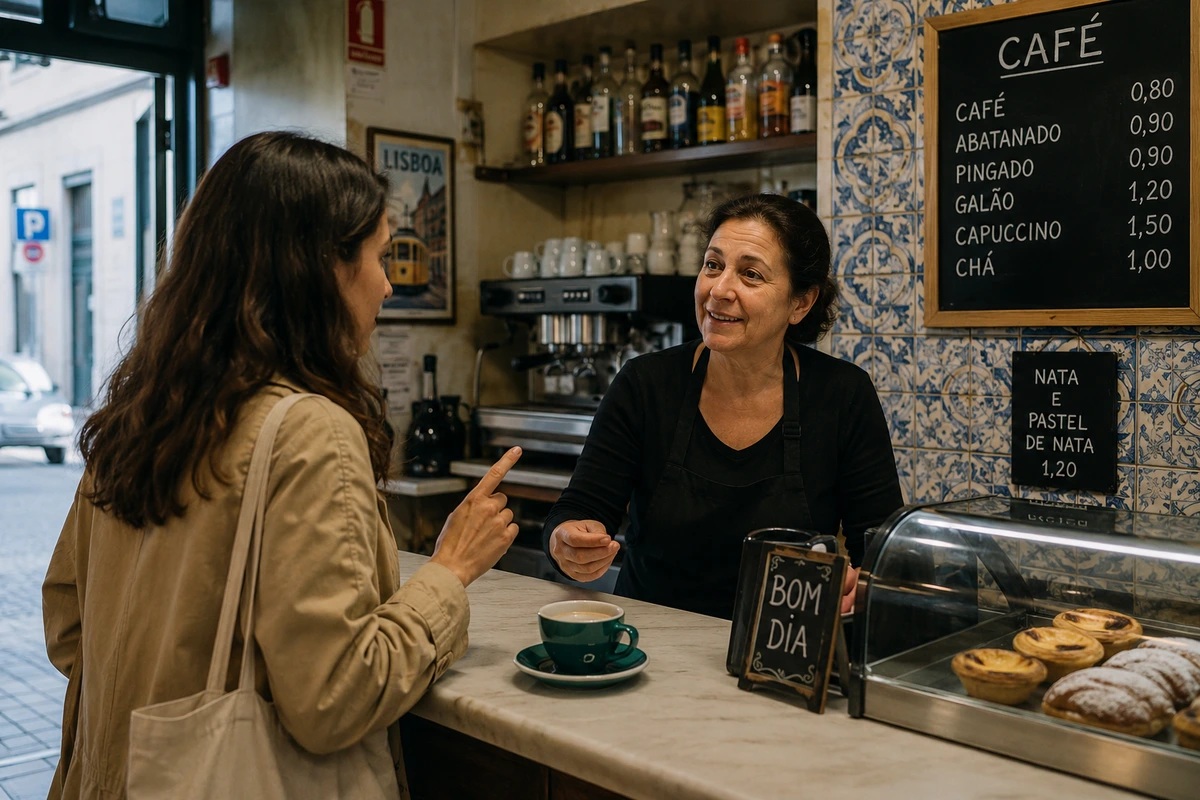

European Portuguese for beginners should be practical from the start. If you are moving to Portugal, visiting often, or building relationships with Portuguese family and friends, learning the language through real-life situations can make a real difference in your daily life.
My guide to Portuguese for daily life in Portugal will help you prepare for common interactions in cafés, shops, appointments, services and social situations.
Many beginners study Portuguese through apps or courses that focus mainly on Brazilian Portuguese. That can be confusing when you arrive in Portugal, because the pronunciation, vocabulary and some grammar are different.
This is why many learners feel stuck: they study Portuguese, but freeze in real conversations.
As a tutor working with adult learners, I see this every day. Some students understand quite a lot on paper, but struggle to use Portuguese naturally when it really matters. This guide is designed to help you move past that stage and start using European Portuguese in practical, everyday situations from the beginning.
- At a Glance
- Why European Portuguese Matters
- European Portuguese vs Brazilian Portuguese
- Essential European Portuguese Phrases
- European Portuguese Pronunciation Tips
- Simple Grammar That Works in Real Life
- How to Learn European Portuguese
- Common Mistakes Beginners Make
- How to Practise European Portuguese in Real Life
- Get Personalised Support With Your Portuguese
- See Also
- Final Thoughts
- FAQ
- About the Author
Some links on this website may be affiliate or referral links. If you use them, I may receive a small commission or reward, at no extra cost to you.
I only recommend resources, tools, and services that I believe may be helpful for learning European Portuguese. These links help support the website, but they do not influence the advice or learning guidance I share.
At a Glance
- Learn European Portuguese for beginners in real-life situations.
- Understand key differences from Brazilian Portuguese.
- Use simple phrases immediately in Portugal.
- Build confidence speaking from day one.
- Focus on communication, not perfection.
Why European Portuguese Matters

European Portuguese for beginners is most useful when it connects directly to daily life.
Even basic Portuguese can help you feel more confident, more independent, and more connected in Portugal.
You will use it when:
- Ordering food in cafés and restaurants.
- Speaking with neighbours.
- Visiting a doctor or pharmacy.
- Shopping at local markets.
- Handling appointments or paperwork.
- Talking with Portuguese family members.
If you live here or are preparing to move, this practical guide to European Portuguese for expats in Portugal explores the language that can help you become more independent in everyday life.
In Portugal, small details matter. Saying bom dia when you enter a café, shop or waiting room is normal and polite. These simple habits help communication feel more natural and respectful.
You do not need perfect grammar to begin. You need useful phrases, a little confidence, and the willingness to try.
European Portuguese vs Brazilian Portuguese
Many beginners do not realise how different European and Brazilian Portuguese can feel in real life.
For a more detailed comparison of pronunciation, vocabulary and everyday structures, read European Portuguese vs Brazilian Portuguese.
Pronunciation Differences
European Portuguese often sounds more closed and compressed. Some vowels are reduced or almost disappear, which can make native speakers sound fast.
Example:
Portugal: Estou a aprender português.
Brazil: Estou aprendendo português.
Both mean “I am learning Portuguese”, but the structure used in Portugal is different.
Vocabulary Differences
Some everyday words are different:
- Bus: autocarro in Portugal, ônibus in Brazil.
- Train: comboio in Portugal, trem in Brazil.
- Juice: sumo in Portugal, suco in Brazil.
- Mobile phone: telemóvel in Portugal, celular in Brazil.
Grammar Differences
In Portugal, this structure is very common:
estar + a + infinitive
Examples:
Estou a estudar.
I am studying.
Estou a aprender português.
I am learning Portuguese.
This is one of the first differences beginners notice when they focus on Portuguese from Portugal.
Essential European Portuguese Phrases
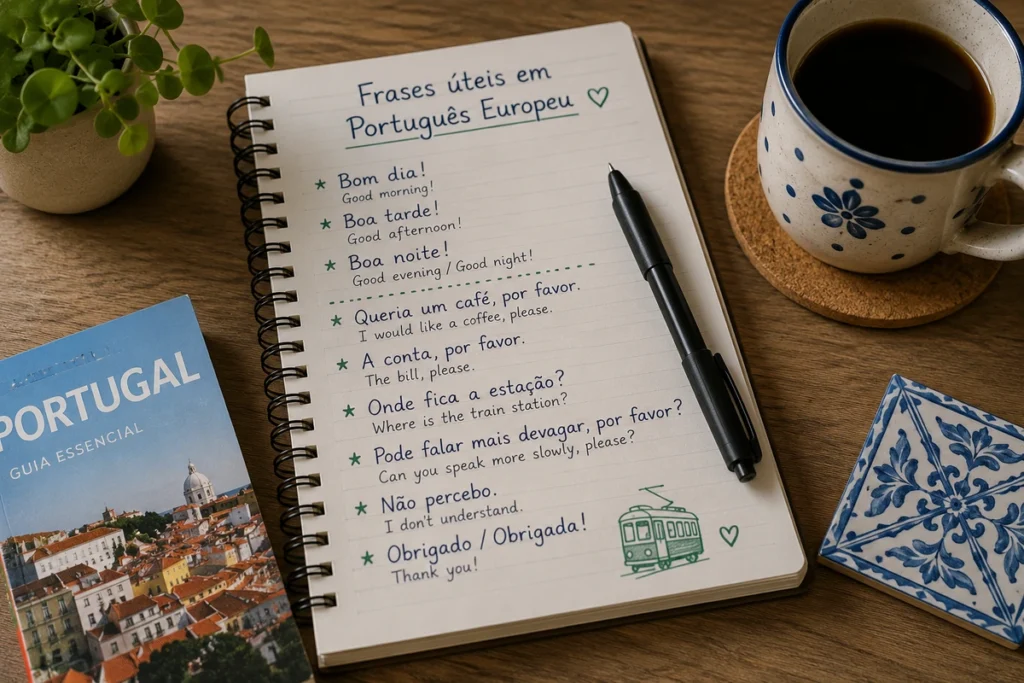
These phrases are useful from the beginning because you can use them immediately in Portugal.
Greetings
Bom dia.
Meaning: Good morning.
Use this when entering cafés, shops, clinics, offices or starting a polite conversation.
Example: Bom dia, queria um café, por favor.
Boa tarde.
Meaning: Good afternoon.
Use this from early afternoon until evening.
Example: Boa tarde, queria marcar uma consulta.
Boa noite.
Meaning: Good evening / good night.
Use this in the evening or when saying goodbye at night.
Example: Boa noite, até amanhã.
Useful European Portuguese Phrases for Daily Life
Desculpe.
Meaning: Excuse me / sorry.
Use this to get someone’s attention or apologise politely.
Example: Desculpe, onde fica a estação?
Não percebo.
Meaning: I don’t understand.
Very useful when someone speaks too fast.
Example: Desculpe, não percebo muito português.
Não percebi.
Meaning: I didn’t understand what you just said.
Example: Desculpe, não percebi.
Pode falar mais devagar?
Meaning: Can you speak more slowly?
This is one of the most useful phrases for beginners.
Example: Pode falar mais devagar, por favor?
Queria um café, por favor.
Meaning: I would like a coffee, please.
In Portugal, queria sounds polite and natural.
Quero is grammatically correct, but it can sound too direct in some situations.
Quanto custa?
Meaning: How much does it cost?
Use this in shops, markets and cafés.
Example: Quanto custa este pão?
Onde fica…?
Meaning: Where is…?
Use this to ask for directions.
Example: Onde fica a farmácia?
Tenho uma consulta amanhã.
Meaning: I have an appointment tomorrow.
Useful in medical, dental or service situations.
Example: Tenho uma consulta amanhã às dez.
Mini Dialogue
Cliente: Bom dia, queria um café, por favor.
Empregado: Sim, mais alguma coisa?
Cliente: Não, obrigado/a.
Practising small exchanges like this makes real conversations feel much easier.
If you want to practise these phrases with guidance and real feedback, private European Portuguese lessons can help you start using them naturally in conversation.
European Portuguese Pronunciation Tips
European Portuguese pronunciation can feel difficult at first. That is completely normal, especially if you understand written Portuguese better than spoken Portuguese.
My European Portuguese pronunciation guide explains reduced vowels, nasal sounds, word stress and connected speech through practical examples from Portugal.
Listen Before Trying to Speak Fast
Start slowly. Pay attention to rhythm, stress and melody before trying to speak quickly.
The goal is not perfect pronunciation. The goal is to be understood and to understand more each week.
Notice Reduced Vowels
European Portuguese often reduces unstressed vowels.
Example:
pequeno may sound like p’queno
This is one reason spoken Portuguese can feel fast.
Learn Common Sound Patterns
Some sounds appear often in Portuguese:
- ão is nasal.
- lh has no exact equivalent in English, although the middle sound in words such as “million” can provide an approximate starting point.
- nh is similar to the “ny” sound in “canyon”, although the Portuguese sound should be learnt through listening and imitation.
With regular listening, these sounds become easier to recognise.
Simple Grammar That Works in Real Life
You do not need complex grammar to start communicating. Focus first on structures you can use every day.
The guide to European Portuguese grammar for beginners introduces essential structures through practical sentences rather than isolated rules.
Using “ter”
The verb ter means “to have”, and it is very practical.
Examples:
Tenho 40 anos.
I am 40 years old.
Tenho uma pergunta.
I have a question.
Tenho de ir ao banco.
I have to go to the bank.
Tenho uma consulta amanhã.
I have an appointment tomorrow.
Using “queria” for Polite Requests
In Portugal, requests are often softened to sound more polite.
Examples:
Queria marcar uma consulta.
I would like to book an appointment.
Queria pagar.
I would like to pay.
Queria uma mesa para duas pessoas.
I would like a table for two people.
This small change can make your Portuguese sound much more natural.
How to Learn European Portuguese
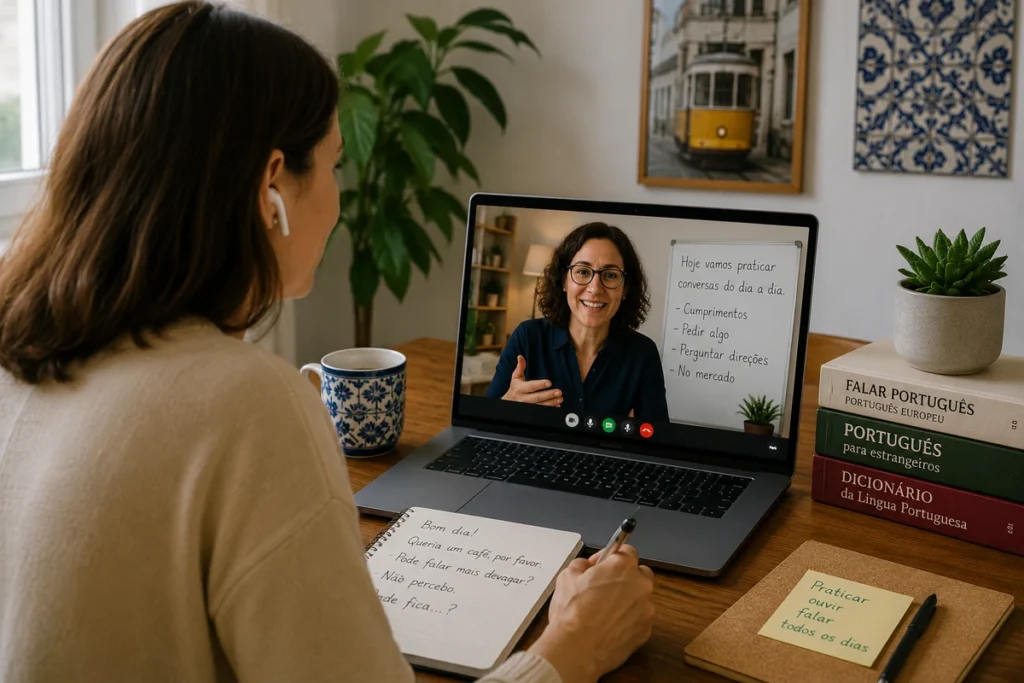
To learn European Portuguese effectively, focus on communication from the start. If you study remotely, this guide explains how to learn European Portuguese online for real life in Portugal by combining listening, practical grammar and speaking practice.
Learn Phrases, Not Isolated Words
Instead of memorising single words, learn complete phrases.
Better:
Queria um café.
Instead of only:
café = coffee
This helps you speak more naturally and translate less in your head.
Practise Speaking Early
Do not wait until you feel ready. Most learners never feel completely ready.
These strategies for practising spoken European Portuguese can help you move from prepared phrases to more spontaneous conversations.
Start with:
- Greetings.
- Ordering food.
- Asking simple questions.
- Saying you do not understand.
- Asking someone to speak more slowly.
Small interactions build confidence.
Listen Every Day
Listening is essential for European Portuguese.
Try:
- Portuguese radio.
- YouTube content from Portugal.
- TV series from Portugal.
- Podcasts for learners.
- Short daily dialogues.
Consistency is more important than long study sessions.
Accept the Learning Curve
Many beginners understand written Portuguese before they understand fast spoken Portuguese. That is normal.
European Portuguese takes time to recognise by ear, particularly because of reduced vowels, connected speech and sentence rhythm. Progress also varies according to your goals, study routine and opportunities to use the language. How Long Does It Take to Learn European Portuguese? will help you develop more realistic expectations for your learning journey.
Common Mistakes Beginners Make
Using Only Brazilian Portuguese Resources
Brazilian Portuguese resources can be useful, but they may cause confusion if your goal is to communicate in Portugal. Some popular apps primarily teach the Brazilian variety. If you are considering using one, read Is Duolingo Good for European Portuguese? to understand what it can offer and its limitations for learners focused on Portugal.
Choose materials that focus on pronunciation, vocabulary and expressions from Portugal.
Waiting Too Long to Speak
Speaking early is important. You can start with simple phrases before you know much grammar.
Even saying bom dia, obrigado/a and queria um café is real practice.
Translating Everything Word by Word
Portuguese does not always work like English.
Instead of translating every word, learn patterns.
Example:
Tenho 40 anos literally means “I have 40 years”, but in English we say “I am 40 years old.”
If English is your main support language, this guide explains some of the common mistakes English speakers make in European Portuguese and how to replace direct translations with more natural structures.
How to Practise European Portuguese in Real Life

Use your daily routine as practice.
In a Café
Bom dia.
Queria um café, por favor.
Obrigado/a.
At the Pharmacy
Tenho uma dor de cabeça.
Preciso deste medicamento.
Pode ajudar-me?
With Neighbours
Bom dia.
Tudo bem?
Como está?
At the Market
Quanto custa?
Aceita cartão?
Queria meio quilo, por favor.
These small conversations are where real progress happens.
Get Personalised Support With Your Portuguese
Understanding useful phrases is an important first step, but using them spontaneously in a real conversation is a different skill.
In a personalised lesson, we can practise the situations that are most relevant to your life, whether you need Portuguese for cafés, appointments, neighbours, family, travel or work in Portugal. I teach mainly in Portuguese, with support in English whenever it helps you understand a new structure or resolve a specific doubt.
If you would like my help as you begin learning Portuguese, you can schedule a trial lesson with me on Preply. We can identify what you already understand, what is currently making communication difficult and create a practical plan around your needs.
See Also
Continue learning European Portuguese with these related guides:
- Portuguese for Daily Life in Portugal — learn useful language for cafés, appointments, neighbours and everyday services.
- European Portuguese Pronunciation Guide — understand reduced vowels, nasal sounds, word stress and connected speech.
- European Portuguese Grammar for Beginners — learn essential grammar through practical sentences and everyday examples.
- How to Practise Speaking European Portuguese — turn passive knowledge into more confident and spontaneous communication.
- Common Mistakes English Speakers Make in European Portuguese — recognise recurring patterns and avoid unnatural direct translations.
- Learn European Portuguese Online for Real Life in Portugal — combine online resources with listening, practical grammar and speaking practice.
Final Thoughts
European Portuguese for beginners should be useful, practical and connected to real life in Portugal.
Start with the phrases you need most in cafés, shops, appointments, transport and everyday conversations. You do not need perfect Portuguese to begin. You need simple Portuguese that helps you communicate.
With regular listening, small speaking practice and the right European Portuguese resources, you can gradually feel more confident using Portuguese in daily life.
If you want more structure and speaking practice, guided European Portuguese lessons can help you use these phrases more naturally in real conversations.
FAQ
About the Author

Isabel M.
Native European Portuguese Tutor | Founder of Practical Portuguese
Hi, I’m Isabel, a native European Portuguese tutor from Portugal and the founder of Practical Portuguese.
I help adults learn authentic European Portuguese through structured, personalised online lessons. My lessons are taught mainly in Portuguese, with support in English whenever needed. I teach students from complete beginner to advanced levels, focusing on practical communication for everyday life, family, travel and work in Portugal.
Every article on Practical Portuguese combines natural language as it is spoken in Portugal with my experience teaching adult learners from different language backgrounds.
Why Learn with Me?
✔ Native European Portuguese speaker from Portugal
✔ Lessons taught in Portuguese with support in English
✔ Experience teaching adults from different language backgrounds
✔ Personalised one-to-one online lessons
✔ Practical Portuguese for everyday life, family, travel and work in Portugal
✔ Lessons adapted to your listening, pronunciation, sentence structure and speaking needs