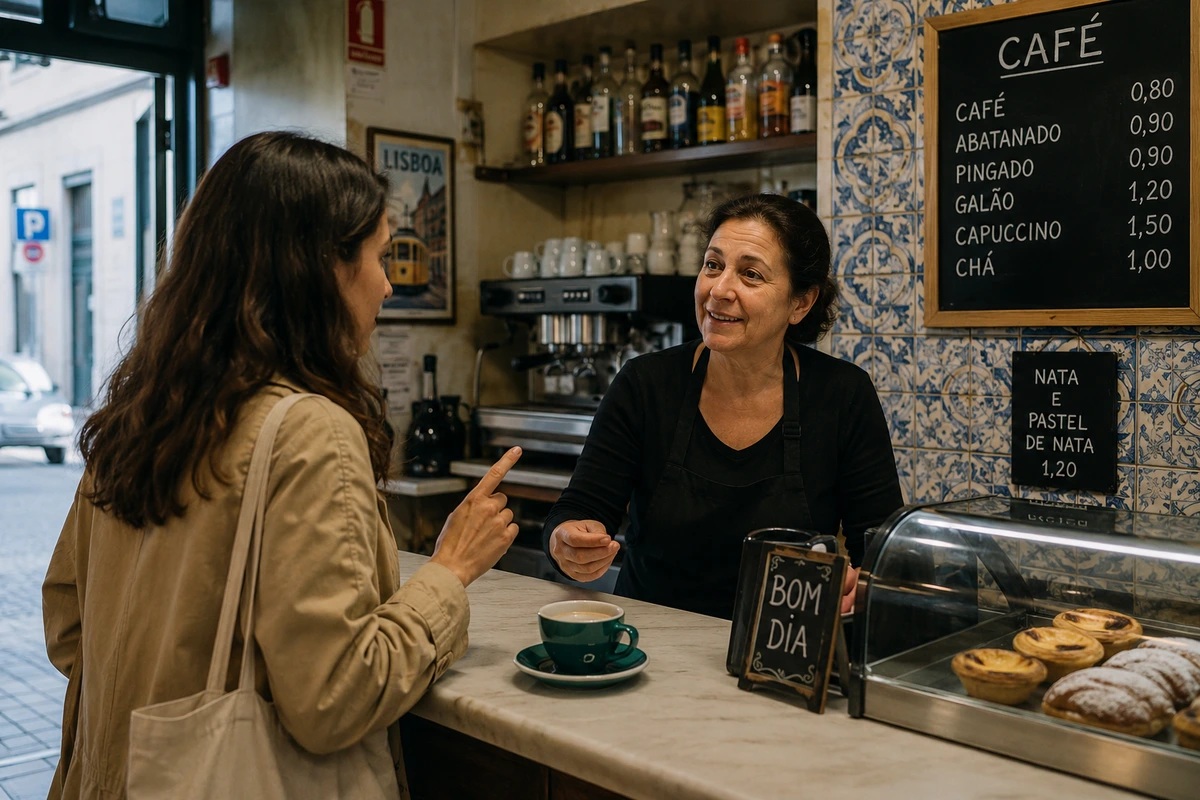


The best way to practise speaking European Portuguese is to use complete phrases, say them aloud, retrieve them from memory and rehearse situations you are likely to experience in Portugal.
You do not need to wait until you know more grammar or feel completely confident. You can begin with short conversations connected to your real life, such as ordering in a café, booking an appointment, speaking to a neighbour or asking for help in a shop.
This guide will help you turn Portuguese that you recognise into Portuguese that you can actually use. For the best results, use audio recorded by speakers from Portugal and practise expressions that you are likely to hear in everyday life.
For a broader learning structure that combines speaking, listening, vocabulary and grammar, see Best Way to Learn European Portuguese Online.
- At a Glance
- Why Understanding Portuguese Is Not the Same as Speaking It
- Build a Personal European Portuguese Phrase Bank
- Use the Look, Cover, Say and Change Method
- Listen and Repeat Short European Portuguese Audio
- Record Short Answers on Your Phone
- Rehearse Real Conversations Before They Happen
- Learn Phrases That Keep the Conversation Going
- What to Do When Someone Replies in English
- A 20-Minute European Portuguese Speaking Routine
- How Guided Speaking Practice Can Help
- Practise Real-Life Portuguese With Personal Support
- How to Measure Your Speaking Progress
- Common Speaking Practice Mistakes
- Your First Seven Days of Speaking Practice
- Start With One Small Speaking Goal
- See Also
- Final Thoughts
- FAQ
- About the Author
Some links on this website may be affiliate or referral links. If you use them, I may receive a small commission or reward, at no extra cost to you.
I only recommend resources, tools, and services that I believe may be helpful for learning European Portuguese. These links help support the website, but they do not influence the advice or learning guidance I share.
At a Glance
- Learn complete phrases instead of isolated words.
- Say Portuguese aloud during every practice session.
- Rehearse likely questions as well as your own answers.
- Use short recordings to practise pronunciation and rhythm.
- Measure progress through real communication tasks.
- Practise regularly in short, focused sessions.
Why Understanding Portuguese Is Not the Same as Speaking It
Many learners can understand a simple Portuguese sentence but struggle to produce the same sentence in conversation.
Recognition and speaking are different skills. When you listen or read, the words are already in front of you. When you speak, you need to retrieve the words, organise the sentence and pronounce it while another person is waiting for your answer.
This does not mean that you have failed to learn the language. It simply means that speaking needs its own kind of practice.
Studying more vocabulary does not always solve a speaking problem. You also need opportunities to retrieve and use the Portuguese you already know.
The goal is to make useful sentence patterns more automatic, so that you can access them more easily when you need them.
Build a Personal European Portuguese Phrase Bank
A personal phrase bank is a collection of complete sentences that you are likely to use in your own life.
Instead of memorising isolated words such as consulta, amanhã and marcar, learn the complete phrase:
I would like to book an appointment for tomorrow.
Complete phrases are easier to retrieve during a real conversation because you do not have to construct each sentence from the beginning.
Choose phrases connected to situations you regularly experience. For example:
- Queria marcar uma consulta.
I would like to book an appointment. - Preciso de falar com o senhorio.
I need to speak to the landlord. - Estou à procura de uma farmácia.
I am looking for a pharmacy. - Tenho uma encomenda para levantar.
I have a parcel to collect. - Pode repetir, por favor?
Can you repeat that, please? - Ainda estou a aprender português.
I am still learning Portuguese.
Ten phrases are enough to begin. Choose phrases that you may need during the next week and practise those before adding more.
Use the Look, Cover, Say and Change Method
You may find that a phrase looks familiar on the page but disappears when you need to say it. This simple exercise helps move it from recognition to active use.
1. Look
Read the complete sentence aloud:
Tenho uma consulta amanhã.
I have an appointment tomorrow.
2. Cover
Hide the Portuguese sentence.
3. Say
Say the sentence again from memory.
4. Change
Replace one part of the sentence:
- Tenho uma reunião amanhã.
- Tenho uma entrega amanhã.
- Tenho uma consulta na sexta-feira.
- Tenho de ir ao banco amanhã.
Changing one part helps you learn a flexible sentence pattern instead of memorising one fixed example.
You can use the same method with requests:
- Queria um café, por favor.
- Queria uma água, por favor.
- Queria pagar, por favor.
- Queria marcar uma consulta.
It is fine to practise slowly at first. Speed usually develops as the structure becomes more familiar.
Listen and Repeat Short European Portuguese Audio
Short audio is often more useful for speaking practice than a long podcast or a fast television programme.
Choose a recording spoken by someone from Portugal. One or two sentences are enough.
You can use this process:
- Listen to the complete sentence.
- Listen again and notice the rhythm.
- Repeat the sentence in short sections.
- Copy the speaker’s stress and connected sounds.
- Say the complete sentence without the recording.
For example:
Bom dia, queria marcar uma consulta para a próxima semana.
Divide it into sections:
- Bom dia.
- Queria marcar uma consulta.
- Para a próxima semana.
Then say the complete sentence.
Try not to focus only on individual sounds. European Portuguese often connects words closely, so practising the rhythm of the whole phrase is important.
Choosing audio from Portugal is important because European Portuguese has different pronunciation, rhythm and everyday expressions from Brazilian Portuguese. Read European Portuguese vs Brazilian Portuguese to understand the main differences.
If you are building your listening and speaking routine from the beginning, European Portuguese for Beginners can help you create a practical foundation.
Record Short Answers on Your Phone
Recording yourself can feel uncomfortable at first, but it gives you a clear way to notice whether you can produce Portuguese without reading it.
Choose one simple question:
- Onde mora?
- Há quanto tempo vive em Portugal?
- Porque está a aprender português?
- O que costuma fazer ao fim de semana?
- O que vai fazer amanhã?
Record an answer of approximately one minute.
For example:
Moro em Setúbal há dois anos. Gosto de viver aqui porque a cidade é tranquila e fica perto do mar. Durante a semana trabalho em casa e ao fim de semana costumo passear.
Listen to the recording once and choose one area to improve:
- long pauses;
- unclear pronunciation;
- repeated words;
- missing connectors;
- difficulty finishing sentences.
Then record the answer again.
You do not need to correct every detail at the same time. One clear improvement is more useful than a long list of possible mistakes.
Keep some recordings and repeat the same task after a few weeks. Progress is often easier to notice when you compare two recordings made at different times.
Rehearse Real Conversations Before They Happen
One of the most useful ways to practise speaking European Portuguese is to prepare for conversations that you are likely to have.
You do not need to memorise a long script. It is usually enough to prepare:
- your opening sentence;
- two likely questions;
- short answers to those questions;
- a phrase to use if you do not understand.
If you live in Portugal, European Portuguese for Expats in Portugal explains which situations and communication skills are most useful in everyday life.
At a Café
You could begin with:
Bom dia, queria um café e uma torrada, por favor.
Good morning, I would like a coffee and toast, please.
You may hear:
É para aqui ou para levar?
Is it for here or to take away?
Possible answers:
- É para aqui.
It is for here. - É para levar.
It is to take away.
You may also need:
Queria pagar, por favor.
I would like to pay, please.
At the Pharmacy
You could begin with:
Bom dia, queria alguma coisa para a tosse, por favor.
Good morning, I would like something for a cough, please.
You may hear:
Há quanto tempo está assim?
How long have you been like this?
A possible answer is:
Há três dias.
For three days.
You may also need:
- Tenho febre.
I have a fever. - Não tenho febre.
I do not have a fever. - Posso tomar isto com outros medicamentos?
Can I take this with other medication?
These phrases can support communication but do not replace professional medical advice.
Booking an Appointment
You could begin with:
Bom dia, queria marcar uma consulta, por favor.
Good morning, I would like to book an appointment, please.
You may hear:
- É para si?
Is it for you? - Prefere de manhã ou à tarde?
Do you prefer the morning or afternoon? - Tem algum dia de preferência?
Do you have a preferred day?
Possible answers:
- Sim, é para mim.
- Prefiro de manhã.
- Pode ser na quinta-feira.
- Não posso na segunda-feira.
Preparing dates and times before making the call can reduce the number of things you need to think about during the conversation.
Speaking to a Neighbour
Neighbour conversations are often short and predictable, which makes them useful for regular practice.
You could try:
- Bom dia, tudo bem?
- Está muito calor hoje.
- Vai passear?
- Vou às compras.
- Tenha um bom fim de semana.
You do not need to create a long conversation. A greeting and one additional sentence are already useful speaking practice.
Learn Phrases That Keep the Conversation Going
You do not need to understand every word to communicate successfully. What matters is knowing how to respond when something is not clear.
These phrases can help you continue in Portuguese instead of immediately switching to English:
- Desculpe, não percebi.
Sorry, I did not understand. - Pode repetir, por favor?
Can you repeat that, please? - Pode falar um pouco mais devagar?
Can you speak a little more slowly? - O que quer dizer?
What does that mean? - Como se diz isto em português?
How do you say this in Portuguese? - Quer dizer que…?
Do you mean that…? - Não me lembro da palavra, mas…
I cannot remember the word, but…
For example:
Quer dizer que tenho de voltar amanhã?
Do you mean that I have to return tomorrow?
You can also describe a word that you cannot remember:
Não me lembro da palavra, mas é uma coisa que usamos para abrir garrafas.
I cannot remember the word, but it is something we use to open bottles.
Learning these phrases can reduce pressure because you already know what to say when communication becomes difficult.
What to Do When Someone Replies in English
People in Portugal may reply in English because they want to help or make the interaction faster.
This does not necessarily mean that your Portuguese is poor.
You can continue politely:
Obrigado, mas gostava de praticar português.
Thank you, but I would like to practise Portuguese.
If you are a woman, say:
Obrigada, mas gostava de praticar português.
You can also say:
Podemos continuar em português? Ainda estou a aprender.
Can we continue in Portuguese? I am still learning.
Choose the situation carefully. A quiet café or informal conversation may give you more space to practise than a busy queue where staff need to serve several people quickly.
A 20-Minute European Portuguese Speaking Routine
You do not need a long study session. Even twenty focused minutes can give you useful speaking practice.
Five Minutes: Retrieve Useful Phrases
Choose five phrases from your personal phrase bank.
Say each one without reading it and change one part of the sentence.
Five Minutes: Listen and Repeat
Use one short European Portuguese recording.
Repeat it several times and copy the speaker’s rhythm.
Five Minutes: Rehearse a Conversation
Choose one situation, such as:
- ordering lunch;
- booking an appointment;
- asking about a bus;
- collecting a parcel;
- speaking to a neighbour.
Say both sides of the conversation aloud.
Five Minutes: Speak Freely
Speak for one or two minutes about your day.
For example:
Hoje fui ao supermercado. Comprei pão, fruta e leite. Depois fui à farmácia. Amanhã tenho uma consulta às dez horas.
Try not to restart every time you make a mistake. Finish your thought first, even if the sentence is not perfect.
The aim is to practise continuing your message.
How Guided Speaking Practice Can Help
Practising with another person helps you respond to questions that you did not prepare in advance.
To make the practice more useful, choose a specific activity rather than simply asking to have a conversation.
For example, you could:
- practise calling a clinic;
- role-play a conversation with a landlord;
- rehearse ordering in a restaurant;
- practise explaining a problem at the pharmacy;
- answer five questions about your week.
After the first attempt, ask the other person to correct two or three important mistakes. Then repeat the same conversation.
This second attempt gives you an immediate opportunity to use the feedback while the language is still fresh.
With a Portuguese partner, friend or relative, you can say:
- Podemos falar em português durante dez minutos?
Can we speak in Portuguese for ten minutes? - Podes fazer-me algumas perguntas?
Can you ask me some questions? - Podes corrigir só os erros mais importantes?
Can you correct only the most important mistakes?
These examples use informal tu forms, which are suitable for friends, partners and relatives.
Short, structured practice is often more manageable and productive than an unplanned conversation that quickly returns to English.
A Student’s Experience
My main focus is on gaining confidence and skills to speak more in Portuguese in my daily life, and Isabel’s classes have been a game-changer. Unlike the group classes I took elsewhere, her lessons are personalized, insightful, and structured specifically around day-to-day conversations.
I already talked more during my first two classes than during my entire 12-day group course. She provides practical sentence structures that help me stay fluent and organized.
She encourages me to say as much as possible before providing clear feedback. She also provides many other examples so I can expand my vocabulary and avoid sounding repetitive.
Most importantly, Isabel creates a supportive atmosphere where it feels safe to make mistakes. While I used to dread going to class, these lessons fly by.
Laurens’s experience shows how much easier speaking can feel when you have enough time to express yourself, receive focused feedback and repeat useful structures in a supportive environment.
Practise Real-Life Portuguese With Personal Support
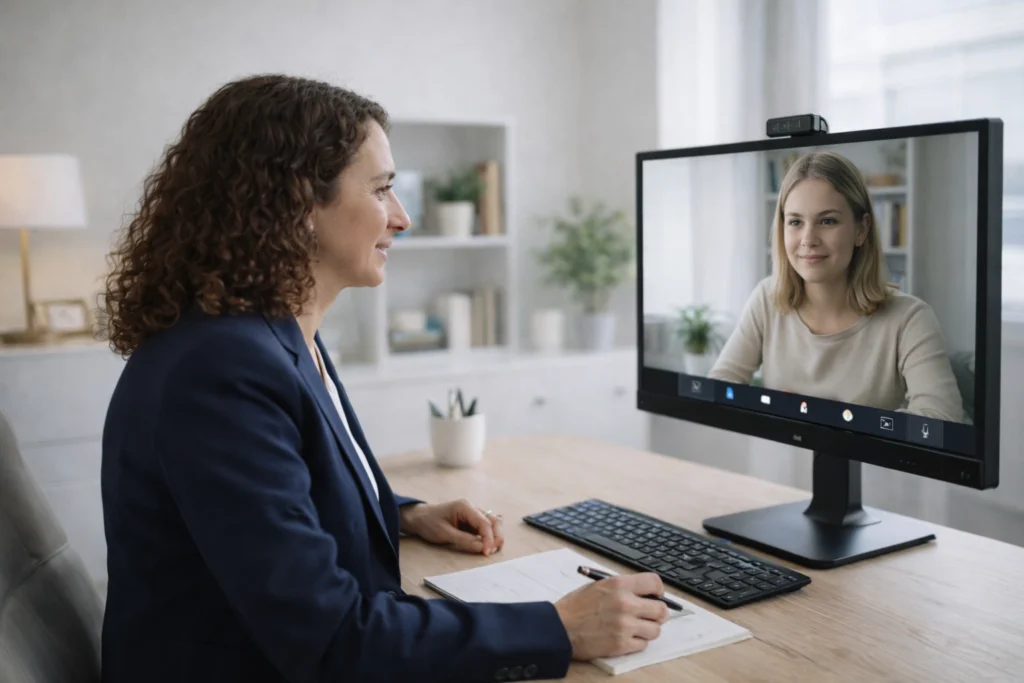
You may recognise yourself in Laurens’s experience: you understand some Portuguese, but you need more opportunities to speak, organise your ideas and receive feedback without being interrupted after every mistake.
In a private European Portuguese lesson, we can practise situations that are relevant to your life in Portugal, such as speaking to neighbours, booking appointments, visiting a pharmacy or having conversations with Portuguese relatives.
The lessons are adapted to your level, goals and daily routine, so you can focus on the Portuguese you are most likely to use.
How to Measure Your Speaking Progress
It is often more helpful to measure progress through practical communication tasks than by asking whether you feel fluent.
At the beginning of the month, record yourself:
- introducing yourself for one minute;
- ordering in a café;
- describing what you did yesterday;
- explaining a simple problem;
- making plans for the weekend.
Repeat the same tasks four weeks later.
You can also keep a simple record of real interactions:
- I ordered in Portuguese.
- I asked one follow-up question.
- I understood the price.
- I booked an appointment.
- I spoke to a neighbour.
- I asked someone to repeat.
- I continued after forgetting a word.
These small results can show you that your Portuguese is becoming more usable, even when progress does not always feel obvious from day to day.
Common Speaking Practice Mistakes
Translating Complete Sentences From English
Long translations can create pressure and often produce unnatural sentences.
It may be easier to begin with a Portuguese structure that you already know:
- Queria saber se… — I would like to know whether…
- Preciso de… — I need…
- Tenho de… — I have to…
- Pode ajudar-me? — Can you help me?
Use the structure to build a short, clear message instead of trying to translate a complicated English sentence word for word.
Stopping After Every Mistake
If you stop and restart every time something sounds imperfect, you may end up practising correction more than communication.
Give yourself permission to finish the message first. You can review the mistake afterwards.
Practising Only Prepared Monologues
Talking about yourself is useful, but real conversations include questions, interruptions and unexpected replies.
Try to include some question-and-answer practice in your routine.
Preparing Your Sentence but Not the Possible Reply
Learners often rehearse what they want to say but do not prepare for the answer.
Before an interaction, it can help to ask:
- What might the other person say?
- What details might they request?
- How will I ask them to repeat?
- How will I confirm that I understood?
Choosing Material That Is Too Difficult
A fast interview or long podcast may contain useful Portuguese, but it may not be suitable for repetition practice.
Choose short audio that feels manageable and that you can copy reasonably well. You can increase the difficulty gradually as your listening and speaking improve.
Your First Seven Days of Speaking Practice
If you are not sure where to begin, this simple plan can guide your first week.
Day 1
Choose ten phrases connected to one real situation.
Day 2
Practise the phrases using the Look, Cover, Say and Change method.
Day 3
Listen to and repeat one short European Portuguese recording.
Day 4
Prepare three likely questions and answers for your chosen situation.
Day 5
Record a one-minute role-play.
Day 6
Use at least one phrase in a real interaction.
Day 7
Review what felt difficult and repeat the conversation.
During the following week, keep the most useful phrases and introduce one new situation.
Start With One Small Speaking Goal
Choose one communication goal at a time.
You might begin by ordering coffee in Portuguese and then practise understanding the likely follow-up question. Later, you can add another question or attempt a short phone call.
Prepare your opening sentence, one or two possible replies and a phrase for asking someone to repeat.
Small, completed interactions gradually make speaking feel more manageable.
See Also
Continue learning with these practical European Portuguese guides:
- European Portuguese for Beginners — build a practical foundation for everyday communication in Portugal.
- Best Way to Learn European Portuguese Online — create a balanced learning routine that includes speaking, listening, vocabulary and grammar.
- European Portuguese for Expats in Portugal — learn the Portuguese you need for appointments, neighbours, services and daily life.
- Learn European Portuguese Online — explore practical ways to study European Portuguese with structure and regular support.
- European Portuguese vs Brazilian Portuguese — understand the main differences in pronunciation, vocabulary and everyday usage.
Final Thoughts
Learning how to practise speaking European Portuguese is mainly about turning passive knowledge into active communication.
Build a small phrase bank, retrieve sentences from memory and rehearse situations that are relevant to your life in Portugal. Practise possible replies as well as your own opening sentence, and use communication phrases when you do not understand.
You do not need to speak perfectly before you begin. Each short interaction gives you an opportunity to retrieve familiar language, notice what you need and try again.
Regular speaking practice does not need to be long. A focused 20-minute routine can help you become quicker, clearer and more comfortable using Portuguese in real situations.
If you would like guided speaking practice, private lessons can help you rehearse the conversations you need, receive clear feedback and develop more confidence speaking European Portuguese.
Book a private European Portuguese lesson with Isabel on Preply
FAQ
About the Author

Isabel M.
Native European Portuguese Tutor | Founder of Practical Portuguese
Hi, I’m Isabel, a native European Portuguese tutor from Portugal and the founder of Practical Portuguese.
I help adults learn authentic European Portuguese through structured, personalised online lessons. My lessons are taught mainly in Portuguese, with support in English whenever needed. I teach students from complete beginner to advanced levels, focusing on practical communication for everyday life, family, travel and work in Portugal.
Every article on Practical Portuguese combines natural language as it is spoken in Portugal with my experience teaching adult learners from different language backgrounds.
Why Learn with Me?
✔ Native European Portuguese speaker from Portugal
✔ Lessons taught in Portuguese with support in English
✔ Experience teaching adults from different language backgrounds
✔ Personalised one-to-one online lessons
✔ Practical Portuguese for everyday life, family, travel and work in Portugal
✔ Lessons adapted to your listening, pronunciation, sentence structure and speaking needs