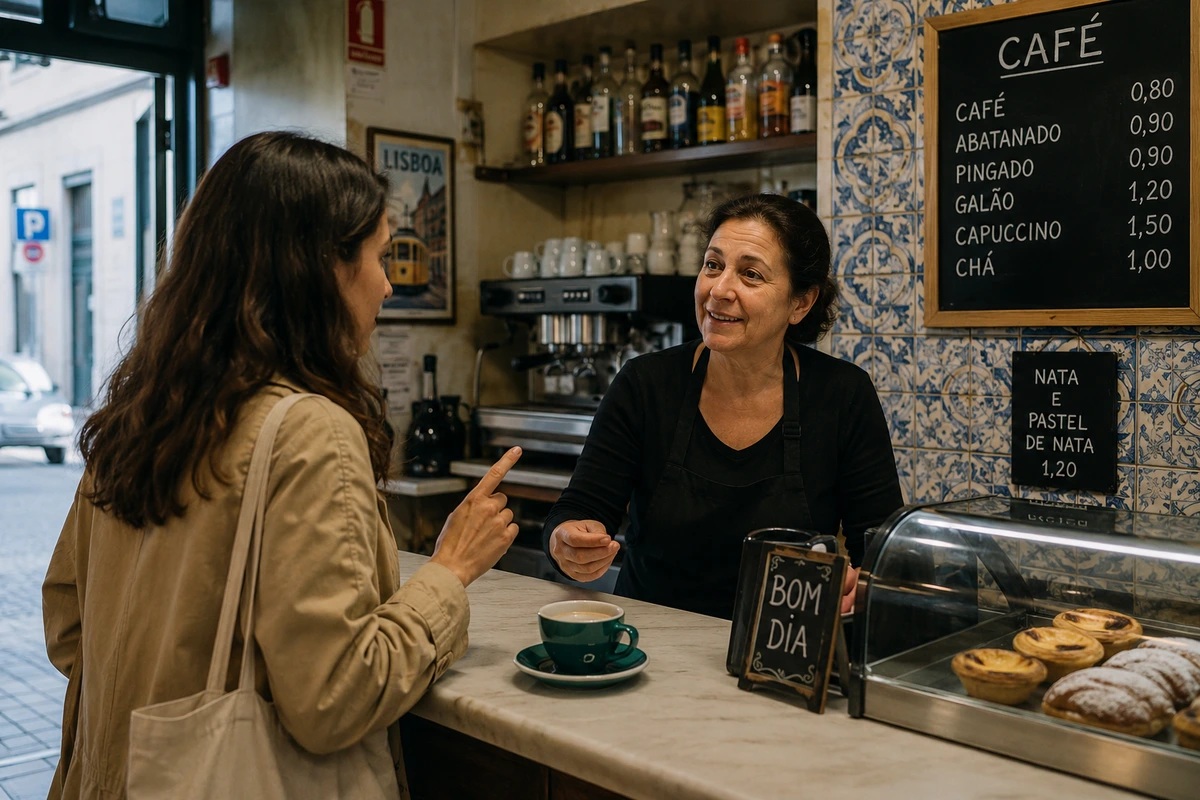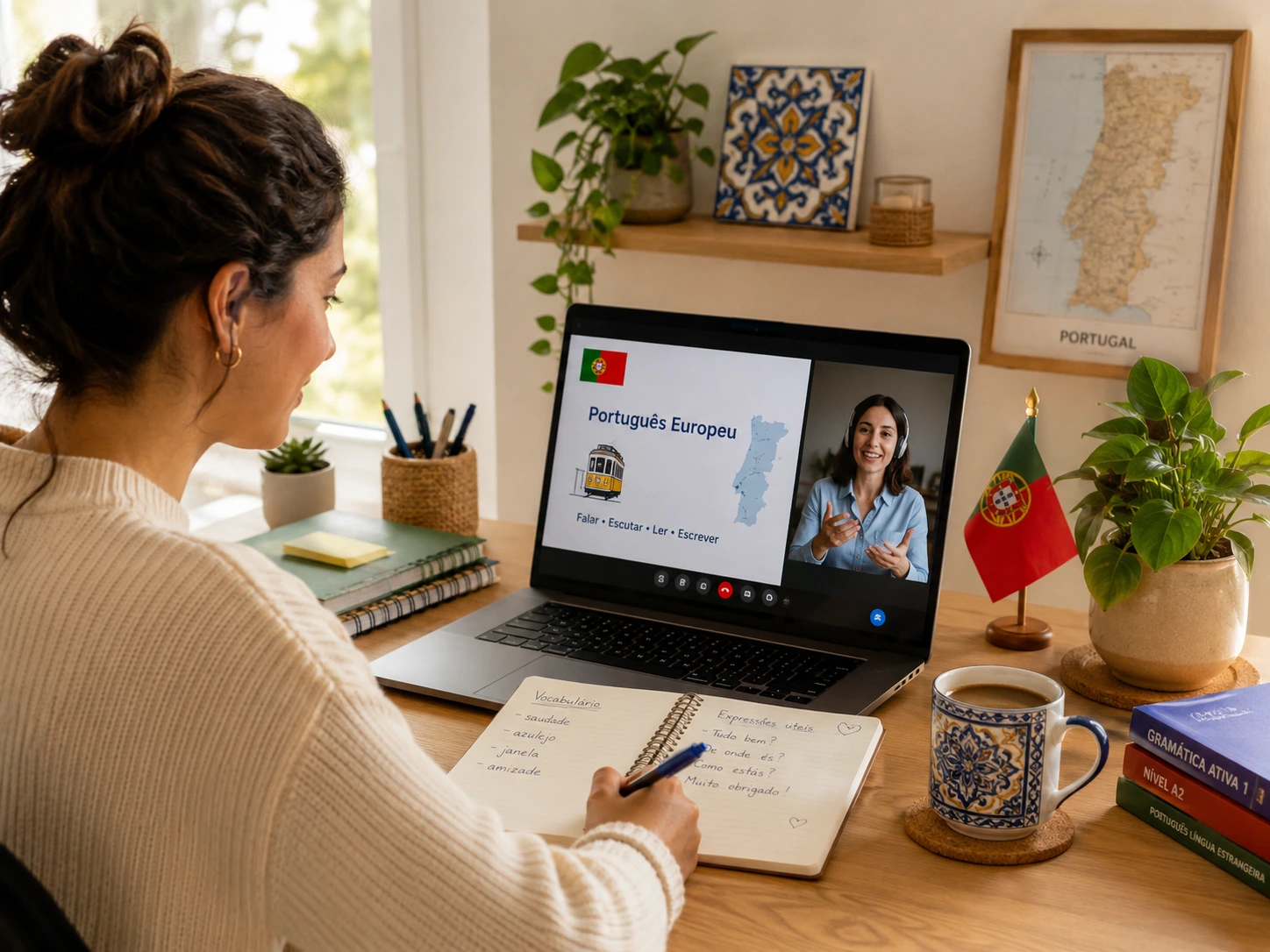


The best way to learn European Portuguese online is not to rely on one app, one podcast or one course. It is to follow a balanced method that helps you understand Portuguese from Portugal, practise speaking regularly and receive feedback on the mistakes that are blocking your progress.
As a native European Portuguese tutor, I work mostly with adult learners who want Portuguese for real life: family conversations, daily situations in Portugal, work, appointments, travel, cafés, shops and everyday confidence. Many of them have already studied vocabulary or grammar before, but still feel stuck when they need to speak.
This article explains the method I recommend when your goal is not only to study Portuguese, but to actually use it in conversations.
- At a Glance
- Make Sure You Are Learning European Portuguese
- Why Many Learners Study Online but Still Struggle to Speak
- The 4-Part Method I Recommend as a Tutor
- How I Adapt This Method to Different Learners
- Use Apps, But Do Not Depend Only on Apps
- A Realistic Online Learning Routine with Speaking Feedback
- How to Turn Online Study into Real Speech
- My Recommended Method for Learning European Portuguese Online
- Ready to Turn Passive Knowledge into Real Speech?
- See Also
- Final Thoughts: The Best Way to Learn European Portuguese Online
- FAQ
- About the Author
Some links on this website may be affiliate or referral links. If you use them, I may receive a small commission or reward, at no extra cost to you.
I only recommend resources, tools, and services that I believe may be helpful for learning European Portuguese. These links help support the website, but they do not influence the advice or learning guidance I share.
At a Glance
- The best method combines structure, listening, speaking and feedback.
- Apps are useful, but they are not enough for real conversation.
- European Portuguese from Portugal should be the focus from the beginning.
- Speaking practice needs correction, repetition and real-life context.
- A tutor or guided speaking lesson can help turn passive knowledge into active speech.
- Your learning method should match your goal: family, daily life, work, travel or moving to Portugal.
Make Sure You Are Learning European Portuguese
Before choosing how to study, check one essential point: are you learning European Portuguese, also called Portuguese from Portugal or PT-PT?
This matters because many popular apps, videos and general Portuguese resources teach mostly Brazilian Portuguese. Brazilian Portuguese is valid Portuguese, but it may not match the pronunciation, rhythm, vocabulary and expressions you will hear in Portugal.
You can explore these differences in more detail in European Portuguese vs Brazilian Portuguese.
For example:
European Portuguese:
Estou a aprender português.
I am learning Portuguese.
Brazilian Portuguese:
Estou aprendendo português.
If your goal is to live in Portugal, speak with Portuguese family, work with Portuguese clients or feel more confident in daily life here, your method should train your ear and speech for the Portuguese used in Portugal.
Duolingo is a common starting point for many learners. If you are considering using it, read Is Duolingo Good for European Portuguese? to understand what it can offer and its limitations for learners focused on Portugal.
Why Many Learners Study Online but Still Struggle to Speak
Many adult learners are very consistent. They use apps, watch videos, take notes and review vocabulary. But when someone in Portugal asks them a simple question, they freeze.
This does not mean they are bad at languages.
It usually means their learning has been too passive.
Passive learning includes things like:
- watching lessons without speaking aloud;
- recognising words in an app but not using them in sentences;
- reading grammar explanations without practising conversation;
- listening to Portuguese but never answering questions;
- memorising vocabulary that is not connected to real situations.
To speak European Portuguese, you need to practise the skill of speaking itself. That means forming sentences, pronouncing words, reacting in real time and becoming comfortable making small mistakes.
The best online method should help you move from:
“I understand some Portuguese”
to:
“I can use simple Portuguese in real situations.”
The 4-Part Method I Recommend as a Tutor
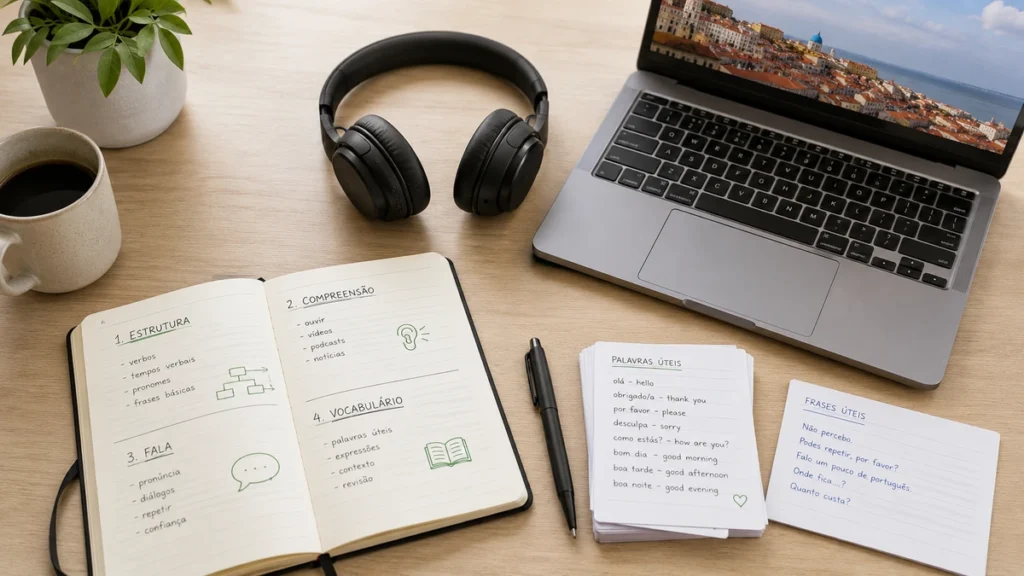
The best way to learn European Portuguese online is to combine four elements:
- clear structure;
- regular listening;
- guided speaking practice;
- personal feedback and review.
Each part has a different role. Together, they help you build usable Portuguese instead of passive knowledge.
1. Clear Structure: Know What to Study Next
Many learners waste time jumping between random videos, apps, worksheets and social media posts. They learn useful bits of Portuguese, but the pieces do not connect.
A clear structure helps you build step by step.
For beginners and lower-intermediate learners, this usually means learning:
- pronunciation basics;
- greetings and polite expressions;
- useful verbs such as ser, estar, ter, querer and precisar;
- simple questions;
- sentence patterns;
- daily-life vocabulary;
- listening skills;
- short dialogues;
- speaking practice.
If you are starting from the beginning, this European Portuguese guide for beginners will help you choose the first phrases, pronunciation features and grammar structures to study.
For example, instead of learning the word consulta alone, it is more useful to learn a full sentence:
Queria marcar uma consulta.
I would like to book an appointment.
Then you can use the same structure in other situations:
Queria um café, por favor.
I would like a coffee, please.
Queria uma mesa para dois, por favor.
I would like a table for two, please.
Queria falar com o médico.
I would like to speak with the doctor.
This is structured learning because one useful pattern becomes many useful sentences.
2. Regular Listening: Train Your Ear for Portugal
European Portuguese can feel difficult to understand at first because natural speech is often fast, reduced and connected.
My European Portuguese pronunciation guide explains vowel reduction, connected speech, nasal sounds and other features that can make familiar words difficult to recognise.
Many learners say:
“I can read Portuguese, but I cannot understand people when they speak.”
This is very common.
Listening practice helps your brain get used to:
- the rhythm of Portuguese from Portugal;
- reduced vowels;
- connected words;
- common expressions;
- different voices and accents;
- real-life speed.
For example, you may know the words in this sentence:
Queria um café, por favor.
But recognising it in a busy café can be harder than reading it on a screen.
How to Practise Listening Effectively
Use short audio or video clips in European Portuguese. Do not start with long, complicated material.
A simple method is:
- Listen once without stopping.
- Listen again and notice familiar words.
- Read the transcript if available.
- Repeat useful phrases aloud.
- Change one detail and make your own sentence.
Example:
Original phrase:
Queria uma água, por favor.
I would like a water, please.
Change it:
Queria um café, por favor.
I would like a coffee, please.
Queria uma sopa, por favor.
I would like a soup, please.
Queria pagar, por favor.
I would like to pay, please.
This turns listening into speaking practice.
3. Guided Speaking Practice: Speak Before You Feel Ready
Many learners wait too long to speak.
They think:
“I will start speaking when I know more grammar.”
But speaking is not the reward at the end. Speaking is part of the learning process.
These strategies for practising spoken European Portuguese can help you move from prepared sentences to more spontaneous interaction.
You can start with short, imperfect sentences from the beginning.
For example:
Olá, chamo-me Anna.
Hello, my name is Anna.
Vivo em Lisboa.
I live in Lisbon.
Sou da Alemanha.
I am from Germany.
Ainda estou a aprender português.
I am still learning Portuguese.
Pode repetir, por favor?
Can you repeat, please?
These sentences are simple, but they are useful. They help you participate in real conversations.
Why Guided Practice Helps
Speaking alone at home is useful, but speaking with another person gives you a different kind of practice.
A tutor can help you:
- correct pronunciation;
- choose more natural phrases;
- understand why a sentence sounds unusual;
- practise real situations;
- build confidence;
- respond more quickly;
- notice repeated mistakes.
For example, a learner might say a sentence that is understandable but not natural in Portugal. A tutor can help adjust it gently.
Less natural:
Você pode me ajudar?
More natural in many everyday situations in Portugal:
Pode ajudar-me, por favor?
The goal is not perfection. The goal is clear, natural communication.
4. Feedback and Review: Turn Mistakes into Progress
Feedback is one of the biggest differences between studying alone and learning with guidance.
When you study alone, you may repeat the same mistakes without noticing. With feedback, you can correct them earlier.
Feedback can help with:
- pronunciation;
- word order;
- verb forms;
- formality;
- natural expressions;
- listening misunderstandings;
- confidence when speaking.
For example, a learner might say:
Tenho 45 anos de idade.
This is understandable, but in everyday Portuguese it is usually enough to say:
Tenho 45 anos.
I am 45 years old.
Or a learner might say:
Eu quero um café.
This is correct, but in a café in Portugal, a softer and more polite option is:
Queria um café, por favor.
I would like a coffee, please.
Small corrections like these make your Portuguese sound more natural and appropriate.
If you are comparing different tutors, this guide explains how to choose the right European Portuguese teacher for your goals, communication needs and preferred type of support.
Comparing Online Learning Methods
Different online tools can help you with different parts of the process. The problem starts when you expect one tool to do everything.
| Learning method | Best for | What it usually lacks |
|---|---|---|
| Apps | Vocabulary, habit building, short review | Real conversation, pronunciation feedback, local context |
| Flashcards | Memorising words and phrases | Speaking practice and listening in context |
| Podcasts | Listening exposure and rhythm | Correction and personalised practice |
| YouTube videos | Explanations, examples, pronunciation tips | Structure and active speaking |
| Online courses | Clear progression and organised lessons | Personal feedback and conversation practice |
| Textbooks | Grammar and written exercises | Natural speech and real-time interaction |
| Private lessons | Speaking, correction and personalised goals | Requires consistency between lessons |
| Conversation practice | Fluency and confidence | May lack structure if not guided |
The strongest approach usually combines several tools.
For example:
- use an app for short vocabulary review;
- use audio for listening practice;
- use a structured course for grammar and progression;
- use lessons or conversation practice for speaking and correction.
This is why I do not usually recommend looking for one “perfect” resource. A better question is:
“What combination will help me understand, speak and use Portuguese in my real life?”
How I Adapt This Method to Different Learners

The best way to learn European Portuguese online depends on your real goal.
A complete beginner does not need the same plan as someone preparing for a job interview. A retiree moving to the Algarve may need different language from someone trying to speak with Portuguese in-laws.
Learners who are living here or preparing to move may also find this practical guide to European Portuguese for expats in Portugal useful for identifying their everyday communication priorities.
In my lessons, I adapt the method to the learner’s life.
Portuguese for Family Conversations
Many learners want Portuguese because they have a Portuguese partner, relatives or in-laws.
In this case, the goal is often emotional as well as practical. You may want to understand conversations at lunch, speak with grandparents, follow family jokes or feel less isolated in social situations.
Focus on:
- informal conversation;
- family vocabulary;
- common everyday expressions;
- listening comprehension;
- short answers;
- confidence joining small parts of the conversation.
Useful phrases:
Como estás?
How are you?
Está tudo bem?
Is everything okay?
Gostei muito do almoço.
I really enjoyed the lunch.
Ainda estou a aprender português.
I am still learning Portuguese.
Pode repetir, por favor?
Can you repeat, please?
Portuguese for Daily Life in Portugal
If you live in Portugal or plan to move here, your Portuguese needs are practical.
You may need to:
- order in cafés;
- shop at the market;
- speak at the pharmacy;
- book appointments;
- greet neighbours;
- ask for help;
- talk to a landlord;
- deal with public services.
Focus on phrases that give you independence.
Useful phrases:
Queria um café, por favor.
I would like a coffee, please.
Quanto é?
How much is it?
Preciso de ajuda.
I need help.
Tenho uma consulta amanhã.
I have an appointment tomorrow.
Pode ajudar-me, por favor?
Can you help me, please?
This kind of Portuguese is simple, but powerful. It helps you manage daily life with less stress.
My guide to Portuguese for daily life in Portugal includes more useful phrases and communication strategies for cafés, appointments, neighbours and everyday services.
Portuguese for Work and Professional Situations
Some learners need Portuguese for work in Portugal.
They may need to speak with colleagues, clients, managers, service providers or interviewers. In this case, the method should include more formal language and role-play.
Focus on:
- professional introductions;
- polite requests;
- meeting vocabulary;
- emails;
- phone calls;
- explaining your work;
- interview practice;
- pronunciation and clarity.
Useful phrases:
Trabalho na área de marketing.
I work in marketing.
Podemos marcar uma reunião?
Can we schedule a meeting?
Pode enviar-me essa informação por email?
Can you send me that information by email?
Tenho uma pergunta sobre o projeto.
I have a question about the project.
Pode explicar novamente, por favor?
Can you explain again, please?
For work, the goal is not to sound perfect. The goal is to communicate clearly and professionally.
Portuguese for Travel and Short Stays
If you are visiting Portugal, you may not need a full long-term study plan. You need useful phrases for common travel situations.
Focus on:
- greetings;
- ordering food and drinks;
- asking prices;
- directions;
- transport;
- hotel or accommodation language;
- polite phrases.
Useful phrases:
Onde fica a estação?
Where is the station?
Queria uma mesa para dois, por favor.
I would like a table for two, please.
A que horas sai o comboio?
What time does the train leave?
Pode falar mais devagar?
Can you speak more slowly?
Even basic Portuguese can make travel in Portugal more respectful and enjoyable.
Use Apps, But Do Not Depend Only on Apps
Apps can be useful. They can help you build a habit, review vocabulary and practise short exercises.
But apps are usually not enough if your goal is to speak confidently.
Apps often cannot:
- correct your pronunciation;
- explain why something sounds unnatural in Portugal;
- adapt to your personal goals;
- practise emotional or stressful situations;
- help you respond in real time;
- prepare you for natural speech in Portugal.
This is why many learners recognise words on a screen but still freeze in a café, clinic or family conversation.
The best way to use apps is as support, not as the whole method.
For example:
- 5–10 minutes of app review per day;
- one short European Portuguese audio clip;
- one phrase repeated aloud;
- one weekly speaking task;
- one lesson or conversation session for feedback.
A Realistic Online Learning Routine with Speaking Feedback
You do not need to study for hours every day. A manageable routine that combines lessons, independent study and real-life practice is usually more effective than an ambitious plan you cannot maintain.
When your schedule allows, I recommend two 50-minute lessons per week. In my experience teaching learners at different levels, students who follow this rhythm generally make more consistent progress. They have regular opportunities to speak, receive feedback and revisit difficulties before too much time passes between lessons.
Here is a realistic weekly routine for busy adults:
| Practice | Time | Purpose |
|---|---|---|
| Vocabulary review | 5–10 minutes, 4–5 times a week | Keep useful words active |
| Listening practice | 10–15 minutes, 2–3 times a week | Train your ear for European Portuguese |
| Speaking aloud | 5 minutes, several times a week | Build confidence and pronunciation |
| Private lesson or guided conversation | Two 50-minute lessons per week | Practise speaking and receive feedback |
| Lesson review | 10 minutes after class | Remember corrections and useful phrases |
| Real-life practice | One small situation per week | Use Portuguese outside study |
Your ideal routine will depend on your goals, availability and opportunities to use Portuguese. How Long Does It Take to Learn European Portuguese? explains why progress cannot be reduced to one universal number of months or study hours.
A simple week could look like this:
Monday: review vocabulary from your last lesson.
Tuesday: listen to a short European Portuguese dialogue.
Wednesday: repeat 5 useful sentences aloud.
Thursday: practise one grammar pattern in context.
Friday: prepare a mini-dialogue for a real situation.
Saturday: use one phrase in real life or in a lesson.
Sunday: review and repeat.
The key is not to do everything. The key is to repeat the right things often.
How to Turn Online Study into Real Speech
Online learning should prepare you for offline communication.
One of the best ways to do this is to choose one real-life situation each week and practise it actively.
Week 1: Ordering in a Café
Practise:
Bom dia, queria um café, por favor.
Good morning, I would like a coffee, please.
Quanto é?
How much is it?
Queria pagar, por favor.
I would like to pay, please.
Week 2: Going to the Pharmacy
Practise:
Preciso de algo para a dor de cabeça.
I need something for a headache.
Tem alguma coisa para a tosse?
Do you have something for a cough?
Como devo tomar isto?
How should I take this?
Week 3: Booking an Appointment
Practise:
Queria marcar uma consulta.
I would like to book an appointment.
Tem disponibilidade esta semana?
Do you have availability this week?
A que horas?
At what time?
Week 4: Speaking with Neighbours
Practise:
Bom dia, tudo bem?
Good morning, how are you?
Sou o novo vizinho. / Sou a nova vizinha.
I am the new neighbour.
Ainda estou a aprender português.
I am still learning Portuguese.
This method makes your study practical. You are not learning Portuguese as an abstract subject. You are preparing for the conversations you actually need.
My Recommended Method for Learning European Portuguese Online
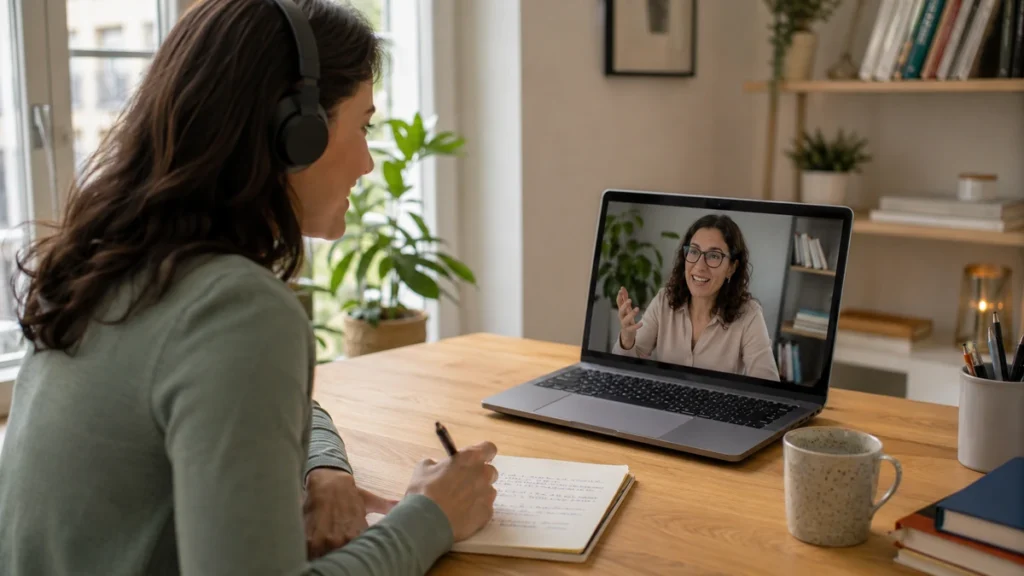
The best way to learn European Portuguese online is to combine self-study with human feedback.
For most adult learners, I recommend:
- a clear European Portuguese learning structure;
- short but regular listening practice;
- vocabulary connected to real situations;
- speaking aloud from the beginning;
- guided conversation practice;
- correction from a tutor;
- review between lessons;
- real-life practice in Portugal when possible.
This method works because it connects knowledge with use.
You learn a phrase.
You hear it.
You repeat it.
You practise it in context.
You receive feedback.
You use it again.
That is how Portuguese becomes active.
Ready to Turn Passive Knowledge into Real Speech?

Knowing Portuguese words is a good start. But real progress happens when you can use those words in a conversation.
As a native European Portuguese tutor, I help adult learners bridge the gap between studying and speaking. In my lessons, we focus on the Portuguese you actually need: family conversations, daily life in Portugal, work situations, appointments, cafés, shops and everyday interactions.
Private European Portuguese lessons online can help you:
- create a routine that fits your life;
- practise real conversations;
- improve pronunciation;
- correct common mistakes;
- build speaking confidence;
- prepare for specific situations.
If you would like my help turning passive knowledge into Portuguese you can use in real conversations, you can schedule a trial lesson with me on Preply. We can identify what is currently limiting your communication and create a practical plan around your family, daily life, travel or professional needs.
See Also
Continue building a balanced European Portuguese learning plan with these related guides:
- Learn European Portuguese Online for Real Life in Portugal — organise your online study around listening, grammar and practical communication.
- European Portuguese for Beginners — start with useful phrases, pronunciation and essential grammar.
- European Portuguese Pronunciation Guide — train your ear for reduced vowels, connected speech and Portuguese sounds.
- How to Practise Speaking European Portuguese — turn passive knowledge into more spontaneous comm
Final Thoughts: The Best Way to Learn European Portuguese Online
The best way to learn European Portuguese online is not to search endlessly for the perfect app or course. It is to use a method that combines structure, listening, speaking and feedback.
If your goal is Portugal, focus on European Portuguese from the beginning. Learn phrases you can use in real life. Listen regularly. Speak before you feel completely ready. Review your mistakes. Practise again.
Confidence usually comes from repeated, realistic practice — not from waiting until your Portuguese is perfect.
For guided European Portuguese speaking practice, private lessons can help you use the language with correction, support and more confidence in the situations that matter most to you.
FAQ
About the Author

Isabel M.
Native European Portuguese Tutor | Founder of Practical Portuguese
Hi, I’m Isabel, a native European Portuguese tutor from Portugal and the founder of Practical Portuguese.
I help adults learn authentic European Portuguese through structured, personalised online lessons. My lessons are taught mainly in Portuguese, with support in English whenever needed. I teach students from complete beginner to advanced levels, focusing on practical communication for everyday life, family, travel and work in Portugal.
Every article on Practical Portuguese combines natural language as it is spoken in Portugal with my experience teaching adult learners from different language backgrounds.
Why Learn with Me?
✔ Native European Portuguese speaker from Portugal
✔ Lessons taught in Portuguese with support in English
✔ Experience teaching adults from different language backgrounds
✔ Personalised one-to-one online lessons
✔ Practical Portuguese for everyday life, family, travel and work in Portugal
✔ Lessons adapted to your listening, pronunciation, sentence structure and speaking needs