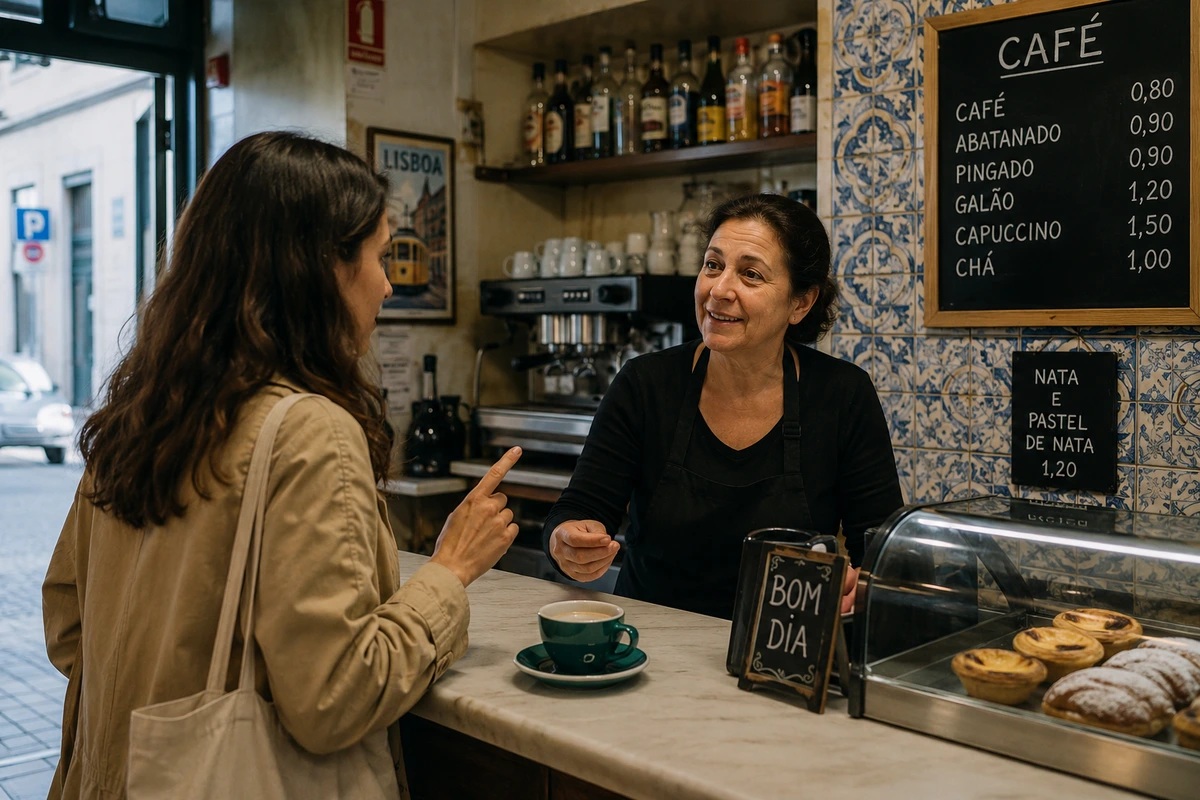
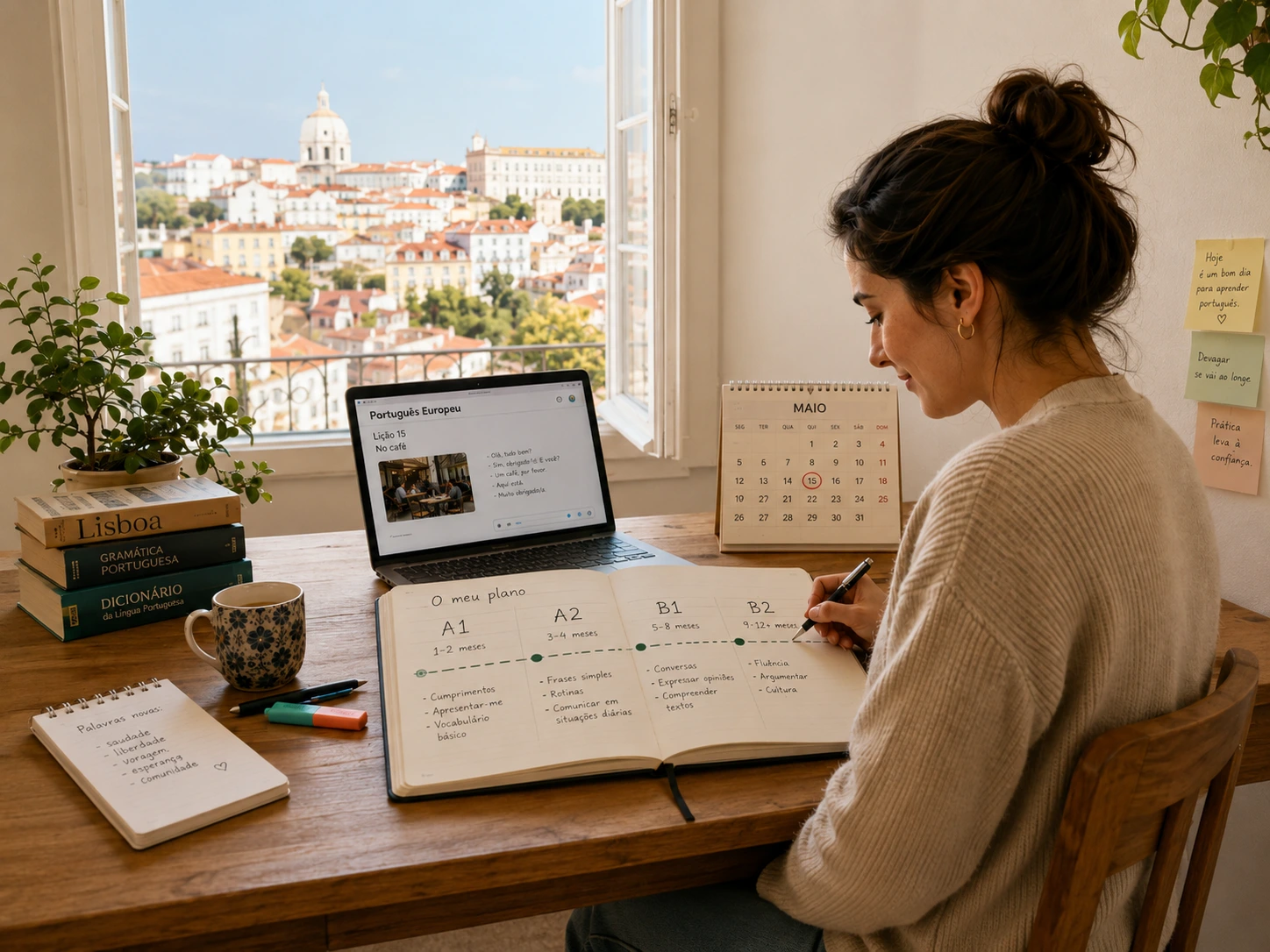

There is no official number of hours that applies to everyone learning European Portuguese.
The Common European Framework of Reference for Languages, or CEFR, describes language ability across six levels, from A1 to C2. However, it does not prescribe how many hours a learner must complete to reach each level.
Portuguese institutions use these common levels to design courses and assess proficiency. The CAPLE at the University of Lisbon, for example, provides Portuguese as a Foreign Language examinations aligned with levels A1 to C2.
The University of Lisbon currently structures its annual Portuguese as a Foreign Language programme into 200-hour semesters, with one level taught per semester. This is an example of an intensive university programme, not a universal requirement for every learner.
Some language-learning websites publish estimates such as 180–200 hours for A2, 350–400 for B1 and 500–600 for B2. These figures may be useful for broad planning, but they are not official learning-time requirements provided by the Council of Europe, CAPLE or an accredited Portuguese certification body.
In practice, you can learn essential Portuguese for a holiday within a relatively short period. Managing predictable situations in Portugal takes longer, while communicating independently with family, services or colleagues requires sustained listening, speaking and study.
- At a Glance
- What Does “Learning European Portuguese” Mean to You?
- How Are European Portuguese Levels Defined?
- How Many Hours Does It Take to Learn European Portuguese?
- A Real Example From the University of Lisbon
- Contact Hours Are Not the Same as Total Learning Time
- What Can You Do at A1?
- What Can You Do at A2?
- What Can You Do at B1?
- What Can You Do at B2?
- What Can You Do at C1 and C2?
- How Long Does It Take to Learn Portuguese for a Holiday?
- What Level Helps With Daily Life in Portugal?
- What Level Helps With Family Conversations?
- What Portuguese Level Do You Need for Work?
- What Can Affect Your Learning Time?
- When Personalised Lessons Can Help
- How to Measure Your Progress
- See Also
- Final Thoughts: Build Your Timeline Around What You Need to Do
- FAQ
- About the Author
Some links on this website may be affiliate or referral links. If you use them, I may receive a small commission or reward, at no extra cost to you.
I only recommend resources, tools, and services that I believe may be helpful for learning European Portuguese. These links help support the website, but they do not influence the advice or learning guidance I share.
At a Glance
| Question | Short answer |
|---|---|
| Is there an official number of hours for learning Portuguese? | No. The CEFR defines abilities, not compulsory learning hours. |
| How many levels are there? | Six: A1, A2, B1, B2, C1 and C2. |
| Can I use Portuguese before completing A1? | Yes. You can learn useful phrases for specific situations from the beginning. |
| Does A2 mean I can manage daily life independently? | A2 supports simple, predictable exchanges but not every unexpected situation. |
| What levels are considered independent? | The CEFR groups B1 and B2 under “Independent User”. |
| How does the University of Lisbon structure its course? | Its annual programme currently allocates 200 hours to each level. |
| Who certifies Portuguese as a foreign language? | The CAPLE at the University of Lisbon provides examinations from A1 to C2. |
What Does “Learning European Portuguese” Mean to You?
There is no single moment when Portuguese changes from “not learned” to “learned”.
For someone preparing for a holiday, learning Portuguese may mean being able to:
- greet people;
- order meals;
- ask for directions;
- understand prices and times;
- use transport;
- ask for help.
Someone living in Portugal may need to:
- speak to neighbours;
- arrange repairs with a landlord;
- make medical appointments;
- visit a pharmacy;
- communicate at a bank;
- handle services and paperwork;
- understand the questions people ask in reply.
If you have Portuguese relatives, you may want to:
- understand the subject of a family conversation;
- speak individually with relatives;
- ask questions and contribute comments;
- communicate with relatives who do not speak English;
- feel more included during family visits.
Portuguese for work may involve:
- writing emails;
- participating in meetings;
- making telephone calls;
- explaining problems;
- understanding formal language;
- communicating with colleagues or clients.
These goals do not require exactly the same vocabulary, grammar or degree of proficiency. Learning enough Portuguese to order a meal is not the same as learning enough to participate in a professional meeting.
A more useful question is:
What do I want to be able to do in Portuguese?
Your answer will help determine the level and type of practice you need.
How Are European Portuguese Levels Defined?
Portuguese proficiency is commonly described through the Common European Framework of Reference for Languages, usually known as the CEFR.
The framework organises proficiency into:
- A1 and A2 — Basic User;
- B1 and B2 — Independent User;
- C1 and C2 — Proficient User.
The levels use can-do descriptors. These describe what a person can understand and communicate rather than how many lessons they have completed.
The framework considers different skills, including:
- listening;
- reading;
- spoken interaction;
- spoken production;
- writing.
These skills may not develop at the same speed.
You may understand simple written Portuguese but struggle to recognise the same words in natural speech. You may speak confidently about familiar subjects while still making grammatical errors. Another learner may understand conversations but need more time to construct a response.
How Many Hours Does It Take to Learn European Portuguese?
The Council of Europe does not provide a universal table specifying how many hours every learner needs to reach A1, A2, B1 or another level in European Portuguese.
The CEFR is a framework for describing proficiency. It is not a fixed curriculum or learning timetable.
Some language schools, tutoring platforms and language-learning websites publish approximate figures such as:
- 180–200 cumulative hours for A2;
- 350–400 hours for B1;
- 500–600 hours for B2;
- 700–800 hours for C1.
These figures should not be presented as official requirements for learning European Portuguese.
Different estimates may count different activities, including:
- independent study;
- homework;
- listening practice;
- speaking;
- reading;
- revision;
- immersion.
They may also refer to learners with different starting points, language backgrounds and objectives.
Reaching a CEFR level requires demonstrated ability across several skills—not a universally prescribed number of hours.
A Real Example From the University of Lisbon
The University of Lisbon’s annual Portuguese as a Foreign Language programme is organised into two independent semesters, allowing students to attend them separately or continuously according to their availability and learning objectives.
Each semester comprises 200 hours. The curriculum covers levels A1 to C2 and includes 12 teaching hours per week over 14 weeks, as well as 32 hours of immersion activities.
At A1 and A2, the curriculum includes:
- language structure;
- oral comprehension and production;
- written comprehension and production;
- laboratory work.
At B1 and B2, it includes:
- language structure;
- oral and written comprehension;
- writing practice;
- conversation;
- contemporary Portuguese culture.
At C1, the curriculum includes:
- advanced Portuguese language topics;
- written and oral communication practice;
- literary text reading;
- Portuguese history;
- art, culture and Portuguese society.
At C2, it includes:
- advanced Portuguese language topics;
- written and oral communication practice;
- contemporary Portuguese literature;
- Portugal in Europe and the world;
- art, culture and Portuguese society.
The learning objectives for each level are based on the Common European Framework of Reference for Languages. Students who attend at least 75% of classes and complete the compulsory assessments receive a final evaluation. Those who achieve a passing grade receive a certificate of completion.
Contact Hours Are Not the Same as Total Learning Time
When a course advertises 60, 80 or 200 hours, it is important to understand what those hours include.
Contact hours normally refer to the time spent in lessons.
Total learning time may also include:
- homework;
- vocabulary review;
- listening;
- reading;
- speaking outside lessons;
- writing assignments;
- preparation for assessments;
- real use of Portuguese.
Two learners can attend the same number of lessons and make different progress.
One may review regularly, listen to European Portuguese and use the language in daily life. Another may attend lessons but have little time to practise between them.
The number of contact hours alone cannot predict the final result.
What Can You Do at A1?
A1 is the first CEFR level.
According to the Council of Europe’s global CEFR scale, an A1 learner can understand and use familiar everyday expressions and very basic phrases connected to concrete needs.
An A1 learner can also introduce themselves, ask and answer basic personal questions and interact simply when the other person speaks slowly, clearly and is prepared to help.
In European Portuguese, this may include:
- greeting people;
- introducing yourself;
- saying where you live;
- giving simple personal details;
- ordering something familiar;
- asking a short question;
- understanding familiar numbers and prices when spoken clearly;
- asking someone to repeat.
For example:
Bom dia.
Good morning.
Chamo-me Sarah.
My name is Sarah.
Moro em Portugal.
I live in Portugal.
Queria um café, por favor.
I would like a coffee, please.
Pode repetir, por favor?
Can you repeat, please?
At this stage, you will normally depend on familiar situations, prepared phrases and cooperation from the other person. However, you are already communicating.
If you are at the beginning of your journey, this European Portuguese guide for beginners can help you choose useful first phrases and structures.
What Can You Do at A2?
At A2, the Council of Europe describes learners as able to understand frequently used expressions related to areas of immediate relevance.
They can communicate in simple and routine tasks requiring a direct exchange of information on familiar matters.
In daily life, this may include:
- exchanging simple personal information;
- describing your family or routine;
- buying familiar items;
- ordering food;
- asking for simple directions;
- arranging a straightforward appointment;
- explaining a basic need;
- having a short conversation with a neighbour.
For example:
Queria marcar uma consulta para a próxima semana.
I would like to book an appointment for next week.
Tem alguma coisa para a tosse?
Do you have anything for a cough?
Ainda estou a aprender português. Pode falar mais devagar?
I am still learning Portuguese. Can you speak more slowly?
A2 can help with predictable everyday situations, but it does not guarantee complete independence.
You may still struggle when:
- the other person speaks naturally or quickly;
- the reply is unexpected;
- you need to explain a complicated problem;
- the conversation contains unfamiliar vocabulary;
- several people speak at the same time.
The CIPLE examination from the CAPLE corresponds to CEFR level A2. It assesses reading, writing, listening and spoken production and interaction.
This shows that reaching A2 involves several abilities, not only completing grammar exercises.
What Can You Do at B1?
The CEFR groups B1 and B2 under Independent User.
At B1, a learner can understand the main points of clear, standard communication about familiar subjects. The learner can also deal with many situations likely to arise while travelling and produce connected language about familiar topics and personal interests.
In Portugal, B1 may help you:
- explain a straightforward problem to a landlord;
- describe familiar symptoms;
- make arrangements;
- discuss experiences and plans;
- maintain a conversation about familiar subjects;
- understand the main point of clear speech;
- write straightforward messages and emails;
- communicate with less dependence on prepared dialogues.
The word independent should not be interpreted as complete independence in every situation.
A B1 learner may still need help with:
- complex administrative language;
- technical explanations;
- unfamiliar accents;
- rapid group conversations;
- formal documents;
- unexpected subjects.
The important development at B1 is that you can normally do more than repeat a memorised sentence. You can combine language, ask questions, clarify meaning and explain an idea in another way.
What Can You Do at B2?
The Council of Europe describes a B2 learner as able to understand the main ideas of complex communication on concrete and abstract subjects, including technical discussions within their field.
A B2 learner can also interact with enough fluency and spontaneity to make regular interaction with native speakers possible without strain for either person.
In practical terms, B2 may help you:
- participate more actively in longer conversations;
- explain and support an opinion;
- discuss a wider range of subjects;
- deal with many services independently;
- write clear, detailed emails;
- participate in familiar professional discussions;
- understand more Portuguese media;
- follow more family conversations;
- adapt your language to different situations.
B2 does not mean that you will understand every Portuguese speaker, regional expression or informal group conversation.
The CAPLE examination corresponding to B2 is the DIPLE, or Diploma Intermédio de Português Língua Estrangeira. The complete CAPLE examination system covers levels from A1 to C2.
What Can You Do at C1 and C2?
At C1, the Council of Europe describes learners as able to understand demanding, longer texts and recognise implicit meaning.
They can communicate fluently and spontaneously and use the language flexibly for social, academic and professional purposes.
This may include:
- participating confidently in complex discussions;
- understanding implicit meaning;
- adapting language to formal and professional situations;
- producing detailed, well-structured communication;
- discussing abstract or unfamiliar subjects;
- understanding a wide range of spoken and written Portuguese.
C2 represents an even higher degree of comprehension, precision and flexibility. A C2 user can understand virtually everything heard or read and express fine differences in meaning.
The CAPLE qualifications corresponding to these levels are:
- DAPLE for C1;
- DUPLE for C2.
Many adult learners do not need C1 or C2 to achieve their main goals. If you want to manage daily life or communicate about familiar subjects, A2 or B1 may be a more appropriate initial objective.
How Long Does It Take to Learn Portuguese for a Holiday?
There is no official number of hours required to prepare Portuguese for a holiday.
You also do not need to complete a full CEFR level before using basic phrases.
You can focus on a small number of predictable situations:
- greetings;
- ordering;
- paying;
- directions;
- transport;
- accommodation;
- numbers and times;
- emergencies;
- asking for help.
For example:
Queria reservar uma mesa para duas pessoas.
I would like to reserve a table for two people.
A que horas sai o autocarro?
What time does the bus leave?
Onde fica a estação?
Where is the station?
Pode ajudar-me, por favor?
Can you help me, please?
Learning these phrases does not prove that you have reached A1 or A2. It means that you have prepared for a limited set of useful situations.
What Level Helps With Daily Life in Portugal?
A2 can support simple and predictable everyday exchanges. B1 normally provides more flexibility when situations do not follow a prepared script.
At A2, you may be able to ask to book an appointment.
At B1, you are more likely to explain why you need the appointment, respond to follow-up questions and clarify a misunderstanding.
Consider the difference between:
- ordering food;
- asking about ingredients because of an allergy;
- understanding an explanation about how the dish is prepared.
Each additional step requires more listening, vocabulary and spontaneous interaction.
Living in Portugal provides opportunities to hear and use the language, but simply residing in the country does not guarantee progress.
To benefit from your environment:
- review difficult interactions.
- prepare Portuguese before an interaction;
- notice the questions people commonly ask;
- write down useful phrases afterwards;
- listen to Portuguese from Portugal;
- attempt a reply before changing to English;
What Level Helps With Family Conversations?
There is no CEFR level that guarantees complete understanding of every family conversation.
Group conversations can be difficult because relatives may:
- speak at the same time;
- interrupt one another;
- change subjects quickly;
- use regional expressions;
- refer to shared memories;
- use humour or informal language;
- leave information unstated.
You can begin participating before understanding every word.
A realistic progression might be:
- identifying the subject;
- recognising who or what people are discussing;
- understanding repeated words;
- asking a relevant question;
- contributing a short comment;
- speaking individually with one relative;
- gradually following longer group conversations.
A learner may manage many B1 tasks and still find a large family gathering difficult. This does not mean that their Portuguese is poor. It means that spontaneous group communication places several demands on listening and processing at the same time.
What Portuguese Level Do You Need for Work?
There is no single Portuguese level required for every job.
The appropriate level depends on:
- the profession;
- the employer;
- the amount of contact with the public;
- the complexity of the tasks;
- whether Portuguese is the main working language;
- the need to write formal or technical documents.
A2 may support limited and predictable workplace exchanges.
B1 may support familiar professional communication.
The official B2 descriptors include understanding technical discussions within the learner’s field and interacting with a degree of fluency and spontaneity.
C1 includes flexible and effective use for professional and academic purposes.
However, these are broad CEFR abilities. An employer, university or professional body may set its own language requirement.
What Can Affect Your Learning Time?
Several factors can influence the time you need.
Your specific goal
Learning Portuguese for a holiday is different from preparing for professional meetings or complex family conversations.
A clearly defined goal helps you focus on the language you genuinely need.
Your weekly consistency
Regular contact with Portuguese gives you more opportunities to revisit vocabulary and sentence patterns.
The total number of hours is only part of the picture. The distribution of those hours also matters to the learner’s routine and ability to review.
The skills you practise
If you mainly read and complete grammar exercises, your reading may improve faster than your listening or speaking.
A balanced plan should include:
- listening;
- speaking;
- reading;
- writing;
- vocabulary;
- grammar in context.
Your exposure to European Portuguese
If your goal is Portugal, use resources with Portuguese pronunciation, vocabulary and structures from Portugal.
Look for resources labelled:
- European Portuguese;
- Portuguese from Portugal;
- Portugal Portuguese;
- PT-PT.
Your previous knowledge
The languages you know and your previous language-learning experience may influence your progress. However, they do not determine an exact timeline.
Learners with similar backgrounds may still respond differently to pronunciation, grammar, listening and speaking.
Personalised Feedback
Useful feedback can help you identify whether the difficulty is:
- pronunciation;
- listening;
- sentence construction;
- vocabulary;
- grammatical accuracy;
- confidence during interaction.
Once the obstacle is clearer, your practice can focus on the skill that is limiting your communication.
When Personalised Lessons Can Help
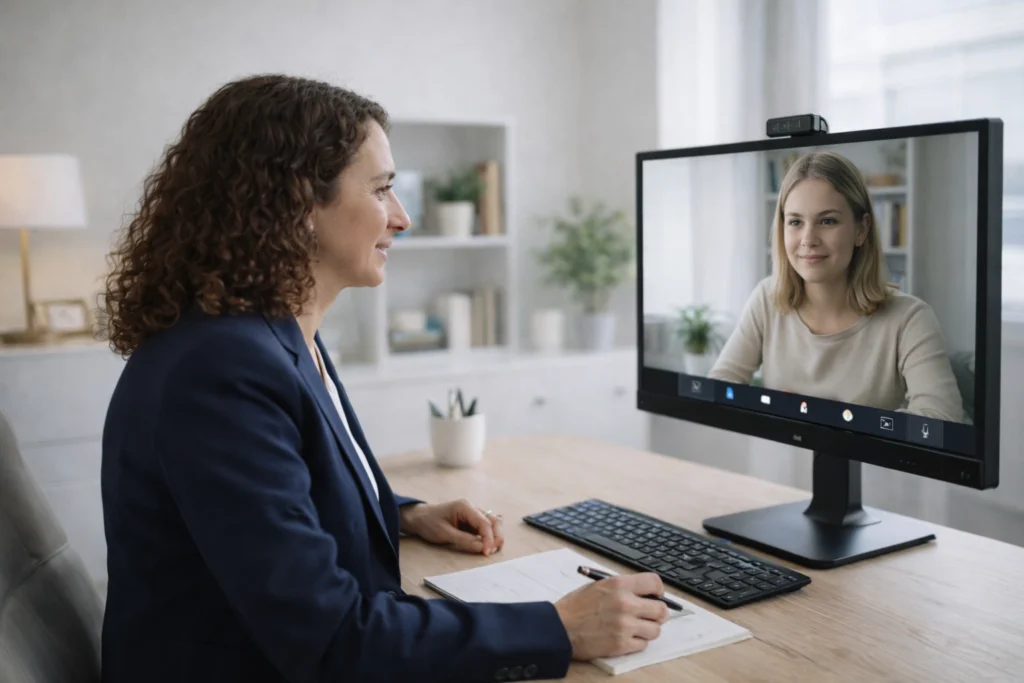
Personalised lessons can be particularly useful when you are studying regularly but are unsure why you still feel blocked.
You may understand written Portuguese but struggle with natural speech. You may know the vocabulary but need too long to construct a reply. You may also pronounce words accurately but hesitate when the conversation becomes unpredictable.
No teacher can guarantee that you will reach a CEFR level within an exact number of lessons. However, personalised feedback can help you identify the skill limiting your communication and use your study time more purposefully.
In my lessons, I see very different learning profiles. Some learners need focused pronunciation practice, while others pronounce Portuguese accurately from the beginning. Some understand written Portuguese but struggle to recognise familiar words in natural speech. Others understand the question but need more time to construct a complete answer.
Personalised lessons can help you:
- identify your current abilities;
- define practical goals;
- select relevant vocabulary;
- practise realistic conversations;
- understand recurring mistakes;
- improve listening;
- receive pronunciation feedback;
- prepare situations you face in Portugal;
- balance different language skills.
My lessons are taught mainly in Portuguese, with support in English whenever needed. The aim is to give you meaningful exposure to Portuguese while ensuring that explanations remain clear.
If you want to practise European Portuguese with personalised feedback, you can schedule an online lesson with me on Preply.
How to Measure Your Progress
CEFR levels and formal assessments are useful, but you can also monitor what you can do in real life.
Ask yourself:
- Can I introduce myself more comfortably?
- Can I understand the main question?
- Can I ask for clarification?
- Can I make an appointment?
- Can I explain a simple problem?
- Can I speak to a neighbour for longer?
- Can I understand more of a familiar recording?
- Can I remain in Portuguese instead of immediately changing to English?
Keep a short record of practical achievements:
- ordered entirely in Portuguese;
- booked an appointment;
- understood a neighbour’s question;
- left a voice message;
- explained a problem;
- contributed to a family conversation;
- wrote an email.
These achievements do not replace formal assessment, but they show whether Portuguese is becoming more useful in your life.
If you need formal certification, the CAPLE provides examinations aligned with the CEFR from A1 to C2.
See Also
- Is European Portuguese Hard to Learn? — understand the main challenges and what makes the language more accessible.
- European Portuguese for Beginners — begin with useful phrases, pronunciation and practical grammar.
- Learn European Portuguese Online — combine listening, speaking, grammar and feedback.
- How to Practise Speaking European Portuguese — develop your speaking through practical activities.
- Portuguese for Daily Life in Portugal — prepare for common situations after moving to Portugal.
Final Thoughts: Build Your Timeline Around What You Need to Do
How long does it take to learn European Portuguese? There is no official universal answer.
The CEFR defines proficiency through abilities from A1 to C2, but it does not require a fixed number of learning hours. The University of Lisbon currently uses 200-hour semesters for each level in one of its intensive Portuguese as a Foreign Language programmes, but this is a course structure rather than a universal rule.
Some language-learning websites publish hour estimates for each CEFR level. These can be used as broad planning references, but they should not be presented as official requirements from the Council of Europe, CAPLE or an accredited Portuguese certification body.
You can begin using Portuguese before completing a full level. Start with the situations that matter in your life and measure progress through what you can understand and communicate.
If you would like my support as you learn European Portuguese, you can book a trial lesson with me on Preply. Together, we can identify your current level, understand what is making communication difficult and create a practical learning plan for your daily life, family, travel or work in Portugal.
FAQ
About the Author

Isabel M.
Native European Portuguese Tutor | Founder of Practical Portuguese
Hi, I’m Isabel, a native European Portuguese tutor from Portugal and the founder of Practical Portuguese.
I help adults learn authentic European Portuguese through structured, personalised online lessons. My lessons are taught mainly in Portuguese, with support in English whenever needed. I teach students from complete beginner to advanced levels, focusing on practical communication for everyday life, family, travel and work in Portugal.
Every article on Practical Portuguese combines natural language as it is spoken in Portugal with my experience teaching adult learners from different language backgrounds.
Why Learn with Me?
✔ Native European Portuguese speaker from Portugal
✔ Lessons taught in Portuguese with support in English
✔ Experience teaching adults from different language backgrounds
✔ Personalised one-to-one online lessons
✔ Practical Portuguese for everyday life, family, travel and work in Portugal
✔ Lessons adapted to your listening, pronunciation, sentence structure and speaking needs