

Learning Portuguese for daily life in Portugal is not about memorising every verb tense or understanding every word you hear. It is about feeling able to manage your own life, connect with the people around you and participate more fully in the situations that matter.
If you live in Portugal or are preparing to move here, you may want to speak to a neighbour, book an appointment or solve an everyday problem without always depending on someone else. If you have a Portuguese partner or family, you may want to follow conversations around the table and feel more included. If you visit Portugal for holidays or spend part of the year here, even a few useful phrases can make cafés, shops and local interactions feel more personal.
These may seem like small moments, but they can make a significant difference to how confident, independent and connected you feel in Portugal.
Many learners already know grammar and vocabulary but still feel blocked when someone speaks to them unexpectedly. Others understand Portuguese on the page but find real conversations faster and more difficult to follow. You may know what you want to say and still need more time to organise the sentence. This is normal, and it does not mean you are bad at languages.
The best place to start is with the situations you actually experience. This practical approach is consistent with the Council of Europe’s action-oriented approach to language learning, which connects learning with realistic scenarios and meaningful communication.
In this guide, you will learn practical European Portuguese expressions for cafés, shops, appointments, transport, neighbours and services—phrases you can practise and reuse in everyday life in Portugal.
- At a Glance
- What Daily Portuguese Means
- Start With Your Real Needs
- Greetings and Politeness
- Ordering in Cafés and Restaurants
- Shopping in Portugal
- Booking and Managing Appointments
- At the Pharmacy
- Asking for Directions
- Using Public Transport
- Talking to Neighbours
- Housing, Bills and Services
- Asking People to Repeat
- Formal and Informal Communication
- Why Spoken Portuguese Can Feel Fast
- Learn Phrases, Not Only Words
- How to Practise Portuguese Every Week
- Common Mistakes to Avoid
- Get Personalised Support for Daily Life in Portugal
- See Also
- Final Thoughts
- FAQ
- About the Author
Some links on this website may be affiliate or referral links. If you use them, I may receive a small commission or reward, at no extra cost to you.
I only recommend resources, tools, and services that I believe may be helpful for learning European Portuguese. These links help support the website, but they do not influence the advice or learning guidance I share.
At a Glance
To use Portuguese more confidently in daily life:
- prioritise situations you experience regularly;
- learn complete phrases instead of isolated words;
- practise polite requests with queria, pode and por favor;
- become familiar with informal and more formal or distant forms of address;
- prepare phrases for asking people to repeat or speak more slowly;
- listen to European Portuguese from Portugal;
- reuse the same language in different contexts;
- focus on communication before perfection.
You do not need advanced Portuguese to become more independent. A small number of well-practised expressions can already make everyday interactions much easier.
What Daily Portuguese Means
Daily Portuguese is the language you need to manage ordinary situations without depending entirely on English or on someone else to speak for you.
Depending on your life in Portugal, this might include:
- greeting people;
- ordering food and drinks;
- shopping;
- asking for directions;
- using public transport;
- booking appointments;
- visiting a pharmacy;
- speaking to neighbours;
- dealing with housing, bills or services;
- asking someone to repeat;
- explaining a simple problem.
A person living permanently in Portugal may need more language for healthcare, housing and public services. A visitor may prioritise restaurants, directions and transport. Someone with Portuguese family may need more informal conversation.
There is no single vocabulary list that works equally well for everyone. Start with your real life and build from there.
If you are beginning from zero, European Portuguese for Beginners explains which foundations to learn first.
Start With Your Real Needs
It is tempting to study many topics simultaneously because you want to be prepared for everything. However, learning ten situations superficially is usually less useful than practising one important situation properly.
Choose one immediate need, such as ordering in a café, and learn how to:
- greet the person;
- ask for what you want;
- understand a likely follow-up question;
- ask how much it costs;
- pay;
- say goodbye.
When those expressions become familiar, move to another situation.
Greetings and Politeness
Starting politely can make an interaction in Portugal feel smoother and more natural.
| European Portuguese | English |
|---|---|
| Bom dia. | Good morning. |
| Boa tarde. | Good afternoon. |
| Boa noite. | Good evening / Good night. |
| Olá. | Hello. |
| Tudo bem? | How are you? / Is everything all right? |
| Obrigado / Obrigada. | Thank you. |
| Se faz favor. / Por favor. | Please. |
| Com licença. | Excuse me. |
| Desculpe. | Excuse me/Sorry. |
| Até logo. | See you later. |
| Bom fim de semana. | Have a good weekend. |
A male speaker normally says obrigado, while a female speaker says obrigada.
In a café or shop, beginning with bom dia or boa tarde often sounds more polite than going directly to the request:
Bom dia. Queria um café, por favor.
Good morning. I would like an espresso, please.
Ordering in Cafés and Restaurants
Cafés are good places to practise because many interactions follow a predictable pattern.
Queria um café, por favor.
I would like an espresso, please.
Queria uma água sem gás.
I would like a still water.
Para mim, uma sopa, por favor.
I’ll have a soup, please.
O que recomenda?
What do you recommend?
Este prato tem carne?
Does this dish contain meat?
Pode trazer a conta, por favor?
Can you bring the bill, please?
Queria pagar.
I would like to pay.
Posso pagar com cartão?
Can I pay by card?
In Portugal, um café usually means a small espresso. You may also hear:
É para aqui ou para levar?
Is it for here or to take away?
Quer mais alguma coisa?
Would you like anything else?
You can respond:
É para aqui.
It is for here.
É para levar.
It is to take away.
Não, obrigado/obrigada. É tudo.
No, thank you. That is everything.
Shopping in Portugal
In shops and supermarkets, you may need to locate something, ask for another size or understand a checkout question.
Onde posso encontrar o leite?
Where can I find the milk?
Tem isto num tamanho maior?
Do you have this in a larger size?
Tem outra cor?
Do you have another colour?
Posso experimentar?
Can I try it on?
Onde ficam os provadores?
Where are the fitting rooms?
Quanto custa?
How much does it cost?
Queria trocar este artigo.
I would like to exchange this item.
Queria um saco, por favor.
I would like a bag, please.
Queria fatura com número de contribuinte, por favor.
I would like an invoice with my tax number, please.
At the checkout, you may hear:
Tem cartão de cliente?
Do you have a loyalty card?
Precisa de saco?
Do you need a bag?
Quer contribuinte na fatura?
Do you want your tax number on the invoice?
Even if you do not understand the entire question, recognising words such as cartão, saco, fatura and contribuinte can help you identify what is being asked.
Booking and Managing Appointments
The same basic expressions can be used with doctors, dentists, hairdressers and other services.
Queria marcar uma consulta.
I would like to book an appointment.
Tem disponibilidade esta semana?
Do you have availability this week?
Que horários têm disponíveis?
What times do you have available?
Tenho uma consulta marcada para amanhã.
I have an appointment booked for tomorrow.
Queria confirmar a minha marcação.
I would like to confirm my appointment.
Preciso de cancelar a consulta.
I need to cancel the appointment.
É possível remarcar?
Is it possible to reschedule?
Pode enviar-me a confirmação por email?
Can you send me the confirmation by email?
You may be asked:
Qual é o seu nome?
What is your name?
Pode dizer-me a sua data de nascimento?
Can you tell me your date of birth?
Tem número de utente?
Do you have a health service user number?
É a primeira vez que vem cá?
Is this your first time here?
Practise saying your name, telephone number, email address and date of birth clearly. These details are frequently needed during appointments and telephone calls.
At the Pharmacy
You do not need advanced medical vocabulary to explain a simple symptom or ask for help.
Preciso de falar com o farmacêutico.
I need to speak to the pharmacist.
Dói-me a garganta.
My throat hurts.
Estou com tosse.
I have a cough.
Tenho dores nas costas.
I have back pain.
Tem alguma coisa para a dor de cabeça?
Do you have something for a headache?
Como devo tomar isto?
How should I take this?
Quantas vezes por dia?
How many times a day?
Preciso de receita?
Do I need a prescription?
When discussing health, make sure you understand the instructions. Ask the pharmacist to repeat or write down the information if necessary.
Asking for Directions
Even if you have a map on your telephone, asking a simple question can still be useful.
Onde fica a estação?
Where is the station?
Onde é a casa de banho?
Where is the bathroom?
Como vou para o centro?
How do I get to the centre?
É longe?
Is it far?
Posso ir a pé?
Can I walk there?
É por aqui?
Is it this way?
Useful direction expressions include:
| European Portuguese | English |
|---|---|
| à direita | to the right |
| à esquerda | to the left |
| siga em frente | go straight ahead |
| ao lado de | next to |
| em frente de | opposite/in front of |
| no fim da rua | at the end of the street |
If the explanation is too long, ask:
Pode mostrar-me no mapa?
Can you show me on the map?
Using Public Transport
In Portugal, you will normally hear autocarro for bus and comboio for train.
Onde fica a paragem do autocarro?
Where is the bus stop?
Este autocarro vai para o centro?
Does this bus go to the centre?
Em que paragem tenho de sair?
At which stop do I need to get off?
Um bilhete para Lisboa, por favor.
One ticket to Lisbon, please.
A que horas parte o comboio?
What time does the train leave?
Este lugar está ocupado?
Is this seat taken?
If you find resources using ônibus and trem, they are teaching Brazilian vocabulary. European Portuguese vs Brazilian Portuguese explains the main differences learners in Portugal need to recognise.
Talking to Neighbours
Short conversations with neighbours can help you feel more connected to where you live.
Bom dia. Sou a Isabel. Vivo no segundo andar.
Good morning. I’m Isabel. I live on the second floor.
Mudei-me para cá recentemente.
I moved here recently.
Vive aqui há muito tempo?
Have you lived here for a long time?
Gosta de viver aqui?
Do you like living here?
Sabe em que dias recolhem o lixo?
Do you know which days the rubbish is collected?
Desculpe incomodar.
Sorry to bother you.
Há algum problema com a água?
Is there a problem with the water?
Obrigada pela ajuda.
Thank you for your help.
You do not need a long conversation. Greeting someone regularly and exchanging a few sentences already helps create familiarity.
For learners living in Portugal, European Portuguese for Expats covers the wider communication skills needed for greater independence and integration.
Housing, Bills and Services
Telephone calls can be difficult because you cannot rely on gestures or facial expressions. Prepare the purpose of the conversation before calling.
Estou a ligar por causa da minha fatura.
I am calling about my bill.
Não recebi a fatura deste mês.
I did not receive this month’s bill.
Queria confirmar se o contrato está ativo.
I would like to confirm whether the contract is active.
Há um problema com a água.
There is a problem with the water.
A eletricidade não está a funcionar.
The electricity is not working.
Pode enviar-me a informação por email?
Can you send me the information by email?
Preciso de falar com o apoio ao cliente.
I need to speak to customer support.
Before calling, write down your customer number, address, the problem you need to explain and the questions you want to ask.
Asking People to Repeat
Knowing how to ask for clarification helps you remain in Portuguese instead of switching immediately to English.
Pode repetir, por favor?
Can you repeat, please?
Pode falar mais devagar?
Can you speak more slowly?
Desculpe, não percebi.
Sorry, I didn’t understand.
Pode dizer de outra maneira?
Can you say it another way?
Pode escrever, por favor?
Can you write it down, please?
O que quer dizer?
What does that mean?
Ainda estou a aprender português.
I am still learning Portuguese.
If understanding spoken Portuguese is currently your greatest challenge, the European Portuguese Pronunciation Guide explains why familiar words can sound different in natural speech.
Formal and Informal Communication
European Portuguese uses different verb forms depending on the relationship and situation.
Informal communication
With a friend, relative or someone with whom you use tu:
Como estás?
How are you?
Podes ajudar-me?
Can you help me?
Queres um café?
Do you want a coffee?
More formal or distant communication
In shops, clinics and services, third-person forms are common. The pronoun is often omitted:
Como está?
How are you?
Pode ajudar-me?
Can you help me?
Quer um café?
Would you like a coffee?
The word você exists in Portugal, but it is not the automatic formal equivalent of “you”. Omitting it and using the appropriate verb form is often more natural.
Useful polite patterns include:
Queria… — I would like…
Pode…? — Can you…?
É possível…? — Is it possible…?
Por favor. — Please.
My European Portuguese Grammar for Beginners gives a broader introduction to verb forms, sentence structure, agreement and everyday prepositions.
Why Spoken Portuguese Can Feel Fast
You may know all the words in a written sentence and still struggle to recognise them in speech. European Portuguese includes reduced unstressed vowels, connected speech and less audible word endings.
A simple checkout question such as:
Tem cartão de cliente?
may sound much shorter in natural speech than it looks on the page.
This does not mean that everyone has the same difficulty. Some students recognise Portuguese rhythm and reduced vowels quickly. Others need more repetition before they can separate the words in a sentence.
Regular exposure to Portuguese spoken in Portugal helps connect written expressions with the way they sound in real conversations.
Learn Phrases, Not Only Words
An isolated word helps you recognise meaning. A complete phrase gives you something you can use.
Instead of learning only:
consulta — appointment
Learn:
Queria marcar uma consulta.
I would like to book an appointment.
Instead of learning:
fatura — bill/invoice
Learn:
Ainda não recebi a fatura.
I still haven’t received the bill.
Complete phrases also teach grammar, prepositions and natural word combinations without requiring you to analyse every element separately.
How to Practise Portuguese Every Week
Choose one everyday situation each week. Learn five useful expressions, practise the questions you might hear, listen and repeat, rehearse the interaction and use at least one phrase in real life.
After the interaction, record:
- what you managed to say;
- what the other person asked;
- what you did not understand;
- which expression you need next time.
Return to the same situation later in the week. Repetition helps transform studied language into language you can retrieve spontaneously.
For more ideas, read How to Practise Speaking European Portuguese.
Common Mistakes to Avoid
Translating everything word for word
Learn natural Portuguese expressions rather than assembling every sentence from individual English words.
Waiting until your grammar is perfect
You need some grammar, but you do not need to master it before ordering a coffee or greeting a neighbour.
Studying only written Portuguese
Reading is valuable, but it does not prepare you fully for the rhythm of spoken European Portuguese.
Switching to English immediately
Try Pode repetir? or Pode falar mais devagar? before leaving the Portuguese conversation.
Learning too many unrelated topics
Prioritise language connected to your life and return to it regularly.
The goal is not perfection. It is usable Portuguese for real interactions.
Get Personalised Support for Daily Life in Portugal
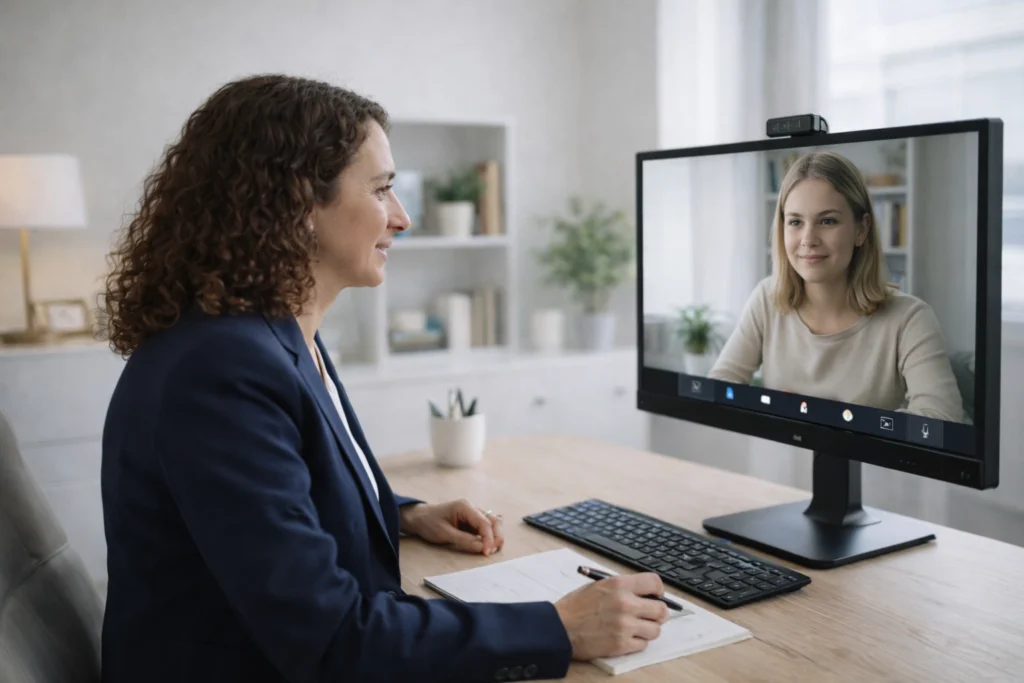
You can learn useful phrases independently and still find it difficult to use them when someone responds unexpectedly. Knowing what to say is only one part of a conversation—you also need to understand the other person, respond naturally and ask for clarification when necessary.
In personalised lessons, we can prepare and practise the situations that are most relevant to your life, including:
- speaking to neighbours;
- ordering in cafés and restaurants;
- shopping;
- booking and managing appointments;
- visiting a pharmacy;
- contacting services or speaking to a landlord;
- participating in family and social conversations;
- communicating at work.
I teach primarily in Portuguese, with support in English whenever it helps you understand a new structure or resolve a specific doubt. We can practise likely questions, useful responses and ways to keep the conversation going when you do not understand everything.
If you would like my help becoming more confident and independent in everyday situations, you can schedule a trial lesson with me on Preply. Together, we can identify what is currently limiting your communication and create a practical learning plan around your life in Portugal.
See Also
If you would like to continue developing practical European Portuguese, you may also find these guides helpful:
Final Thoughts
You do not need to understand every conversation or speak perfect Portuguese to begin using the language in Portugal. Start with one everyday situation, learn a few complete expressions, practise the questions you may hear and prepare ways to ask for clarification.
Each small interaction matters: greeting a neighbour, asking a question in a shop, confirming an appointment or completing a short conversation without switching to English. These moments gradually build the confidence and independence that vocabulary lists alone cannot provide.
If you would like personalised help preparing for the situations that are part of your life in Portugal, you can book a trial lesson with me on Preply. Together, we can identify what is currently limiting your communication and create a practical learning plan around your needs.
FAQ
About the Author

Isabel M.
Native European Portuguese Tutor | Founder of Practical Portuguese
Hi, I’m Isabel, a native European Portuguese tutor from Portugal and the founder of Practical Portuguese.
I help adults learn authentic European Portuguese through structured, personalised online lessons. My lessons are taught mainly in Portuguese, with support in English whenever needed. I teach students from complete beginner to advanced levels, focusing on practical communication for everyday life, family, travel and work in Portugal.
Every article on Practical Portuguese combines natural language as it is spoken in Portugal with my experience teaching adult learners from different language backgrounds.
Why Learn with Me?
✔ Native European Portuguese speaker from Portugal
✔ Lessons taught in Portuguese with support in English
✔ Experience teaching adults from different language backgrounds
✔ Personalised one-to-one online lessons
✔ Practical Portuguese for everyday life, family, travel and work in Portugal
✔ Lessons adapted to your listening, pronunciation, sentence structure and speaking needs