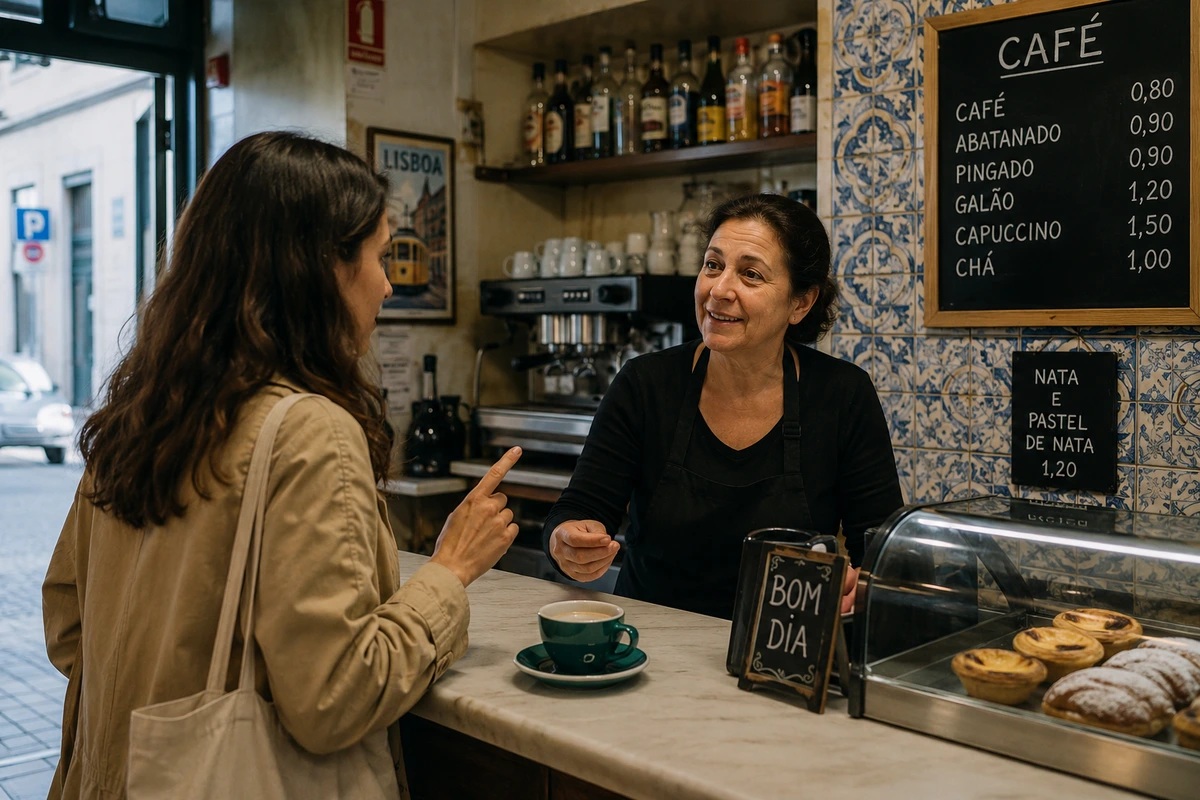
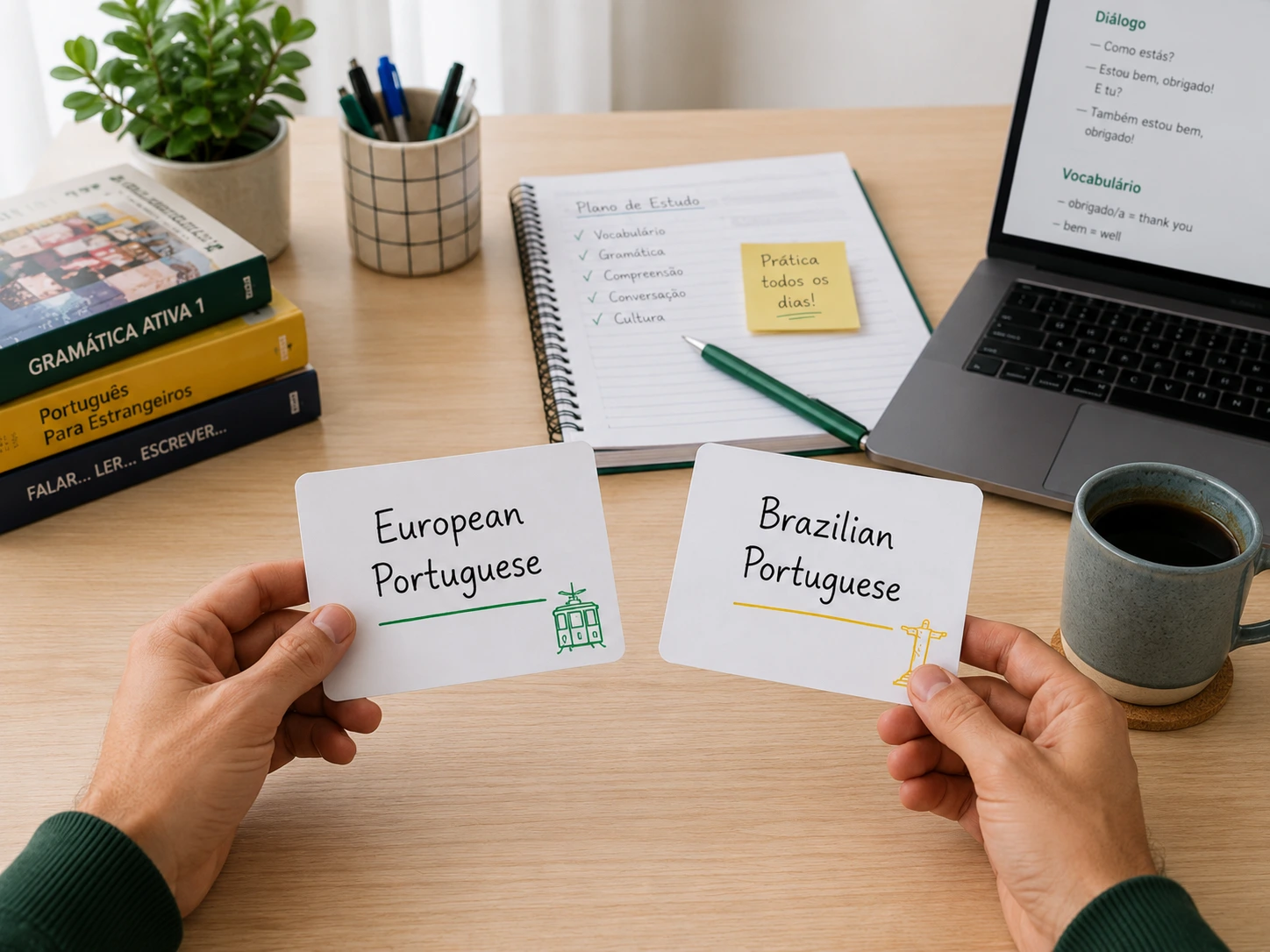

European and Brazilian Portuguese are mutually intelligible varieties of the same language, but they differ most in pronunciation, everyday vocabulary, grammar patterns and forms of address. Learn European Portuguese if you live in or are moving to Portugal; choose Brazilian Portuguese if your main connections are with Brazil.
For learners in Portugal, pronunciation is usually the biggest challenge. You may recognise Portuguese in writing but still struggle to understand conversations because European Portuguese reduces unstressed vowels and has a more compressed rhythm.
This guide compares the two varieties and shows you which vocabulary, grammar and pronunciation patterns matter most in everyday life.
- At a Glance
- European Portuguese vs Brazilian Portuguese: Quick Comparison
- Why European Portuguese vs Brazilian Portuguese Matters
- European Portuguese vs Brazilian Portuguese Pronunciation Differences
- European Portuguese vs Brazilian Portuguese Vocabulary Differences
- How to Make European Portuguese Listening Easier
- Key Grammar Differences Between European and Brazilian Portuguese
- Real-Life Phrase Comparison
- Is Brazilian Portuguese Understood in Portugal?
- Which Portuguese Should You Learn?
- Common Mistake: Mixing Both Varieties Too Early
- How to Practise European Portuguese in Real Life
- Need Help With the Right Type of Portuguese?
- See Also
- Final Thoughts on European Portuguese vs Brazilian Portuguese
- FAQ
- About the Author
Some links on this website may be affiliate or referral links. If you use them, I may receive a small commission or reward, at no extra cost to you.
I only recommend resources, tools, and services that I believe may be helpful for learning European Portuguese. These links help support the website, but they do not influence the advice or learning guidance I share.
At a Glance
- European Portuguese is the variety spoken in Portugal.
- Brazilian Portuguese is the variety spoken in Brazil.
- The biggest difference for learners is usually pronunciation.
- Everyday vocabulary can change in cafés, shops, transport and appointments.
- If you live in Portugal, European Portuguese will help you understand people more easily.
- Brazilian Portuguese is often understood in Portugal, but it may not sound natural in local situations.
European Portuguese vs Brazilian Portuguese: Quick Comparison
| Feature | European Portuguese | Brazilian Portuguese |
|---|---|---|
| Mainly spoken in | Portugal | Brazil |
| Pronunciation | More vowel reduction and a compressed rhythm | Vowels often sound more open and distinct |
| Ongoing actions | Estou a aprender | Estou aprendendo |
| Informal “you” | Tu is common; pronouns are often omitted in formal contexts | Você is common, while tu varies by region |
| Bus | Autocarro | Ônibus |
| Train | Comboio | Trem |
| Mobile phone | Telemóvel | Celular |
| Best choice for | Living, travelling or working in Portugal | Living, travelling or communicating in Brazil |
Why European Portuguese vs Brazilian Portuguese Matters
Many learners start with the easiest Portuguese resource they can find. Often, that means Brazilian Portuguese, because it is widely available in apps, videos and online courses.
Duolingo is a common example. If you are considering using it, read Is Duolingo Good for European Portuguese? to understand what it can offer and its limitations for learners who want to communicate in Portugal.
That can be useful if you are travelling to Brazil or speaking mainly with Brazilians. But if your goal is to speak with neighbours, doctors, landlords, shop assistants, colleagues or family members in Portugal, it can create confusion.
You may learn words, sounds and sentence patterns that are understandable, but not the most natural in Portugal.
For example, you may learn:
Estou aprendendo português.
Meaning: I am learning Portuguese.
Common in Brazil.
In Portugal, you are more likely to hear:
Estou a aprender português.
Meaning: I am learning Portuguese.
Natural in European Portuguese.
Both are correct in their own varieties, but the second sounds natural in Portugal.
European Portuguese vs Brazilian Portuguese Pronunciation Differences

For many learners, pronunciation is the most noticeable difference between European Portuguese and Brazilian Portuguese.
Brazilian Portuguese often sounds more open and easier to hear for beginners. European Portuguese tends to reduce unstressed vowels, which can make words sound shorter, faster or more compressed.
This is one reason many learners say, “I can read Portuguese, but I don’t understand people in Portugal.”
That does not mean European Portuguese is impossible. It simply means you need listening practice with speakers from Portugal, not only written exercises or Brazilian audio.
My European Portuguese Pronunciation Guide explains the main sounds and pronunciation patterns you need to recognise in Portugal.
Common Pronunciation Features in Portugal
In European Portuguese, you will often hear:
- reduced vowel sounds;
- words linked together in natural speech;
- more closed vowel sounds;
- a strong difference between stressed and unstressed syllables;
- phrases that sound faster than they look on the page.
This matters in daily situations such as:
Queria um café, por favor.
I would like an espresso, please.
Tem cartão de cliente?
Do you have a customer card?
A consulta é às três.
The appointment is at three.
On paper, these phrases are simple. In real speech, they may sound much faster than expected.
European Portuguese Sounds Learners Often Find Difficult
European Portuguese pronunciation can feel unfamiliar because some sounds may not exist in your native language.
Learners often struggle with:
- reduced vowels;
- nasal sounds;
- the Portuguese “r”;
- soft word endings;
- connected speech;
- sentence rhythm.
Some words may look simple but need listening and repetition to sound natural:
obrigado / obrigada
thank you
desculpe
excuse me / sorry
farmácia
pharmacy
consulta
appointment
The goal is not to have a perfect accent. The goal is to be understood and to understand others more easily.
If you are wondering why spoken Portuguese can feel more difficult than written Portuguese, Is European Portuguese Hard to Learn? looks more closely at listening, pronunciation, grammar and realistic learner expectations.
European Portuguese vs Brazilian Portuguese Vocabulary Differences
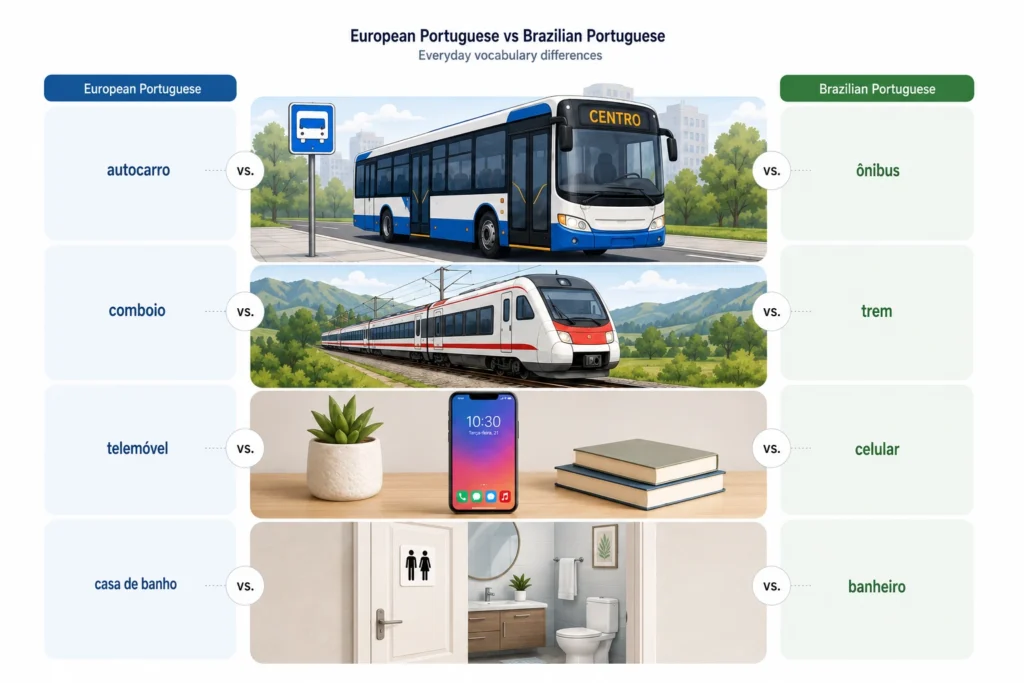
Many everyday words are different in Portugal and Brazil. This is especially important because these are the words you need most in daily life.
| English | European Portuguese | Brazilian Portuguese |
|---|---|---|
| bus | autocarro | ônibus |
| train | comboio | trem |
| mobile phone | telemóvel | celular |
| bathroom | casa de banho | banheiro |
| fridge | frigorífico | geladeira |
| breakfast | pequeno-almoço | café da manhã |
| ice cream | gelado | sorvete |
| juice | sumo | suco |
| ID card | cartão de cidadão | carteira de identidade / RG |
Some words are understood in both countries, but they may not sound natural everywhere.
In Portugal, you would normally say:
Vou apanhar o autocarro.
I’m going to take the bus.
Not:
Vou pegar o ônibus.
A Portuguese person will probably understand you, but it will sound Brazilian, not European Portuguese.
How to Make European Portuguese Listening Easier
Start with short audio, not long conversations.
A good listening method is:
- Listen once for the general meaning.
- Listen again and notice familiar words.
- Read the transcript if available.
- Repeat useful phrases aloud.
- Listen again a few days later.
Do not expect to understand everything immediately. Repetition is more useful than constantly searching for new material.
For example, you can practise one short café phrase:
Queria um café, por favor.
I would like a coffee, please.
Listen to it several times. Repeat it aloud. Then change one word:
Queria uma água, por favor.
I would like a water, please.
Queria um chá, por favor.
I would like a tea, please.
Queria pagar, por favor.
I would like to pay, please.
This turns listening into active practice.
You can use the same method to develop your speaking skills. How to Practise Speaking European Portuguese includes practical ways to move from recognising phrases to using them in conversation.
Key Grammar Differences Between European and Brazilian Portuguese
The grammar is mostly the same, but there are some common differences in how people speak and write.
For beginners, you do not need to study every technical detail. The most useful thing is to recognise the patterns you will hear in Portugal.
If you need help with the foundations, my European Portuguese Grammar for Beginners guide explains sentence structure, verb forms, agreement, prepositions and other essential patterns.
1. Estar a + Infinitive vs the Gerund
In Portugal, people usually use:
estar a + infinitive
Examples:
Estou a estudar português.
I am studying Portuguese.
Estamos a jantar.
We are having dinner.
Ela está a trabalhar.
She is working.
In Brazil, you often hear:
estar + gerund
Examples:
Estou estudando português.
I am studying Portuguese.
Estamos jantando.
We are having dinner.
Ela está trabalhando.
She is working.
For learners in Portugal, it is better to practise the European Portuguese form first.
A useful phrase for daily life is:
Ainda estou a aprender português.
I am still learning Portuguese.
You can use this in shops, cafés, appointments or conversations with neighbours.
2. Placement of Object Pronouns
European Portuguese often places object pronouns after the verb in everyday affirmative sentences.
European Portuguese:
Liga-me amanhã.
Call me tomorrow.
Ajuda-me, por favor.
Help me, please.
Vi-o ontem.
I saw him yesterday.
Brazilian Portuguese often places the pronoun before the verb in speech:
Me liga amanhã.
Call me tomorrow.
Me ajuda, por favor.
Help me, please.
This is one of the differences that can make Brazilian Portuguese sound noticeably different in Portugal.
As a beginner, do not worry about mastering every pronoun rule immediately. Start by recognising common phrases you may hear, such as:
Pode ajudar-me?
Can you help me?
Pode enviar-me a morada?
Can you send me the address?
Pode ligar-me mais tarde?
Can you call me later?
These are useful in real situations with services, clinics, landlords or work contacts.
3. Tu, Você and Polite Forms
In Brazil, você is extremely common for “you”.
In Portugal, tu is common with friends, family and people you know well. In more formal situations, people often avoid using a direct pronoun and simply use the verb form.
For example, at a clinic or shop in Portugal, you may hear:
Tem marcação?
Do you have an appointment?
Quer pagar com cartão?
Do you want to pay by card?
Precisa de ajuda?
Do you need help?
You may also hear o senhor or a senhora in polite contexts:
A senhora quer marcar uma consulta?
Would you like to book an appointment?
The word você exists in Portugal, but it can sound too direct, distant or unnatural in some situations, depending on tone and context.
For beginners in Portugal, it is often safer to learn polite verb forms first.
Useful examples:
Pode repetir, por favor?
Can you repeat, please?
Pode falar mais devagar?
Can you speak more slowly?
Pode ajudar-me?
Can you help me?
These phrases are polite, practical and natural in Portugal.
Real-Life Phrase Comparison
Here are some practical examples of European Portuguese vs Brazilian Portuguese in everyday situations.
Ordering Coffee
The sentence Queria um café, por favor can be used in both Portugal and Brazil. The main differences may be pronunciation and what the speaker expects to receive.
In Portugal, um café normally means a small espresso:
European Portuguese:
Queria um café, por favor.
I would like an espresso, please.
In Brazil, cafezinho is also commonly used, but it is not the only way to ask for coffee:
Brazilian Portuguese:
Queria um café, por favor.
I would like a coffee, please.
Taking Public Transport
European Portuguese:
Onde fica a paragem do autocarro?
Where is the bus stop?
Brazilian Portuguese:
Onde fica o ponto de ônibus?
Where is the bus stop?
European Portuguese:
Vou de comboio para Lisboa.
I’m going to Lisbon by train.
Brazilian Portuguese:
Vou de trem para Lisboa.
I’m going to Lisbon by train.
In Portugal, comboio is the normal word for train.
Speaking at a Shop
European Portuguese:
Queria pagar com cartão.
I would like to pay by card.
Tem saco?
Do you have a bag?
Queria experimentar, por favor.
I would like to try it on, please.
These are useful in supermarkets, clothes shops and local stores.
Brazilian Portuguese may use different vocabulary or pronunciation, but many basic shopping phrases are similar.
Asking for the Bathroom
European Portuguese:
Onde é a casa de banho?
Where is the bathroom?
Brazilian Portuguese:
Onde fica o banheiro?
Where is the bathroom?
In Portugal, casa de banho is the natural everyday phrase.
Making an Appointment
European Portuguese:
Queria marcar uma consulta.
I would like to book an appointment.
Brazilian Portuguese:
Queria marcar uma consulta.
I would like to book an appointment.
Some phrases are the same or very similar. The difference may be pronunciation, rhythm or level of formality.
In Portugal, you may also need:
Tem disponibilidade esta semana?
Do you have availability this week?
Queria cancelar a consulta.
I would like to cancel the appointment.
Queria remarcar a consulta.
I would like to reschedule the appointment.
These phrases are useful for doctors, dentists, hairdressers and other services.
Is Brazilian Portuguese Understood in Portugal?
Yes, in most cases, Portuguese people understand Brazilian Portuguese.
Portuguese people are familiar with Brazilian Portuguese through music, television, social media and Brazilian communities in Portugal. If you speak Brazilian Portuguese in Portugal, people will usually understand the general meaning.
But being understood is not the same as sounding natural.
If you use Brazilian vocabulary, pronunciation and grammar patterns in Portugal, people may understand you, but you may still struggle to understand them. This is especially true in fast everyday conversations.
For example, you may recognise the written sentence:
Vou ao supermercado.
I’m going to the supermarket.
But when a Portuguese person says it naturally, it may sound much shorter and faster than expected.
That is why learners in Portugal should practise listening to European Portuguese from the beginning.
Which Portuguese Should You Learn?
You should learn the variety of Portuguese that matches your real life.
Choose European Portuguese if you:
- live in Portugal;
- are moving to Portugal;
- have a Portuguese partner or family;
- need Portuguese for doctors, shops, neighbours or paperwork in Portugal;
- want to understand local pronunciation;
- want to feel more confident in daily situations in Portugal.
If you are living in Portugal or preparing to relocate, European Portuguese for Expats in Portugal explains which communication skills can help you become more independent in everyday life.
Choose Brazilian Portuguese if you:
- live in Brazil;
- travel mostly to Brazil;
- speak mainly with Brazilians;
- enjoy Brazilian media and culture as your main focus;
- need Portuguese for work or family connected to Brazil.
For many learners in Portugal, the best choice is simple: learn European Portuguese first, then become familiar with Brazilian Portuguese later.
This gives you a clear base for local life, while still helping you understand other Portuguese speakers.
Common Mistake: Mixing Both Varieties Too Early
Many beginners mix European and Brazilian Portuguese because their resources come from different places.
For example, they may learn European vocabulary but Brazilian sentence patterns:
Estou esperando o ônibus.
In Portugal, a more natural version would be:
Estou à espera do autocarro.
I am waiting for the bus.
Another example:
Estou aprendendo português.
In Portugal, say:
Estou a aprender português.
I am learning Portuguese.
Mixing varieties is normal at the beginning, so do not feel embarrassed. Most learners do it.
But over time, try to build a clear European Portuguese base. This will help you sound more natural and understand local speech better.
How to Practise European Portuguese in Real Life

The best way to practise European Portuguese is to start with the situations you actually need in Portugal.
Portuguese for Daily Life in Portugal shows how to prioritise the language you need for cafés, shops, appointments, neighbours and everyday services.
Do not begin with long grammar lists. Begin with useful phrases you can use this week.
1. Practise One Daily Situation at a Time
Choose one context, such as ordering coffee.
Practise:
Bom dia. Queria um café, por favor.
Good morning. I would like an espresso, please.
Quanto é?
How much is it?
Posso pagar com cartão?
Can I pay by card?
Use the same phrases several times in real cafés until they feel natural.
Then choose another situation, such as going to the pharmacy, speaking to a neighbour or booking an appointment.
2. Listen to European Portuguese Every Day
Even five minutes a day helps.
Listen to Portuguese from Portugal, not only Brazilian content. Focus on practical topics connected to your daily life, such as:
- cafés;
- shops;
- appointments;
- directions;
- family conversations;
- public services;
- transport;
- healthcare;
- housing.
Do not try to understand every word. Listen for rhythm, repeated phrases and familiar sounds.
Over time, European Portuguese will start to feel less compressed and more predictable.
3. Learn Phrases, Not Only Single Words
Instead of learning only:
consulta
appointment
Learn full phrases:
Queria marcar uma consulta.
I would like to book an appointment.
Tenho uma consulta amanhã.
I have an appointment tomorrow.
Preciso de cancelar a consulta.
I need to cancel the appointment.
This is much more useful for real communication.
You can use the same method with other daily words.
For example, instead of only learning:
farmácia
pharmacy
Learn:
Onde é a farmácia mais próxima?
Where is the nearest pharmacy?
Preciso de falar com o farmacêutico.
I need to speak with the pharmacist.
Tem alguma coisa para a dor de garganta?
Do you have something for a sore throat?
4. Ask People to Repeat Naturally
Many learners switch to English too quickly because they panic when they do not understand.
Prepare a few simple phrases so you can stay in Portuguese:
Pode repetir, por favor?
Can you repeat, please?
Pode falar mais devagar?
Can you speak more slowly?
Não percebi.
I didn’t understand.
Ainda estou a aprender português.
I am still learning Portuguese.
These phrases are simple, but they are powerful. They help you keep the conversation going in Portuguese.
5. Check the Variety Before Using a Resource
Before you start a course, app, podcast or YouTube channel, check whether it teaches European Portuguese or Brazilian Portuguese.
For a broader approach to choosing and combining online resources, read The Best Way to Learn European Portuguese Online.
Look for labels such as:
- European Portuguese;
- Portuguese from Portugal;
- Português europeu;
- Português de Portugal;
- PT-PT.
If the resource does not say which variety it teaches, listen for clues.
European Portuguese examples:
Estou a aprender.
I am learning.
Vou apanhar o autocarro.
I am going to take the bus.
Onde é a casa de banho?
Where is the bathroom?
Brazilian Portuguese examples:
Estou aprendendo.
I am learning.
Vou pegar o ônibus.
I am going to take the bus.
Onde fica o banheiro?
Where is the bathroom?
This simple check can prevent confusion later.
Need Help With the Right Type of Portuguese?

If your goal is to live, travel or communicate more confidently in Portugal, personalised European Portuguese lessons can help you focus on the language you actually need in daily life.
In my European Portuguese lessons, we can practise real situations such as ordering in cafés, speaking to neighbours, booking appointments, going to the pharmacy, dealing with paperwork or having family conversations in Portugal.
You can start here:
If your goal is Brazilian Portuguese instead, it is better to work with a tutor who specialises in the Brazilian variety. That way, you can focus on Brazilian pronunciation, vocabulary and everyday expressions from the beginning.
You can search for a Brazilian Portuguese tutor here:
The most important thing is to match your lessons to your real-life goal. If you need Portuguese for life in Portugal, choose European Portuguese. If you need Portuguese for Brazil, choose Brazilian Portuguese.
See Also
If you would like to continue learning European Portuguese for life in Portugal, you may also find these guides helpful:
Final Thoughts on European Portuguese vs Brazilian Portuguese
When comparing European Portuguese vs Brazilian Portuguese, the most important question is not which one is better. The real question is where you want to use Portuguese.
For life in Portugal, European Portuguese is the most practical choice. It will help you understand local pronunciation, use natural vocabulary and feel more confident in everyday situations.
Start with simple phrases you can use this week: in a café, at the pharmacy, with a neighbour or when booking an appointment.
With regular practice, European Portuguese will begin to feel less distant and more useful in your daily life.
If you want guided speaking practice, private European Portuguese lessons can help you use real-life phrases with feedback and build confidence for conversations in Portugal.
FAQ
About the Author

Isabel M.
Native European Portuguese Tutor | Founder of Practical Portuguese
Hi, I’m Isabel, a native European Portuguese tutor from Portugal and the founder of Practical Portuguese.
I help adults learn authentic European Portuguese through structured, personalised online lessons. My lessons are taught mainly in Portuguese, with support in English whenever needed. I teach students from complete beginner to advanced levels, focusing on practical communication for everyday life, family, travel and work in Portugal.
Every article on Practical Portuguese combines natural language as it is spoken in Portugal with my experience teaching adult learners from different language backgrounds.
Why Learn with Me?
✔ Native European Portuguese speaker from Portugal
✔ Lessons taught in Portuguese with support in English
✔ Experience teaching adults from different language backgrounds
✔ Personalised one-to-one online lessons
✔ Practical Portuguese for everyday life, family, travel and work in Portugal
✔ Lessons adapted to your listening, pronunciation, sentence structure and speaking needs