
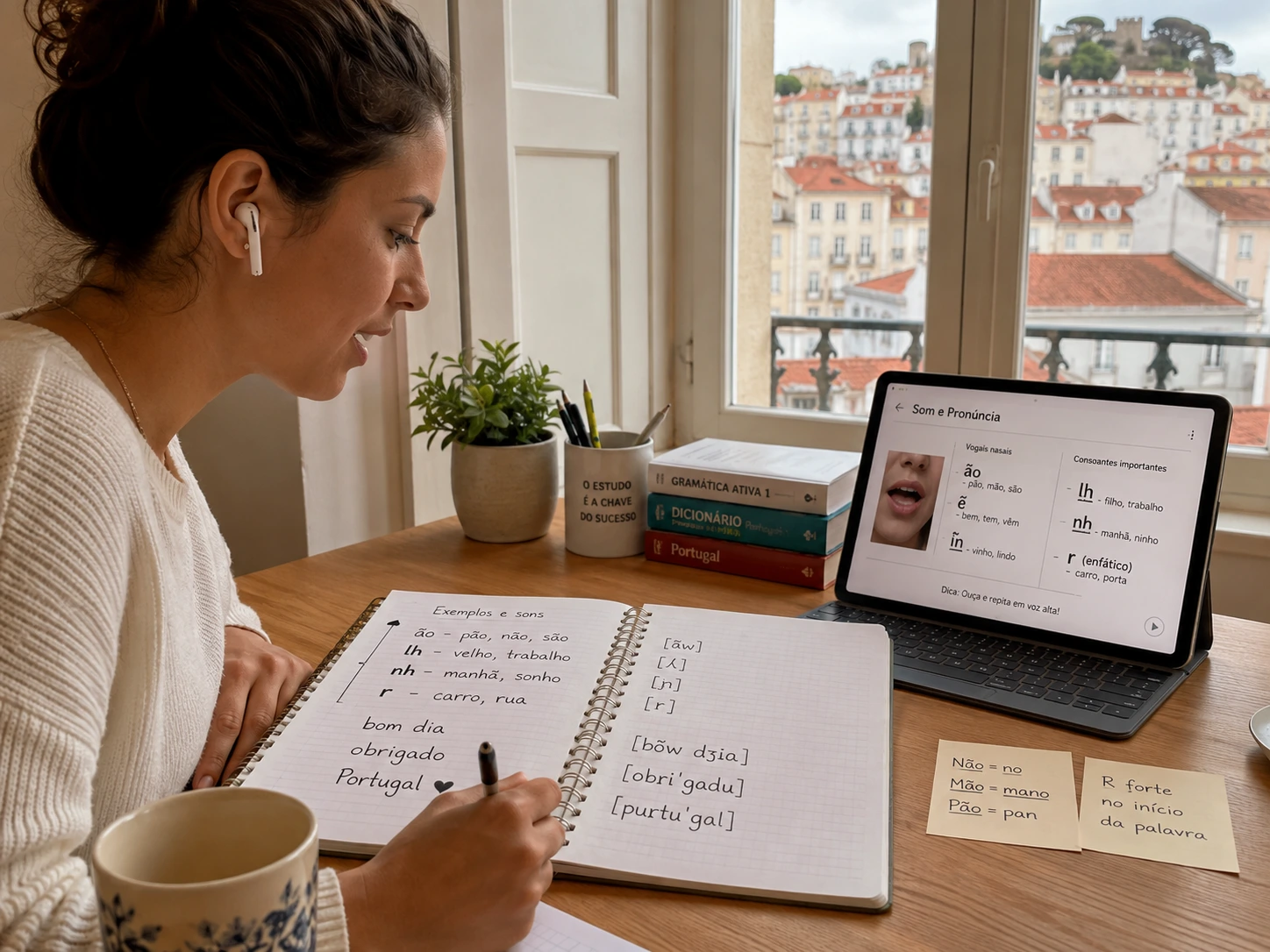

European Portuguese pronunciation becomes easier when you understand three essential features: stressed syllables are clearer, unstressed vowels are often reduced, and words connect in natural speech.
This is one reason you may recognise a sentence on the page but still fail to understand it when someone says it in Portugal. The words have not disappeared; some sounds simply become weaker, shorter or less obvious in connected speech.
You do not need a perfect Portuguese accent to communicate. Your goal should be to pronounce important sounds clearly, place stress correctly and become familiar with the rhythm of Portuguese from Portugal.
This European Portuguese pronunciation guide covers the most useful patterns, including vowel reduction, open and closed vowels, nasal sounds, word stress, the Portuguese r, s, lh, nh and connected speech.
Written explanations are useful, but pronunciation also requires listening and repetition. Whenever possible, combine this guide with audio recorded by native European Portuguese speakers.
- At a Glance
- Why European Portuguese Sounds Fast
- How to Find the Stressed Syllable
- How Vowel Reduction Works
- Open and Closed Vowels
- How to Pronounce Nasal Vowels
- How to Pronounce R
- How to Pronounce S
- How to Pronounce C, Ç, G, J, CH and X
- How to Pronounce LH and NH
- How to Pronounce Syllable-Final L
- How Connected Speech Works
- Common European Portuguese Pronunciation Mistakes
- A European Portuguese Pronunciation Routine
- When Pronunciation Lessons Can Help
- See Also
- Final Thoughts: Improve Your Pronunciation One Pattern at a Time
- FAQ
- About the Author
Some links on this website may be affiliate or referral links. If you use them, I may receive a small commission or reward, at no extra cost to you.
I only recommend resources, tools, and services that I believe may be helpful for learning European Portuguese. These links help support the website, but they do not influence the advice or learning guidance I share.
At a Glance
| Feature | What to remember |
|---|---|
| Word stress | One syllable is usually stronger and clearer than the others. |
| Unstressed vowels | They often become weaker, shorter or almost silent. |
| Open and closed vowels | The letters e and o can represent different sounds. |
| Nasal vowels | Do not automatically add a strong n or m after the vowel. |
| Single and double r | A single r between vowels differs from an initial r or rr. |
| Final s | It often sounds like sh in much of Portugal, with regional variation. |
| lh and nh | These letter combinations each represent a single sound. |
| Connected speech | Practise complete phrases, not only isolated words. |
| Main goal | Aim to be understood and to recognise natural Portuguese speech. |
Why European Portuguese Sounds Fast
Portuguese people do not necessarily speak unusually quickly in every situation. European Portuguese often sounds fast because unstressed vowels become weaker and words connect.
In careful pronunciation, you may hear every part of a word. In natural conversation, an unstressed vowel may become very short or difficult for a beginner to notice.
Consider these common phrases:
Está bem.
That’s fine. / Okay.
Quer mais alguma coisa?
Would you like anything else?
Pode repetir, por favor?
Can you repeat, please?
Tenho uma consulta amanhã.
I have an appointment tomorrow.
You may know all these words but still miss them in conversation because you expect every written vowel to sound equally clear.
Learning European Portuguese pronunciation is therefore not only about producing sounds. It also helps you understand other people.
How to Find the Stressed Syllable
In most Portuguese words, one syllable is stressed. This part of the word sounds stronger or more prominent.
For example:
- ca-FÉ;
- ho-TEL;
- far-MÁ-cia;
- por-tu-GUÊS;
- te-le-FO-ne;
- MÉ-di-co.
Correct word stress is important because placing the emphasis on the wrong syllable can make a familiar word difficult to recognise.
Written accents show stress
When a word contains an acute or circumflex accent, that mark identifies the stressed vowel:
- café;
- farmácia;
- português;
- avó;
- avô;
- médico.
An acute accent can also indicate an open vowel, while a circumflex normally indicates a closed vowel:
- avó — grandmother, with an open o;
- avô — grandfather, with a closed o.
Stress in words without accents
As a useful starting rule:
- words ending in a, e, o, as, es, os, am, em or ens are commonly stressed on the penultimate syllable;
- words ending in many other consonants are commonly stressed on the final syllable;
- a written accent normally identifies a word that does not follow the expected stress pattern.
Examples include:
- CA-sa;
- CA-sas;
- NO-me;
- NO-mes;
- a-MI-go;
- a-MI-gos;
- FA-lam;
- JO-vem;
- JO-vens;
- ho-TEL;
- por-tu-GAL;
- co-MER.
These rules are helpful, but listening remains essential because spelling does not reveal every detail of pronunciation.
How Vowel Reduction Works
Vowel reduction is one of the most important features of European Portuguese pronunciation.
A stressed vowel is generally clearer. An unstressed vowel may become:
- shorter;
- more central;
- less open;
- difficult to hear;
- almost silent in rapid speech.
The letters a, e and o are particularly important.
Unstressed A
An unstressed a is commonly pronounced with a weaker, more central sound than a stressed a.
In CA-sa, the first a is stressed and clearer, while the final a is weaker.
The same contrast between strong and weak vowels can be heard in words such as:
- amanhã;
- cadeira;
- falar;
- semana.
Do not give every written a the same open sound. Listen for the clearer stressed syllable and the weaker syllables around it.
Unstressed E
An unstressed e can become very weak in European Portuguese. In some words and speaking contexts, a beginner may barely hear it.
Examples include:
- pequeno;
- telefone;
- verdade;
- excelente.
You should not simply delete every unstressed e. Its pronunciation depends on its position and the sounds around it.
The practical goal is to stop expecting it to sound like a clear English e every time.
Unstressed O
An unstressed o frequently sounds closer to u in European Portuguese.
For example, the final o in these words does not normally sound like a clear English “oh”:
- obrigado;
- amigo;
- médico;
- banco.
This is a pronunciation pattern, not a spelling change. You still write o.
Do not reduce every vowel deliberately
Vowel reduction should develop through listening and imitation. If you try to remove vowels mechanically, your speech may become unclear.
Begin by identifying the stressed syllable. Then listen to how a native speaker pronounces the weaker syllables around it.
Open and Closed Vowels
The letters e and o can represent open or closed sounds in European Portuguese. This difference can distinguish words.
Open and closed E
Consider the word sede:
- sede, with a closed e — thirst;
- sede, with an open e — headquarters or head office.
The spelling is identical. The pronunciation and context distinguish the meanings.
The word é, meaning “is”, also contains an open e:
Lisboa é a capital de Portugal.
Lisbon is the capital of Portugal.
Open and closed O
Compare:
- avó — grandmother, with an open o;
- avô — grandfather, with a closed o;
- posso — I can, with an open o;
- poço — well, with a closed o.
Accents help in words such as avó and avô, but many open and closed vowels are not marked in writing.
Learn the pronunciation together with the word. When you add new vocabulary to your notes, include audio or mark the stressed syllable.
How to Pronounce Nasal Vowels
Portuguese uses nasal vowels and nasal diphthongs. The sound passes through both the mouth and the nose.
Common examples include:
- não;
- pão;
- mãe;
- irmão;
- informação;
- bem;
- fim;
- bom;
- mundo.
Nasalisation may be shown by:
- a tilde: ã, õ;
- a vowel followed by m or n within the same syllable;
- common endings such as -ão, -ãe, -em and -im.
Avoid adding a strong consonant
In examples such as bem, bom and fim, the written consonant mainly indicates that the preceding vowel is nasal.
Do not add a strong English-style m after the vowel.
Similarly, não should not sound like the English word “now” followed by a separate n.
Practise nasal sounds in groups
Try repeating:
- não — pão — mão;
- mãe — cães — pães;
- bem — tem — cem;
- fim — sim — mim;
- bom — som — com.
Begin slowly, then use the words in complete phrases:
Não, obrigada.
No, thank you.
Queria pão, por favor.
I would like bread, please.
A minha mãe mora em Portugal.
My mother lives in Portugal.
Pronouncing isolated words is useful, but complete phrases also help you practise rhythm and connected speech.
How to Pronounce R
The letter r has more than one common pronunciation in European Portuguese.
Single R between vowels
A single r between vowels is usually a quick tap.
Examples include:
- caro;
- marido;
- barato;
- morar;
- senhora.
This sound is brief. Avoid replacing it with the English r in words such as caro.
Initial R and double RR
An r at the beginning of a word and rr between vowels normally use a stronger sound produced further back in the mouth or throat.
Examples include:
- rua;
- rápido;
- restaurante;
- carro;
- correr;
- bairro.
Compare:
- caro — expensive;
- carro — car.
The difference between the single and double r changes the word.
Pronunciation varies across Portugal and among individual speakers. You do not need to copy one exact throat sound. The important distinction is between the short single r and the stronger initial r or rr.
How to Pronounce S
The pronunciation of s depends on its position and the sounds around it.
S at the beginning of a word
At the beginning of a word, s normally has an s sound:
- sim;
- senhora;
- semana;
- sopa.
Double SS
The combination ss also represents an s sound:
- pessoa;
- possível;
- passar;
- assunto.
Single S between vowels
A single s between vowels usually sounds like z:
- casa;
- mesa;
- coisa;
- visitar.
Final S
In much of central and southern Portugal, including the pronunciation commonly taught to learners, a final s often sounds similar to sh before a pause or a voiceless consonant.
Examples include:
- dois;
- português;
- mais;
- estamos.
Before a voiced consonant, it may sound closer to the consonant in the English word “vision”.
Before a vowel, it can connect to the following word and sound like z:
os amigos
the friends
The pronunciation of final s varies regionally, particularly in northern Portugal. Treat the sh sound as an important listening pattern, not as the only possible Portuguese accent.
How to Pronounce C, Ç, G, J, CH and X
Several Portuguese consonants change according to the letter that follows.
C and Ç
The letter c before a, o or u usually sounds like k:
- casa;
- café;
- coisa;
- cultura.
Before e or i, c normally sounds like s:
- cedo;
- cidade;
- cinco.
The letter ç also sounds like s:
- praça;
- açúcar;
- almoço;
- informação.
The letter ç is not used at the beginning of a word.
G and J
The letter g before a, o or u has the hard sound heard in:
- gato;
- agora;
- seguro.
Before e or i, g normally has the same sound as j:
- gente;
- ginásio;
- janeiro;
- jantar;
- loja.
This sound resembles the middle consonant in the English word “vision”, although the exact Portuguese sound may differ.
CH
In the European Portuguese pronunciation commonly taught to learners, ch normally sounds like sh:
- chá;
- chave;
- chegar;
- chuva.
Regional pronunciation may vary.
X
The letter x is less predictable and can represent different sounds:
- caixa — similar to sh;
- exame — similar to the consonant in the English word “vision”;
- próximo — similar to s;
- táxi — similar to ks.
It is best to learn words containing x together with audio instead of assuming that the letter always has the same pronunciation.
How to Pronounce LH and NH
The combinations lh and nh each represent a single sound.
LH
Examples include:
- filho;
- mulher;
- trabalho;
- melhor;
- velho.
The lh sound is produced with the middle of the tongue close to the roof of the mouth.
Avoid pronouncing it as a simple English l followed by a separate h.
Practise:
O meu filho trabalha em Lisboa.
My son works in Lisbon.
NH
Examples include:
- vinho;
- senhora;
- amanhã;
- dinheiro;
- cozinha.
The nh sound is similar to the sound in the middle of the English word “onion” or the Spanish ñ, but you should practise it within complete Portuguese words and phrases.
Try:
Amanhã tenho uma consulta.
I have an appointment tomorrow.
How to Pronounce Syllable-Final L
The letter l has a clearer sound at the beginning of a syllable, as in:
- lado;
- falar;
- Lisboa.
At the end of a syllable or word, it has a darker sound:
- alto;
- Portugal;
- hotel;
- hospital;
- difícil;
- papel.
In European Portuguese, this final l remains an l sound. Avoid replacing it with a clear u sound.
Practise:
Moro em Portugal.
I live in Portugal.
O hotel fica perto do hospital.
The hotel is near the hospital.
Preciso de papel.
I need paper.
How Connected Speech Works
Correctly pronouncing isolated words is not enough to understand or produce natural European Portuguese.
In conversation:
- unstressed vowels become weaker;
- words connect;
- small grammatical words may be less prominent;
- important information receives more emphasis;
- familiar expressions become compact sound units.
For example:
Queria marcar uma consulta.
I would like to book an appointment.
Practise it as a complete request, not as four unrelated words.
The same applies to:
Pode falar mais devagar?
Can you speak more slowly?
Não percebi. Pode repetir?
I didn’t understand. Can you repeat?
Quanto é que custa?
How much does it cost?
Tenho de falar com o senhorio.
I have to speak to the landlord.
Use thought groups
Divide a longer sentence into meaningful groups:
Bom dia | queria marcar uma consulta | para a próxima semana.
This makes the sentence easier to say and gives you natural places to pause.
Do not pause after every word. At the same time, do not try to say the entire sentence without breathing.
Common European Portuguese Pronunciation Mistakes
Pronouncing every vowel clearly
European Portuguese does not normally give every written vowel equal weight. Identify the stressed syllable and listen for weaker vowels.
Using English R in every position
Practise the difference between the short single r in caro and the stronger sound in carro.
Pronouncing final O as “oh”
An unstressed final o usually sounds closer to u in European Portuguese.
Adding N or M after nasal vowels
In não, bem and bom, focus on nasalising the vowel rather than adding a strong final consonant.
Ignoring word stress
Even relatively accurate consonants and vowels may be difficult to recognise if the stress is placed on the wrong syllable.
Learning mainly from Brazilian Portuguese audio
Brazilian and European Portuguese are valid varieties of the same language, but their pronunciation and rhythm differ.
If your goal is Portugal, listen regularly to speakers from Portugal.
For a detailed comparison, read European Portuguese vs Brazilian Portuguese.
Trying to eliminate your accent
An accent is not a communication failure. Prioritise intelligibility, listening comprehension and confidence.
A European Portuguese Pronunciation Routine
You do not need to practise every Portuguese sound every day.
Choose one short recording containing a sentence you may need in real life.
1. Listen without reading
Try to understand the situation and identify familiar words.
2. Read the transcript
Mark:
- stressed syllables;
- reduced vowels;
- unfamiliar sounds;
- groups of connected words.
3. Listen again
Compare what you expected from the spelling with what you actually hear.
4. Repeat in short sections
Repeat one phrase at a time. Focus on rhythm rather than speed.
5. Record yourself
Record the complete sentence and compare it with the original.
Listen for one feature at a time:
- word stress;
- vowels;
- r;
- nasal sounds;
- rhythm.
6. Change one detail
Turn the original sentence into a reusable pattern:
Queria um café, por favor.
I would like a coffee, please.
Queria uma água, por favor.
I would like some water, please.
Queria pagar, por favor.
I would like to pay, please.
Queria marcar uma consulta.
I would like to book an appointment.
7. Practise the reply
Do not practise only your opening sentence. Think about what the other person may ask and prepare one or two possible replies.
Ten focused minutes with one useful sentence can be more productive than repeating a long list of unrelated words.
When Pronunciation Lessons Can Help

Written guides can explain pronunciation patterns, but they cannot listen to you or identify why a sound is difficult.
Personalised lessons can help when you:
- are frequently asked to repeat;
- know a word but are unsure how to say it;
- understand written Portuguese but struggle with natural speech;
- want feedback on specific sounds;
- pronounce isolated words but lose clarity in sentences;
- feel nervous about speaking to people in Portugal;
- need to prepare for appointments, family conversations or work.
In my lessons, I first listen to how the learner already speaks.
Some learners need help with reduced vowels or nasal sounds. Others pronounce Portuguese accurately but need to improve rhythm, listening or sentence construction.
The goal is not to remove every trace of your accent. It is to help you communicate clearly, understand natural Portuguese and feel more prepared for real conversations.
If you would like personalised guidance, you can book a trial lesson with me on Preply. We can identify the pronunciation and listening features that matter most for your communication in Portugal.
See Also
- Is European Portuguese Hard to Learn? — understand why spoken Portuguese may feel difficult at first.
- European Portuguese for Beginners — start with useful phrases and practical grammar.
- Learn European Portuguese Online — combine listening, speaking, grammar and feedback.
- How to Practise Speaking European Portuguese — develop your speaking through practical activities.
- European Portuguese vs Brazilian Portuguese — compare pronunciation, vocabulary and common structures.
Final Thoughts: Improve Your Pronunciation One Pattern at a Time
European Portuguese pronunciation becomes more manageable when you focus on a few important patterns: word stress, reduced vowels, nasal sounds, the different forms of r and s, and connected speech.
Do not try to perfect every sound at once. Choose a short recording from Portugal, compare it with a transcript and repeat one useful sentence until it feels more natural. Then practise the reply you may hear in a real conversation.
You do not need to eliminate your accent. The goal is to communicate clearly, recognise natural speech and feel more confident using Portuguese in daily life.
If you would like personalised feedback, you can book a trial lesson with me on Preply. We can work on the pronunciation and listening skills most relevant to your life, family, travel or work in Portugal.
FAQ
About the Author

Isabel M.
Native European Portuguese Tutor | Founder of Practical Portuguese
Hi, I’m Isabel, a native European Portuguese tutor from Portugal and the founder of Practical Portuguese.
I help adults learn authentic European Portuguese through structured, personalised online lessons. My lessons are taught mainly in Portuguese, with support in English whenever needed. I teach students from complete beginner to advanced levels, focusing on practical communication for everyday life, family, travel and work in Portugal.
Every article on Practical Portuguese combines natural language as it is spoken in Portugal with my experience teaching adult learners from different language backgrounds.
Why Learn with Me?
✔ Native European Portuguese speaker from Portugal
✔ Lessons taught in Portuguese with support in English
✔ Experience teaching adults from different language backgrounds
✔ Personalised one-to-one online lessons
✔ Practical Portuguese for everyday life, family, travel and work in Portugal
✔ Lessons adapted to your listening, pronunciation, sentence structure and speaking needs