
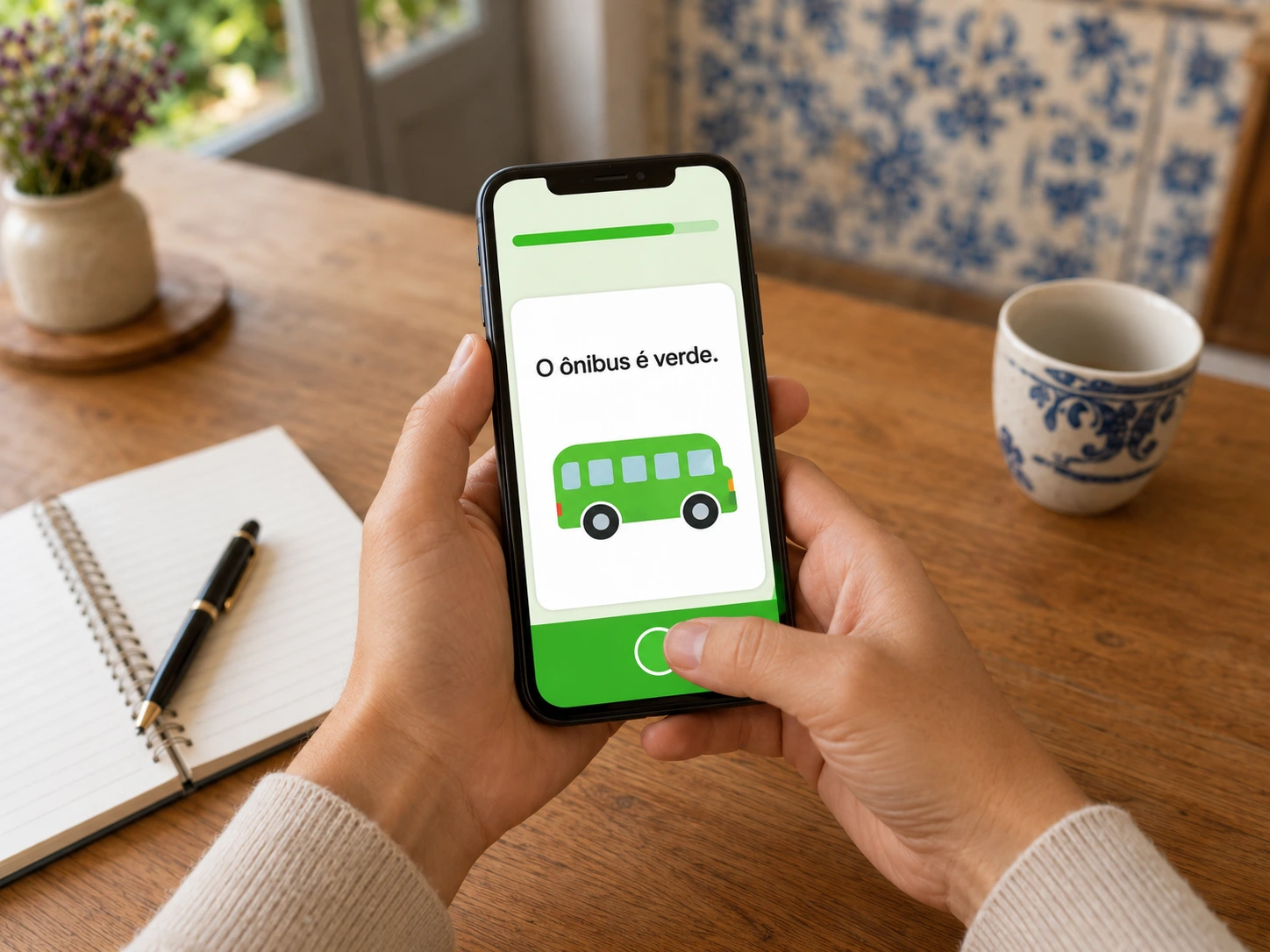

Duolingo can be a useful starting point for learning Portuguese, particularly for building a daily habit and learning basic vocabulary. However, it primarily teaches Brazilian Portuguese, so it will not fully prepare you for the pronunciation, vocabulary and natural conversations you will encounter in Portugal.
One of my new students recently described a problem I hear surprisingly often:
“I’ve been using Duolingo every day for months. I know lots of words, but when my Portuguese family start talking around the dinner table, I have no idea what’s going on.”
If this sounds familiar, you are not alone.
Many of my students started learning Portuguese with Duolingo. I completely understand why—I have also used it to practise English.
It is accessible, engaging and easy to fit into a busy day. Opening an app for five or ten minutes feels much less intimidating than beginning a formal language course. The streaks, short exercises and small rewards can also help you keep going when your initial motivation begins to fade.
After a while, however, many learners reach the same frustrating stage. They can recognise Portuguese words on a screen and complete exercises successfully, but they still struggle to understand a conversation, answer a simple question or use the language when they actually need it.
That does not mean they have failed.
It usually means that the method no longer matches the goal.
- At a Glance
- Does Duolingo Teach European Portuguese?
- Why Does European Portuguese Sound So Different?
- Why So Many Learners Begin with Duolingo
- What Duolingo Does Well
- Where Duolingo Stops Being Enough
- Knowing Portuguese Words Is Not the Same as Communicating
- The Real Reasons People Want to Learn European Portuguese
- Why Human Interaction Helps You Learn Faster
- Why Immediate Feedback Makes a Difference
- Every Learner Struggles with Something Different
- How I Personalise My European Portuguese Lessons
- Can You Become Fluent in European Portuguese with Duolingo Alone?
- Should You Stop Using Duolingo?
- How to Use Duolingo for European Portuguese
- Duolingo vs a European Portuguese Tutor
- Would You Like to Practise European Portuguese with Me?
- See Also
- Final Thoughts: Is Duolingo Good for European Portuguese?
- FAQ
- About the Author
Some links on this website may be affiliate or referral links. If you use them, I may receive a small commission or reward, at no extra cost to you.
I only recommend resources, tools, and services that I believe may be helpful for learning European Portuguese. These links help support the website, but they do not influence the advice or learning guidance I share.
At a Glance
- Portuguese variety: Duolingo primarily teaches Brazilian Portuguese, not European Portuguese.
- Best for: Building a daily learning habit, practising basic vocabulary and revising simple sentence structures.
- Main limitation: It will not fully prepare you for European Portuguese pronunciation, vocabulary and natural speech.
- Speaking practice: Exercises can help with recognition, but they do not replace spontaneous conversations with another person.
- Pronunciation: You will need additional listening and pronunciation practice focused specifically on the Portuguese spoken in Portugal.
- Best approach: Use Duolingo as a supplementary tool alongside European Portuguese resources, real conversations and personalised feedback.
- Overall verdict: Duolingo can help you begin, but it is not enough on its own if your goal is to communicate confidently in Portugal.
Does Duolingo Teach European Portuguese?
No. Duolingo’s Portuguese course primarily teaches Brazilian Portuguese, not the variety spoken in Portugal.
European and Brazilian Portuguese are varieties of the same language. They share much of their vocabulary and grammar, and speakers can generally understand one another.
However, there are important differences in:
- pronunciation;
- rhythm and intonation;
- everyday vocabulary;
- forms of address;
- common grammatical structures;
- the way people naturally form sentences.
This matters if you are learning Portuguese because you live in Portugal, have Portuguese relatives, plan to visit the country or need to communicate with Portuguese colleagues.
For example:
| English | Brazilian Portuguese | European Portuguese |
|---|---|---|
| bus | ônibus | autocarro |
| train | trem | comboio |
| bathroom | banheiro | casa de banho |
| mobile phone | celular | telemóvel |
| ice cream | sorvete | gelado |
| juice | suco | sumo |
| breakfast | café da manhã | pequeno-almoço |
| I am speaking | estou falando | estou a falar |
A learner may arrive in Portugal knowing the word ônibus, only to find autocarro written at the bus stop. They may expect to hear trem at the station, while everyone around them talks about the comboio.
These differences do not make one variety better or more correct than the other. They simply reflect the way Portuguese has developed in different countries.
The important question is: Where and with whom do you want to use Portuguese?
If your main goal is to communicate in Brazil or with Brazilian friends and family, Duolingo’s Portuguese course may suit your needs.
If your goal is to understand and communicate with people in Portugal, you will need resources that reflect European Portuguese vocabulary, pronunciation and usage.
A note about tu and você
The difference between tu and você is more complex than a simple comparison between European and Brazilian Portuguese.
In Portugal, tu is commonly used in informal relationships, but the appropriate form of address depends on the person, context and degree of formality. Portuguese speakers may use tu, a person’s name, a professional title, o senhor/a senhora or omit the pronoun entirely.
This is difficult to learn from isolated sentences because the correct choice depends on the relationship between the speakers.
Why Does European Portuguese Sound So Different?
One of the biggest surprises for learners is pronunciation.
European Portuguese often sounds more reduced and compressed than Brazilian Portuguese, particularly in natural conversation. Unstressed vowels may be reduced or become difficult for beginners to hear. Words also connect, and the rhythm can feel fast even when the speaker is not talking particularly quickly.
Consider this question:
O que é que estás a fazer?
What are you doing?
A beginner may understand every word when reading the sentence. But when a person in Portugal says it naturally, several sounds flow together. The learner may not recognise the sentence at all.
This is one of the most common things I hear from students:
“I can read Portuguese, but I can’t understand Portuguese people speaking.”
Usually, the problem is not a lack of intelligence, commitment or vocabulary.
The learner may simply have had more exposure to a pronunciation model that does not match the Portuguese they hear in everyday life.
Knowing what a word looks like is not the same as recognising it when its sounds change or become reduced in connected speech. This is why European Portuguese listening practice is important from the beginning.
Why So Many Learners Begin with Duolingo
Duolingo removes many of the barriers that prevent adults from beginning a new language.
You do not need to buy a textbook, choose a course or commit to a fixed timetable. You can download the app and complete your first exercise immediately.
For someone who is nervous about learning Portuguese, that matters.
Many adults worry that they are “bad at languages”. They may remember uncomfortable experiences at school or feel embarrassed about making mistakes. An app gives them a private, low-pressure way to begin.
Duolingo also turns learning into a manageable activity. Five or ten minutes feels possible, even during a busy day.
Almost all my students who have used it mention at least one of these benefits:
- it helped them create a routine;
- it made Portuguese feel less intimidating;
- it introduced useful vocabulary;
- it encouraged them to study regularly;
- it allowed them to practise during short breaks;
- their streak motivated them to continue.
These are genuine strengths.
The problem begins when learners expect one app to develop every skill they need.
What Duolingo Does Well
Duolingo is not a complete method for learning European Portuguese, but it can still play a useful role in your routine.
It helps you build consistency
Many adults struggle to make progress not because they are incapable of learning, but because they have not yet found a consistent rhythm.
A short daily lesson is often more beneficial than studying intensively once every few weeks. Regular contact helps you remember vocabulary and become familiar with common structures.
A streak is not the same as fluency, but it can help you build a habit that supports long-term learning.
It introduces basic vocabulary
Beginners need repeated exposure to common words.
Duolingo can introduce vocabulary connected with:
- food and drink;
- family;
- work;
- travel;
- routines;
- places;
- simple descriptions;
- everyday actions.
Some words will differ in Portugal, but a large amount of fundamental Portuguese vocabulary is shared across varieties.
It lowers the pressure
Beginners are often afraid of making mistakes or sounding foolish.
An app provides a private space where they can experiment, repeat exercises and become familiar with basic sentence structures before speaking to another person.
This can help a learner gain enough confidence to take the next step.
It is easy to fit into a busy day
Duolingo can be used while travelling, waiting for an appointment or taking a short break.
This convenience is valuable. If a resource is easy to access, learners are more likely to remain in regular contact with the language.
It can keep motivation alive
Motivation is not constant.
Adults are often balancing work, family and other responsibilities. On some days, ten minutes may be all they can manage.
If Duolingo encourages someone to return to Portuguese each day, that has value. Learning should not always feel like a formal school exercise.
The important question is whether your daily activities are helping you move towards your real-life goal—or simply helping you become better at completing exercises inside the app.
Where Duolingo Stops Being Enough
The limitation is not that Duolingo is “bad”. It is that it develops only part of the skills you need.
Recognising an answer is not the same as producing it.
In an app exercise, you may have:
- several possible answers;
- written words in front of you;
- time to think;
- the option to repeat the audio;
- a clue if you make a mistake.
In a real conversation, none of that is guaranteed.
You need to listen, understand the other person, decide what to say, build your response and pronounce it—all within a few seconds.
Real conversations also include:
- different voices;
- background noise;
- regional accents;
- incomplete sentences;
- unexpected questions;
- people interrupting one another;
- words being connected or reduced;
- the pressure of knowing that someone is waiting for your reply.
That is why a learner can feel confident in the app and still freeze in situations such as:
- ordering in a café;
- speaking at the pharmacy;
- answering a family member;
- making a telephone call;
- asking for help;
- speaking to a neighbour;
- explaining a problem with a bill;
- responding when the conversation changes direction.
I do not see this as a failure.
I see it as a sign that the learner needs a different kind of practice.
Knowing Portuguese Words Is Not the Same as Communicating
Imagine that you have completed several lessons about food and drinks.
You recognise pão, leite, café, água and queijo. You can translate basic sentences and select the correct answer from a list.
Then you enter a busy café in Portugal.
The employee looks at you and says:
“Diga, se faz favor.”
You expected a question closer to “What would you like?” The expression is unfamiliar, people are waiting behind you and you suddenly cannot remember the sentence you had prepared.
You answer in English.
This can feel extremely discouraging because you have studied. You may wonder why everything disappears as soon as you need to speak.
The reason is that recognising language and producing it are different abilities.
Completing an exercise can show that you recognise vocabulary. Communicating requires you to retrieve that vocabulary at the right moment, adapt it to the situation and respond to another person.
The only way to become more comfortable with that process is to practise it.
The Real Reasons People Want to Learn European Portuguese
Most adults are not learning Portuguese simply to complete a course or collect points.
There is usually a more personal reason behind it.
That reason should influence what they learn, how they practise and which difficulties deserve the most attention.
“I want to understand my Portuguese family”
Some learners have a Portuguese partner, parents, grandparents or in-laws.
At the dinner table, everyone may begin by speaking slowly for their benefit. Then the conversation becomes animated. People start talking at their natural speed, interrupting one another and using expressions shared by the family.
The learner catches individual words but loses the meaning of the conversation.
They may smile and wait for someone to translate. Sometimes the family switches to English, but this can create another uncomfortable feeling: everyone has changed language because of them.
They do not necessarily want perfect Portuguese. They want to understand the joke, follow the story and respond without requiring the conversation to stop.
They want to feel included rather than like an outsider.
For this learner, family vocabulary is not enough. They need to become familiar with natural European Portuguese speech, informal questions and the expressions their relatives are likely to use.
“I live in Portugal, but I still depend on English”
Living in Portugal does not automatically mean you will learn Portuguese.
In many places, people switch to English as soon as they hear a foreign accent. They may be trying to help, but the learner loses an opportunity to practise.
Months—or even years—can pass while the person continues to depend on English or asks a partner, friend or colleague to handle more complicated situations.
They may need help:
- booking a medical appointment;
- speaking to a landlord;
- resolving a problem with an electricity or gas bill;
- going to the bank;
- explaining symptoms at the pharmacy;
- arranging a delivery;
- contacting an insurance company;
- talking to a neighbour;
- making a telephone call.
The emotional goal behind these tasks is often independence.
It is the freedom to resolve a small problem without asking someone else to intervene. It is the relief of understanding what a receptionist is asking. It is being able to say more than bom dia to the neighbour you see every morning.
A general app cannot know which of these situations is most urgent in your life.
“I’m visiting Portugal and want to communicate”
Someone preparing for a holiday does not need the same learning programme as someone moving permanently to Portugal.
A visitor may want to:
- greet people politely;
- order food and drinks;
- ask for directions;
- understand prices and numbers;
- check into accommodation;
- ask whether something is available;
- explain a dietary restriction;
- understand a simple reply.
For this learner, practical language and clear pronunciation should come first.
There is no need to spend weeks memorising vocabulary they are unlikely to use during their trip. Their time is better spent practising short, realistic exchanges.
“I need Portuguese for work”
A professional may already understand some everyday Portuguese but need help communicating appropriately at work.
They may want to:
- introduce themselves to Portuguese colleagues;
- answer telephone calls;
- participate in meetings;
- prepare for an interview;
- write more natural emails;
- speak to customers;
- explain a project;
- use an appropriate level of formality.
Here, vocabulary is only one part of the challenge.
The learner also needs to understand how people communicate in a professional context in Portugal. Should they use tu, a person’s name, a professional title or o senhor/a senhora? How direct should an email be? How can they disagree politely during a meeting?
These details depend on context and are difficult to learn through isolated sentences.
Why Human Interaction Helps You Learn Faster
Language is an interaction between people.
When you speak to another person, they do not simply decide whether your sentence is correct or incorrect. They respond to what you mean.
They may:
- ask a follow-up question;
- misunderstand a word;
- ask you to clarify;
- change the subject;
- use an expression you do not know;
- respond in a way you did not expect.
You have to listen and adapt.
This process develops the ability to communicate in a way that predefined exercises cannot fully reproduce.
Another person can also notice why you are struggling.
Perhaps you understand the vocabulary but need too long to construct a sentence. Perhaps one pronunciation difficulty is preventing people from understanding you. Perhaps you understand individual words but cannot recognise them in connected speech.
These are different problems and require different kinds of practice.
Human interaction is therefore not only an opportunity to use what you have already learnt. It is part of the learning process itself.
Why Immediate Feedback Makes a Difference
If you repeatedly pronounce a word incorrectly without anyone correcting you, that pronunciation may become a habit.
The same is true of grammar.
You may use the same structure incorrectly for months while still being understood. Because the conversation continues, you assume that the sentence is correct.
Correcting an established habit later can be more difficult.
However, useful feedback does not mean interrupting the student after every mistake. Too much correction can make a learner nervous and afraid to speak.
A tutor needs to decide:
- which errors interfere with communication;
- which errors are relevant to the lesson;
- which mistakes are becoming repeated habits;
- when to correct immediately;
- when to allow the learner to finish;
- how much explanation the learner needs.
For example, a student might say:
Eu gosto muito viver em Portugal.
The natural structure is:
Eu gosto muito de viver em Portugal.
An app may mark the first sentence as incorrect. A tutor can go further by noticing that the student repeatedly omits de after gostar, explaining the pattern clearly and then creating opportunities to use it:
- Gostas de viver em Portugal?
- Gostas de trabalhar em casa?
- Gostas de viajar?
- De que é que gostas mais em Portugal?
The correction becomes connected to the learner’s own life and is immediately used in conversation.
That makes it easier to understand, remember and eventually produce without thinking.
Every Learner Struggles with Something Different
There is no single reason why people find European Portuguese difficult.
Some learners struggle with pronunciation
They may understand the grammar and remember vocabulary, but people regularly ask them to repeat themselves.
These learners may need focused practice with:
- nasal sounds;
- open and closed vowels;
- reduced vowels;
- word stress;
- connected speech;
- the rhythm of European Portuguese.
Repeating generic audio is not always enough. Someone needs to listen and identify the specific sound causing the difficulty.
Some understand a lot but cannot speak
These learners can follow much of a lesson or conversation but freeze when it is their turn to respond.
They often know more Portuguese than they think. Their main difficulty may be retrieving language quickly and building sentences without translating every word.
They need guided questions, sentence models, realistic role-plays and frequent opportunities to produce language in a supportive environment.
Some speak confidently but repeat the same mistakes
Other learners are happy to talk and can maintain a conversation, but persistent grammar mistakes may reduce clarity or make their Portuguese sound less natural.
They need selective correction and structured practice without losing their confidence or spontaneity.
Some can read but cannot understand natural speech
A learner may understand a text easily but struggle when neighbours, relatives or people in shops speak to them.
They need exposure to different voices and natural European Portuguese—not only slow sentences pronounced one word at a time.
Some need a clearer structure
Apps provide an obvious next button, but learners may not understand how individual exercises connect or what they are working towards.
A structured learning plan can show them:
- what they can already do;
- what they need to develop next;
- which skills require more attention;
- how each activity relates to their goal.
Personalisation can save a great deal of time.
You do not necessarily learn faster because someone gives you more work. You learn faster because the work is better matched to what you need.
How I Personalise My European Portuguese Lessons
When someone begins lessons with me, my first question is not simply: “How many Portuguese words do you know?”
I want to understand where they need to use the language.
Do they need Portuguese for family? Are they living in Portugal? Are they preparing for a holiday? Do they need to communicate at work? Is their main difficulty speaking, listening, pronunciation or sentence structure?
That context changes the learning plan.
If a student lives in Portugal and needs to contact an energy provider, we can practise checking whether a contract is active, asking when the next bill will arrive and spelling a name or address.
If someone wants to communicate with Portuguese relatives, we can work with informal questions, family conversations and the pronunciation patterns they are likely to hear.
If a learner is preparing for a holiday, we can prioritise greetings, restaurants, accommodation, directions and practical questions.
If someone needs Portuguese for work, we can practise introductions, interviews, meetings, telephone calls and professional emails.
This does not mean ignoring grammar.
It means teaching grammar through situations in which the student genuinely needs it.
Depending on the student, a lesson may include:
- reviewing previous language;
- listening to European Portuguese;
- introducing vocabulary connected to a real situation;
- explaining a grammar point clearly;
- practising pronunciation;
- answering guided questions;
- completing a realistic role-play;
- correcting recurring mistakes;
- preparing personalised homework.
A complete beginner may need more repetition, visual support and sentence models. A more confident learner may spend longer discussing a topic, solving a realistic problem or refining natural expressions.
The goal is not merely to finish a textbook unit.
It is to help the learner do something they could not do before.
If you would like help identifying what is holding you back, a one-to-one lesson can give you the opportunity to practise real situations, receive feedback and focus on the areas that need the most attention.
Can You Become Fluent in European Portuguese with Duolingo Alone?
It is unlikely that Duolingo alone will prepare you to communicate confidently in European Portuguese.
Even if you complete a large amount of content, you still need to develop abilities that are difficult to practise fully through an app:
- understanding natural European Portuguese;
- responding to unpredictable questions;
- holding a conversation in real time;
- adapting your language to formal and informal contexts;
- receiving feedback on your pronunciation;
- recognising your recurring mistakes;
- learning vocabulary relevant to your life;
- expressing ideas without selecting from predefined answers.
Fluency is not defined by the number of lessons you complete.
It is the ability to use Portuguese flexibly and appropriately when you need it.
You do not need perfect Portuguese to begin communicating. But you do need practice communicating.
Should You Stop Using Duolingo?
Not necessarily.
If you enjoy Duolingo and it motivates you to study regularly, you can continue using it. The important thing is to understand its role.
Think of it as one tool in a broader learning plan, rather than as the entire plan.
You can use Duolingo for:
- daily contact with Portuguese;
- basic vocabulary;
- light revision;
- confidence at the beginning;
- keeping the language present in your routine.
Combine it with:
- European Portuguese listening;
- speaking practice;
- pronunciation work;
- real conversations;
- personalised feedback;
- review of your own mistakes.
A balanced routine might look like this:
| Activity | Main purpose |
|---|---|
| Short Duolingo practice | Habit and vocabulary revision |
| European Portuguese audio | Listening and pronunciation |
| Reading a short text | Vocabulary in context |
| Speaking with a tutor or partner | Real-time communication |
| Personalised correction | Accuracy and clearer pronunciation |
| Reviewing recurring mistakes | Long-term progress |
That combination is much stronger than any single app.
How to Use Duolingo for European Portuguese
If you decide to continue using Duolingo, a few simple changes can make your practice more active and relevant.
Say the sentences aloud
Do not only tap the answer. Read the complete sentence aloud and then try to repeat it without looking at the screen.
This helps you practise retrieving and producing language rather than only recognising it.
Remember that the audio model may differ from the pronunciation you will hear in Portugal, so combine it with European Portuguese audio.
Write down the European Portuguese equivalent
When the app introduces Brazilian vocabulary, add the equivalent commonly used in Portugal:
- ônibus → autocarro
- trem → comboio
- celular → telemóvel
- suco → sumo
- banheiro → casa de banho
- café da manhã → pequeno-almoço
You can benefit from the app while remaining aware of the variety you want to speak.
Adapt sentences to your own life
If you see:
Ela trabalha num hospital.
Create new sentences and questions:
- Eu trabalho em…
- Onde é que tu trabalhas?
- Conheces alguém que trabalha num hospital?
- Gostas do teu trabalho?
Personal information is usually easier to remember than an isolated example about a fictional person.
Practise without looking at the answers
After completing an exercise, cover the screen and try to reconstruct the sentence.
Selecting the correct answer tests recognition. Rebuilding the sentence tests recall—the ability you need in a real conversation.
Record yourself
Choose three sentences and record yourself saying them.
Listen to the recording and pay attention to:
- pauses;
- word stress;
- sounds that feel difficult;
- words you cannot yet produce automatically.
Recording yourself may feel uncomfortable initially, but it can reveal difficulties you do not notice while speaking.
Use new language with another person
Try to use the new vocabulary in a lesson, language exchange or short conversation.
A word becomes genuinely useful when you can retrieve it at the right moment—not only when you recognise it inside an exercise.
Duolingo vs a European Portuguese Tutor
Duolingo and a tutor do not need to be competitors. They serve different purposes.
| Duolingo | European Portuguese tutor |
|---|---|
| Encourages daily practice | Creates a personalised learning plan |
| Introduces general vocabulary | Selects vocabulary for your real needs |
| Provides predefined exercises | Responds to what you say in real time |
| Primarily teaches Brazilian Portuguese | Focuses on the Portuguese used in Portugal |
| Gives automated corrections | Explains why a mistake is happening |
| Uses standardised content | Adapts activities to your difficulties |
| Allows private practice | Develops real conversational confidence |
| Is available whenever you open the app | Provides human feedback and accountability |
An app is good at providing repeatable exercises to many learners.
A tutor can notice that you understand written Portuguese but struggle with connected speech. Or that you need help with a particular vowel. Or that you are moving to Portugal and urgently need to handle medical appointments, rental contracts and telephone calls.
That individual attention is what makes personalised learning different.
Would You Like to Practise European Portuguese with Me?

If you can recognise Portuguese in an app but still struggle to understand people or respond with confidence, you may need a different kind of practice.
In my one-to-one online lessons, we can identify what is making communication difficult and focus on the European Portuguese you genuinely need—whether that means understanding your Portuguese family, feeling more independent in Portugal, communicating at work or preparing for a holiday.
You do not need to wait until you know all the grammar. We can start with what you already know and build your confidence one conversation at a time.
See Also
If you’d like to continue learning, you may also find these guides helpful:
Final Thoughts: Is Duolingo Good for European Portuguese?
Duolingo can help you begin learning Portuguese, establish a daily routine and acquire basic vocabulary.
However, it primarily teaches Brazilian Portuguese and cannot fully prepare you for the pronunciation, vocabulary and spontaneous conversations you will encounter in Portugal.
The fairest answer is:
Yes, Duolingo can be useful as a starting or revision tool. No, it is not enough on its own if your goal is to communicate confidently in European Portuguese.
You do not necessarily need to delete the app. You need to change its role.
Use it to maintain your routine, but combine it with European Portuguese listening, real speaking practice and feedback adapted to your difficulties.
Because the real measure of progress is not whether you can protect a streak.
It is whether you can follow the conversation around the dinner table.
Whether you can contact the health centre without asking someone else to do it for you.
Whether you can answer your neighbour before they switch to English.
Whether you can enter a café, hear “Diga, se faz favor” and know exactly how to respond.
FAQ
About the Author

Isabel M.
Native European Portuguese Tutor | Founder of Practical Portuguese
Hi, I’m Isabel, a native European Portuguese tutor from Portugal and the founder of Practical Portuguese.
I help adults learn authentic European Portuguese through structured, personalised online lessons. My lessons are taught mainly in Portuguese, with support in English whenever needed. I teach students from complete beginner to advanced levels, focusing on practical communication for everyday life, family, travel and work in Portugal.
Every article on Practical Portuguese combines natural language as it is spoken in Portugal with my experience teaching adult learners from different language backgrounds.
Why Learn with Me?
✔ Native European Portuguese speaker from Portugal
✔ Lessons taught in Portuguese with support in English
✔ Experience teaching adults from different language backgrounds
✔ Personalised one-to-one online lessons
✔ Practical Portuguese for everyday life, family, travel and work in Portugal
✔ Lessons adapted to your listening, pronunciation, sentence structure and speaking needs