
European Portuguese can be moderately challenging, particularly when you begin listening to natural conversations. Vocabulary and basic sentence structures are relatively accessible, but Portuguese people often reduce unstressed vowels and connect words, which can make familiar words difficult to recognise in speech.
Pronunciation may also require practice, although this varies considerably between learners. Some of my students reproduce Portuguese sounds accurately from their first attempts, with little influence from another language. Others need more time and focused listening to distinguish and produce unfamiliar sounds.
Grammar becomes more complex as you progress, but you do not need to master every verb tense or rule before you start communicating.
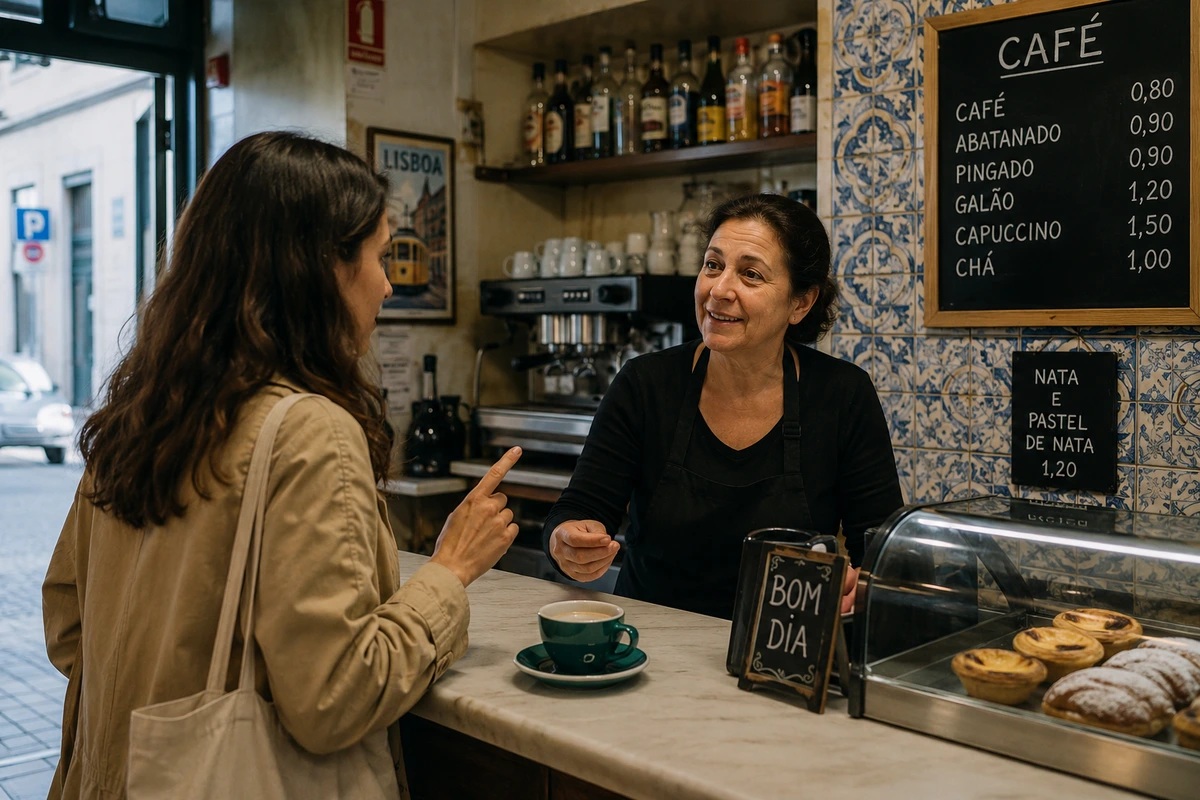
If you live in Portugal, are preparing to move here or want to connect more naturally with Portuguese relatives, fluency does not need to be your first goal. You can begin with the language that helps you order confidently in a café, speak to a neighbour, make an appointment or take part in a family conversation.
My guide to Portuguese for daily life in Portugal will help you prepare for these everyday interactions with useful phrases and practical communication strategies.
If you are at the beginning of your learning journey, start with this European Portuguese guide for beginners to identify the first phrases, pronunciation features and grammar structures worth learning.
- At a Glance
- Why European Portuguese Can Feel Difficult
- Why Does European Portuguese Sound So Fast?
- Is European Portuguese Pronunciation Difficult?
- Why Is Spoken European Portuguese So Difficult to Understand?
- Is European Portuguese Grammar Difficult?
- What Makes European Portuguese Easier to Learn?
- Is European Portuguese Harder Than Brazilian Portuguese?
- How Long Does It Take to Learn European Portuguese?
- How to Make European Portuguese Easier
- A Realistic Weekly Routine
- When Personalised Lessons Can Help
- See Also
- Final Thoughts: Is European Portuguese Hard to Learn?
- FAQ
- About the Author
Some links on this website may be affiliate or referral links. If you use them, I may receive a small commission or reward, at no extra cost to you.
I only recommend resources, tools, and services that I believe may be helpful for learning European Portuguese. These links help support the website, but they do not influence the advice or learning guidance I share.
At a Glance
| Question | Short answer |
|---|---|
| Is European Portuguese difficult? | It is moderately difficult for most learners. |
| What is usually the hardest part? | Understanding natural spoken Portuguese. |
| Is pronunciation difficult? | Some sounds are unfamiliar, but the level of difficulty varies considerably between learners. |
| Is the grammar complicated? | It can become complex, but beginners only need a limited number of useful structures. |
| What makes Portuguese easier? | A familiar alphabet, recognisable vocabulary and reusable sentence patterns. |
| Can beginners communicate in Portugal? | Yes. Simple phrases can be used from the first stages of learning. |
| Is European Portuguese harder than Brazilian Portuguese? | Not grammatically, but many beginners find the European variety harder to understand at first. |
Why European Portuguese Can Feel Difficult
European Portuguese often feels most difficult when the language you read does not seem to match what you hear.
You may understand this sentence on the page:
Queria marcar uma consulta.
I would like to book an appointment.
But when a receptionist says something quickly in reply, you may struggle to identify even words you already know.
This gap between reading and listening is very common. It does not necessarily mean that you need to learn more vocabulary. You may simply need more exposure to the sounds and rhythm of Portuguese from Portugal.
The main challenges are usually:
- reduced vowel sounds;
- words connected in natural speech;
- unfamiliar nasal sounds;
- different regional accents;
- verb conjugations;
- grammatical gender;
- formal and informal ways of addressing people;
- fewer beginner resources than for Brazilian Portuguese.
Not every learner experiences these difficulties in the same way. Your language background, listening skills and previous experience of learning languages can all influence what feels easy or difficult.
Some learners understand grammar quickly but hesitate when speaking. Others communicate confidently while still making grammatical mistakes. Some need considerable pronunciation practice, while others reproduce new sounds naturally from the beginning.
This is why there is no single answer that applies equally to everyone.
Why Does European Portuguese Sound So Fast?
Portuguese people do not necessarily speak unusually fast all the time. European Portuguese often sounds fast because unstressed vowels become weaker and words connect.
This is known as vowel reduction.
In careful speech, you may hear the different parts of a word clearly. In a natural conversation, some vowels become very short or almost disappear. Several words may then sound like one compact group.
For example:
Está bem.
That’s fine. / Okay.
This short expression may sound much more compressed in a natural conversation than a beginner expects from its written form.
Another common question in a café or shop is:
Quer mais alguma coisa?
Would you like anything else?
You may know every word on paper and still fail to recognise the sentence when someone says it naturally.
This happens because your brain is still expecting to hear each word separately and each vowel clearly. With repeated listening, it gradually begins to recognise the phrase as a complete sound pattern.
How to practise vowel reduction
Choose a recording containing one or two short sentences and follow these steps:
- Listen once without reading.
- Identify any words you recognise.
- Read the transcript.
- Listen again while following the text.
- Notice which vowels sound weaker than expected.
- Repeat the whole phrase aloud.
- Return to the same recording a few days later.
Working intensively with a short recording is often more useful than listening to a long podcast that you barely understand.
Is European Portuguese Pronunciation Difficult?
European Portuguese pronunciation can be challenging, but it is not equally difficult for everyone.
Some learners pronounce new words accurately when they hear them for the first time. They can imitate the sounds and rhythm without obvious interference from another language.
Other learners need more time to hear the difference between similar sounds or to find the right position of the mouth and tongue. This is also normal.
Common areas that may require practice include:
- reduced vowels;
- nasal vowels and diphthongs;
- the different sounds represented by the letter r;
- open and closed vowels;
- the sound of lh in words such as filho;
- the sound of nh in words such as vinho;
- connected words and sentence rhythm.
The goal does not need to be a perfect native accent. A more useful goal is to pronounce words clearly enough to be understood and to recognise those same sounds when other people use them.
You can explore these sounds in more detail in my European Portuguese pronunciation guide, which includes practical examples from Portuguese as it is spoken in Portugal.
Nasal sounds in European Portuguese
Words such as these contain nasal sounds:
- não — no;
- pão — bread;
- mãe — mother;
- irmão — brother;
- informação — information.
These sounds may require a new movement or position for some learners. The air passes partly through the nose, but you should not simply add a strong English n sound at the end.
A written explanation can help you understand what is happening, but pronunciation develops mainly through listening, imitation and feedback.
Why Is Spoken European Portuguese So Difficult to Understand?

For many learners, listening is harder than reading, grammar exercises or even prepared speaking.
When you prepare a sentence, you control the vocabulary and the speed. When another person answers, you have to:
- recognise the sounds;
- separate connected words;
- understand the vocabulary;
- process the grammar;
- interpret the meaning;
- prepare a response.
All of this happens within a few seconds.
Imagine that you have prepared this sentence at the pharmacy:
Tem alguma coisa para a tosse?
Do you have anything for a cough?
You may say it correctly and then receive a reply containing the name of a product, instructions, a question and vocabulary you have never heard before.
The problem is not that your original sentence was useless. You have successfully started the interaction. You now need strategies for managing the reply.
Useful phrases include:
Pode repetir, por favor?
Can you repeat, please?
Pode falar mais devagar?
Can you speak more slowly?
Não percebi.
I didn’t understand.
Pode escrever, por favor?
Can you write it down, please?
Quer dizer que…?
Do you mean that…?
These phrases allow you to remain in the conversation instead of changing immediately to English.
Learning these expressions is an important first step, but you also need opportunities to use them while listening and responding. These strategies for practising spoken European Portuguese can help you develop that confidence gradually.
A more effective listening method
Do not measure listening progress only by asking, “Did I understand everything?”
Instead, ask:
- Did I understand the situation?
- Did I identify the main question?
- Which words did I recognise?
- Can I recognise more after reading the transcript?
- Can I repeat one useful sentence?
- Can I understand the same recording more easily the next time?
Listening comprehension develops gradually. Recognising a few important words in a real conversation is already progress.
Is European Portuguese Grammar Difficult?
Portuguese grammar can become complex, particularly at intermediate and advanced levels. The language has numerous verb forms, grammatical gender, pronoun placement and structures that do not always have a direct English equivalent.
More advanced learners eventually encounter areas such as:
- the subjunctive;
- the personal infinitive;
- object pronouns;
- several past tenses;
- differences between formal and informal language.
However, beginners do not need to master all of these areas before speaking.
My guide to European Portuguese grammar for beginners focuses on the structures that have the greatest practical value during the first stages of learning.
You can communicate in many everyday situations with a small number of verbs and reusable sentence patterns.
Learn grammar through useful sentences
Consider the verb ter, meaning “to have”:
Tenho uma pergunta.
I have a question.
Tenho uma consulta amanhã.
I have an appointment tomorrow.
Tenho de ir ao banco.
I have to go to the bank.
These examples introduce grammar, but they also give you complete sentences that you can use.
The same principle applies to other practical patterns.
Queria…
Queria um café, por favor.
I would like a coffee, please.
Queria marcar uma consulta.
I would like to book an appointment.
Queria falar com o senhorio.
I would like to speak to the landlord.
Preciso de…
Preciso de ajuda.
I need help.
Preciso de uma informação.
I need some information.
Preciso de alterar a morada.
I need to change the address.
Pode…?
Pode repetir, por favor?
Can you repeat, please?
Pode ajudar-me?
Can you help me?
Pode dizer-me onde fica?
Can you tell me where it is?
Learning patterns like these allows you to communicate while gradually developing a deeper understanding of the grammar.
What Makes European Portuguese Easier to Learn?
The challenges are real, but Portuguese also has several characteristics that make it more accessible.
Portuguese uses a familiar alphabet
If you already use the Latin alphabet, you do not need to learn a completely new writing system.
You will need to understand accent marks and learn how some letters and combinations are pronounced, but you can begin recognising and writing words immediately.
Many words are recognisable
English and Portuguese share a considerable amount of international and Latin-based vocabulary.
For example:
- informação — information;
- importante — important;
- universidade — university;
- hospital — hospital;
- normal — normal;
- possível — possible;
- documento — document;
- restaurante — restaurant.
The pronunciation will not always be what an English speaker expects, and similar-looking words are not always reliable. Nevertheless, this shared vocabulary can make reading easier from an early stage.
Portuguese has reusable patterns
You do not have to create every sentence from the beginning.
Once you know Queria…, you can ask for many different things. Once you know Preciso de…, you can explain many practical needs.
This makes it possible to communicate with a limited vocabulary.
Context helps you understand
Real-life situations provide clues.
At a café, you can expect questions about your order, payment or whether you want anything else. At a pharmacy, the questions are likely to concern symptoms, medication and instructions.
Preparing the most likely phrases before entering the situation reduces the amount of completely unexpected language you need to process.
Is European Portuguese Harder Than Brazilian Portuguese?
European Portuguese is not grammatically more difficult simply because it is spoken in Portugal. European and Brazilian Portuguese are varieties of the same language, but they differ in pronunciation, vocabulary and some common grammatical structures.
You can explore the main differences between European and Brazilian Portuguese before choosing your learning resources.
Many beginners find Brazilian Portuguese easier to understand at first because its vowels often sound more open and distinct. European Portuguese tends to reduce unstressed vowels more strongly, making natural speech sound more compressed.
You will also encounter structural differences.
In Portugal, you will commonly hear:
Estou a aprender português.
I am learning Portuguese.
Many Brazilian Portuguese resources use:
Estou aprendendo português.
Both are correct within their respective varieties. However, if your goal is to communicate in Portugal, it makes sense to focus on European Portuguese from the beginning.
Many popular apps and online resources primarily teach Brazilian Portuguese. This can cause confusion when the vocabulary, pronunciation and structures in an app do not match what you hear around you in Portugal.
Duolingo is a common example. If you are considering using it, read Does Duolingo Teach European Portuguese? to understand what it offers and its limitations for learners who want to communicate in Portugal.
Look for resources labelled:
- European Portuguese;
- Portuguese from Portugal;
- Portugal Portuguese;
- PT-PT.
How Long Does It Take to Learn European Portuguese?
There is no single number that applies to every learner. In How Long Does It Take to Learn European Portuguese?, I explain why published hour estimates should be interpreted carefully and why your communication goals matter more than a universal deadline.
The time required depends on:
- your communication goal;
- your previous experience of learning languages;
- how frequently you study;
- how much European Portuguese you hear;
- whether you practise speaking;
- whether you receive useful feedback;
- how often you use Portuguese in real life.
It is also important to define what you mean by “learn Portuguese”.
Ordering in a café is a very different goal from understanding a rapid family conversation. Booking an appointment requires a different level from working professionally in Portuguese.
You can start using simple phrases during the earliest stages of learning. Developing comfortable, independent communication takes longer and requires regular exposure to spoken Portuguese.
Instead of focusing only on a final idea of fluency, choose a smaller, measurable goal:
- introduce yourself;
- order food and understand the basic questions;
- speak to a neighbour for two minutes;
- book an appointment;
- explain a simple problem;
- understand the main point of a short conversation;
- follow and contribute to part of a family conversation.
Each of these goals represents useful progress.
How to Make European Portuguese Easier

The most effective learning plan is not necessarily the longest or most complicated. It should focus on the Portuguese you genuinely need.
If you study remotely, this guide explains how to learn European Portuguese online while combining listening, grammar and practical speaking.
1. Connect your learning to real situations
Ask yourself: What do I need to do in Portuguese this week?
You might need to speak to your landlord, visit a pharmacy, order in a restaurant or welcome a Portuguese relative.
Prepare the language for that situation rather than studying an unrelated list of words.
2. Learn complete phrases
Learning consulta gives you one noun.
Learning Queria marcar uma consulta gives you something you can say.
Complete phrases also teach you vocabulary, grammar and word order together.
3. Combine written and spoken Portuguese
If you only read, you may build vocabulary without developing the ability to recognise it in speech.
Whenever possible, combine:
- a short recording;
- a transcript;
- repeated listening;
- repetition aloud;
- a short speaking task.
4. Repeat material
Constantly changing resources can create the feeling that you are studying a lot without giving your brain enough time to recognise patterns.
Return to the same recording or dialogue until it becomes noticeably easier.
5. Speak before everything feels perfect
You do not need advanced Portuguese to say:
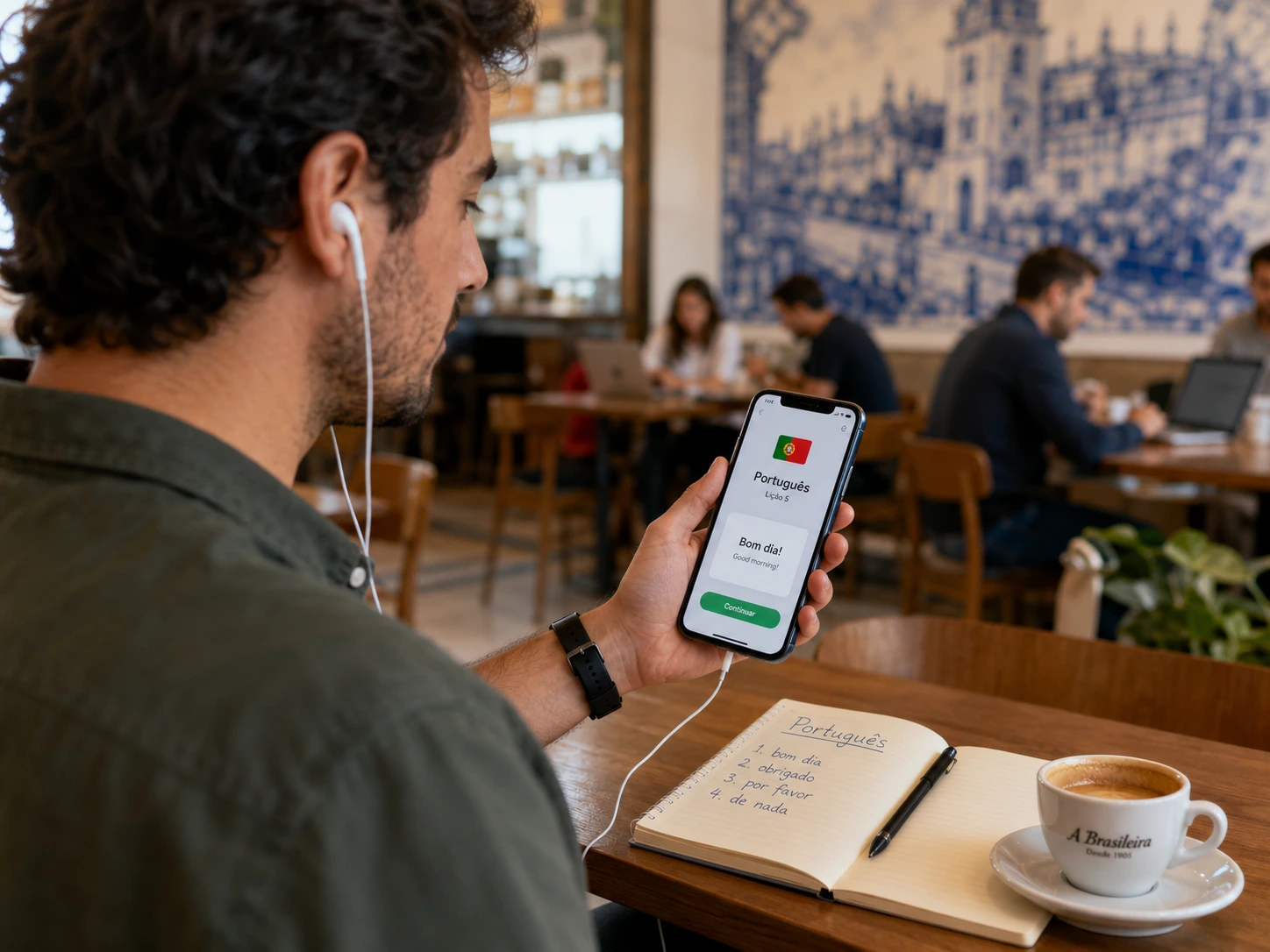
Bom dia.
Good morning.
Ainda estou a aprender português.
I am still learning Portuguese.
Não percebi.
I didn’t understand.
Pode repetir, por favor?
Can you repeat, please?
Speaking is not only the result of learning. It is part of the learning process.
A Realistic Weekly Routine
A manageable routine could include:
- ten minutes of focused listening;
- five useful phrases repeated aloud;
- one grammatical pattern in context;
- one short voice recording;
- one real-life task each week.
For example:
| Day | Activity |
|---|---|
| Monday | Listen to a short café dialogue. |
| Tuesday | Read the transcript and identify reduced sounds. |
| Wednesday | Practise five sentences beginning with Queria… |
| Thursday | Listen to the dialogue again without the transcript. |
| Friday | Record yourself saying both parts of the dialogue. |
| Saturday | Use one phrase in a real situation. |
| Sunday | Review the phrases that were difficult. |
The routine can be adapted to your schedule. Regular contact with the language matters more than completing a perfect plan.
Your routine is only one part of the process. You can also compare different methods in The Best Way to Learn European Portuguese Online.
When Personalised Lessons Can Help

Independent study can give you vocabulary, grammar explanations and listening material. Personalised lessons become particularly useful when you are unsure why you feel stuck.
You may need help if you:
- understand written Portuguese but cannot follow conversations;
- know what you want to say but cannot construct the sentence quickly;
- avoid speaking because you are afraid of making mistakes;
- need correction with specific sounds;
- struggle to understand replies in everyday situations;
- feel confused by European and Brazilian Portuguese resources;
- need Portuguese for family, work or daily life.
The right practice depends on the obstacle.
A learner who pronounces Portuguese accurately but struggles with sentence structure does not need the same lesson as someone who knows the grammar but cannot recognise reduced vowels in natural speech.
See Also
You may also find these guides useful:
Final Thoughts: Is European Portuguese Hard to Learn?
So, is European Portuguese hard to learn? It is moderately difficult, with listening comprehension usually presenting a greater challenge than basic reading or vocabulary.
Reduced vowels and connected speech can make spoken European Portuguese difficult to understand at first. Pronunciation may require focused practice, although some learners reproduce Portuguese sounds accurately from the beginning. Grammar becomes more complex over time, but beginners can communicate with a small number of useful verbs and sentence patterns.
Start with the situations that matter in your life. Listen to short recordings, learn complete phrases and use Portuguese before you feel completely ready.
If you would like personalised support, you can try an online European Portuguese lesson with me. We can identify what is making Portuguese difficult for you and focus the lessons on the listening, speaking, pronunciation or sentence-building skills you need for real communication.
FAQ
About the Author

Isabel M.
Native European Portuguese Tutor | Founder of Practical Portuguese
Hi, I’m Isabel, a native European Portuguese tutor from Portugal and the founder of Practical Portuguese.
I help adults learn authentic European Portuguese through structured, personalised online lessons. My lessons are taught mainly in Portuguese, with support in English whenever needed. I teach students from complete beginner to advanced levels, focusing on practical communication for everyday life, family, travel and work in Portugal.
Every article on Practical Portuguese combines natural language as it is spoken in Portugal with my experience teaching adult learners from different language backgrounds.
Why Learn with Me?
✔ Native European Portuguese speaker from Portugal
✔ Lessons taught in Portuguese with support in English
✔ Experience teaching adults from different language backgrounds
✔ Personalised one-to-one online lessons
✔ Practical Portuguese for everyday life, family, travel and work in Portugal
✔ Lessons adapted to your listening, pronunciation, sentence structure and speaking needs