
When you learn European Portuguese through English, it is natural to use English sentence patterns as a starting point. This can help you understand new vocabulary, but it can also lead to sentences that are grammatically incorrect or understandable without sounding natural in Portugal.
You may forget a preposition, use the wrong form of “to be”, include a subject pronoun that Portuguese speakers would omit or pronounce every written vowel too clearly. These are normal stages of learning, not signs that you are bad at languages.
Not every English-speaking student makes the same mistakes. In my lessons, some students use Portuguese pronunciation naturally from the beginning, while others need more support with rhythm and vowel reduction. Some understand grammar quickly but hesitate when speaking. Others communicate confidently and improve accuracy gradually.
Your first language can influence your Portuguese, but your previous learning experiences, exposure to the language, confidence and individual abilities also affect your progress.
This guide explains some of the most common mistakes made by people learning European Portuguese through English and shows you how to replace them with practical patterns used in Portugal.
- Common Mistakes at a Glance
- 1. Translating Directly From English
- 2. Including the Subject Pronoun in Every Sentence
- 3. Using Você as the Automatic Formal “You”
- 4. Confusing Ser and Estar
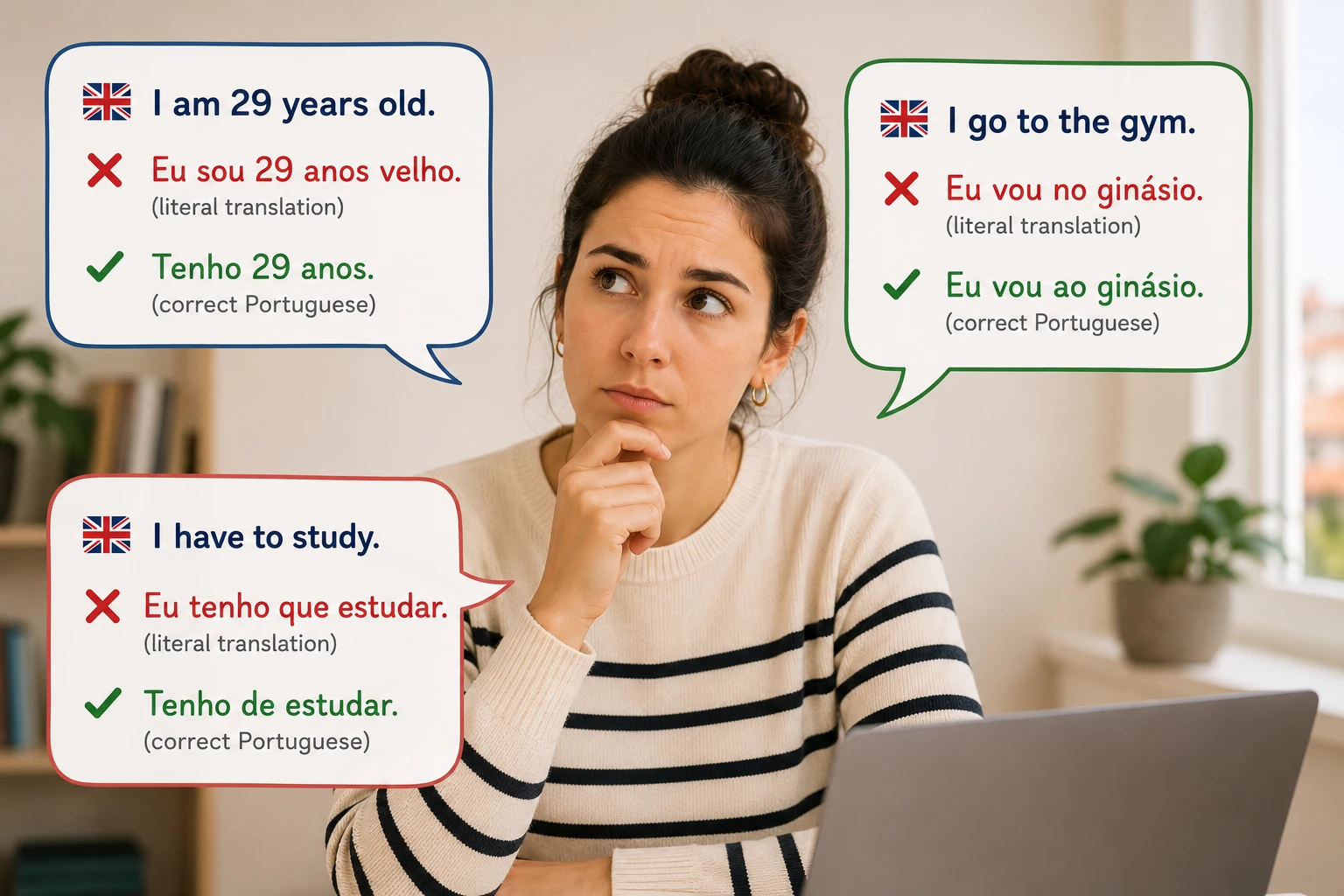
- 5. Using Ser or Estar to Talk About Age
- 6. Forgetting the Preposition After Gostar
- 7. Forgetting Prepositions With Other Verbs
- 8. Forgetting Gender and Number Agreement
- 9. Forgetting Portuguese Contractions
- 10. Using the Wrong Present Continuous Structure
- 11. Using English Word Order With Adjectives
- 12. Trying to Translate “Do” in Questions
- 13. Answering Every Question With Only Sim or Não
- 14. Using an Infinitive Instead of a Conjugated Verb
- 15. Saying Quero When You Intend to Sound Polite
- 16. Translating English Feelings With the Wrong Structure
- 17. Avoiding Double Negatives
- 18. Pronouncing Every Written Vowel Equally Clearly
- 19. Applying English Rhythm to Portuguese
- 20. Waiting Until Your Portuguese Is Perfect Before Speaking
- How to Correct These Mistakes More Effectively
- Correct the Mistakes
- Learn From Mistakes Without Losing Confidence
- Get Personalised Support With Your Portuguese
- See Also
- Final Thoughts
- FAQ
- About the Author
Some links on this website may be affiliate or referral links. If you use them, I may receive a small commission or reward, at no extra cost to you.
I only recommend resources, tools, and services that I believe may be helpful for learning European Portuguese. These links help support the website, but they do not influence the advice or learning guidance I share.
Common Mistakes at a Glance
English-speaking learners commonly need to work on:
- translating sentences word for word;
- overusing subject pronouns;
- treating você as the automatic formal form of “you”;
- confusing ser and estar;
- translating “to be” when Portuguese uses ter;
- forgetting prepositions after certain verbs;
- forgetting gender and number agreement;
- missing contractions;
- using a continuous form that is more typical of Brazilian Portuguese;
- using English word order;
- forming questions with an equivalent of “do”;
- using infinitives without conjugating them;
- making requests that sound more direct than intended;
- applying English rhythm to European Portuguese.
You do not need to correct all these points simultaneously. Identify the patterns that most affect your communication and work on them gradually.
1. Translating Directly From English
Word-for-word translation is one of the most common sources of mistakes.
English and Portuguese do not always express the same idea with equivalent words or sentence structures.
For example, an English speaker might try to translate “I am hungry” using the verb estar:
Estou fome.
In Portuguese, hunger is expressed with ter:
Tenho fome.
I am hungry.
The same applies to several other expressions:
Tenho sede.
I am thirsty.
Tenho frio.
I am cold.
Tenho calor.
I am hot.
Tenho medo.
I am afraid.
The most effective solution is to learn complete expressions rather than isolated translations.
Instead of learning:
fome = hunger
Learn:
ter fome = to be hungry
This gives you a pattern that you can use immediately.
2. Including the Subject Pronoun in Every Sentence
English sentences normally require an explicit subject:
I live in Portugal.
We speak Portuguese.
Portuguese verbs usually contain enough information to identify the subject. As a result, subject pronouns are frequently omitted.
Both of these sentences are correct:
Eu moro em Portugal.
Moro em Portugal.
However, the second often sounds more natural when there is no need for contrast or emphasis.
The same happens with:
Nós falamos português.
Falamos português.
Eu trabalho em casa.
Trabalho em casa.
Nós vamos amanhã.
Vamos amanhã.
Pronouns remain useful when you want to clarify or contrast the subject:
Eu trabalho em casa, mas ela trabalha no escritório.
I work at home, but she works at the office.
The problem is not using eu or nós. It is assuming that every Portuguese sentence needs a subject pronoun because the English sentence has one.
3. Using Você as the Automatic Formal “You”
Many learning resources present the distinction as:
- tu = informal “you”;
- você = formal “you”.
This explanation is incomplete for European Portuguese.
In Portugal, tu is widely used in informal relationships. In formal or more distant situations, speakers normally use third-person verb forms, but frequently omit the word você.
Instead of:
Você precisa de ajuda?
You will commonly hear:
Precisa de ajuda?
Do you need help?
Instead of:
Como você se chama?
In Portugal, you are more likely to hear:
Como se chama?
What is your name?
The word você is used in Portugal, but it can sound distant, abrupt or inappropriate in some contexts. The most natural choice depends on the relationship, age, region and situation.
You may also hear a name or title:
A Ana quer um café?
Would Ana like a coffee?
O senhor tem marcação?
Do you have an appointment, sir?
A senhora precisa de alguma coisa?
Do you need anything, madam?
Learning the correct verb form is important, but understanding the relationship between the speakers is just as important.
4. Confusing Ser and Estar
Both ser and estar can translate as “to be”, but they are not interchangeable.
Use ser for information such as:
- identity;
- origin;
- profession;
- general characteristics;
- dates and time.
Sou a Joana.
I am Joana.
Sou de Portugal.
I am from Portugal.
Ela é professora.
She is a teacher.
Hoje é segunda-feira.
Today is Monday.
Use estar for:
- location;
- temporary states;
- feelings or conditions;
- actions happening now.
Estou em casa.
I am at home.
Estamos cansados.
We are tired.
A loja está fechada.
The shop is closed.
Ela está a trabalhar.
She is working.
Compare:
Ele é nervoso.
He is a nervous person.
Ele está nervoso.
He is nervous at the moment.
A frequent beginner mistake is:
Sou cansado.
The natural sentence is:
Estou cansado.
I am tired.
The simplified explanation that ser is permanent and estar is temporary can be useful initially, but it does not explain every situation. It is better to learn the main uses and notice them in context.
5. Using Ser or Estar to Talk About Age
In English, we say:
I am 40 years old.
Portuguese uses the verb ter, meaning “to have”:
Tenho 40 anos.
I am 40 years old.
Not:
Sou 40 anos.
Estou 40 anos.
To ask someone’s age, you can say:
Quantos anos tens?
How old are you? — informal
Or, using a third-person form:
Quantos anos tem?
How old are you? — more formal or distant
The same verb is used when talking about another person:
A minha filha tem dez anos.
My daughter is ten years old.
6. Forgetting the Preposition After Gostar
The Portuguese verb gostar is normally followed by de.
Gosto de café.
I like coffee.
Gosto de viver em Portugal.
I like living in Portugal.
Gostamos de comida portuguesa.
We like Portuguese food.
A common mistake is:
Gosto café.
The correct structure is:
Gosto de café.
When de is followed by an article, it forms a contraction:
Gosto do restaurante.
I like the restaurant.
Gosto da cidade.
I like the city.
Gosto dos pastéis.
I like the pastries.
Gosto das praias.
I like the beaches.
It is more useful to learn the complete pattern gostar de than to memorise gostar as an isolated equivalent of “to like”.
7. Forgetting Prepositions With Other Verbs
There is no perfect one-to-one correspondence between English and Portuguese prepositions. A Portuguese verb may require a preposition even when its English equivalent does not, or the two languages may use different prepositions.
Useful patterns include:
precisar de — to need
falar com — to speak to
pensar em — to think about
assistir a — to watch or attend
ir a — to go to
ir para — to go towards or leave for
Examples:
Preciso de ajuda.
I need help.
Falei com o médico.
I spoke to the doctor.
Estou a pensar nisso.
I am thinking about that.
Assisti ao filme.
I watched the film.
Avoid trying to choose the preposition by translating the English word. Learn the verb and preposition as a single unit.
8. Forgetting Gender and Number Agreement
Portuguese nouns have grammatical gender. Articles and many adjectives must agree with the noun in gender and number.
Compare:
o carro novo — the new car
a casa nova — the new house
os carros novos — the new cars
as casas novas — the new houses
A learner may remember that casa means “house” but forget to change the article and adjective:
o casa novo – incorrect
a casa nova – correct
It helps to see agreement as a complete pattern:
| Article | Noun | Adjective |
|---|---|---|
| o | carro | novo |
| a | casa | nova |
| os | carros | novos |
| as | casas | novas |
Not every word ending in -o is masculine, and not every word ending in -a is feminine.
For example:
o problema — the problem
o dia — the day
a mão — the hand
Learn nouns with their articles:
- o problema, not only problema;
- a viagem, not only viagem;
- a mão, not only mão.
This makes it easier to use the noun correctly later.
9. Forgetting Portuguese Contractions
Portuguese frequently combines prepositions with articles.
de + article
de + o = do
de + a = da
de + os = dos
de + as = das
Examples:
Sou do Canadá.
I am from Canada.
É a chave da casa.
It is the key to the house.
em + article
em + o = no
em + a = na
em + os = nos
em + as = nas
Examples:
Estou no supermercado.
I am at the supermarket.
Moro na Alemanha.
I live in Germany.
a + article
a + o = ao
a + a = à
a + os = aos
a + as = às
Examples:
Vou ao médico.
I am going to the doctor.
A aula começa às nove.
The lesson begins at nine.
A common beginner mistake is to keep the two words separate:
Vou a o supermercado. – incorrect
Vou ao supermercado. – correct
These contractions are a fundamental part of Portuguese grammar, not optional abbreviations.
10. Using the Wrong Present Continuous Structure
In English, an action happening now is commonly expressed with “to be + verb-ing”:
I am working.
In European Portuguese, the usual construction is:
estar + a + infinitive
Estou a trabalhar.
I am working.
Ela está a cozinhar.
She is cooking.
Estamos a aprender português.
We are learning Portuguese.
Forms with the gerund, such as estou trabalhando, are associated particularly with Brazilian Portuguese and are not the standard everyday construction most learners need for communication in Portugal.
If you use apps or online courses, check which variety they teach. Is Duolingo Good for European Portuguese? explains why this distinction matters when your goal is to communicate in Portugal.
11. Using English Word Order With Adjectives
In English, adjectives normally appear before the noun:
a beautiful house
a Portuguese restaurant
In Portuguese, descriptive adjectives commonly appear after it:
uma casa bonita
um restaurante português
um carro novo
uma pessoa simpática
A common transfer from English is:
uma bonita casa
This structure is not necessarily grammatically impossible, but adjective position can affect emphasis, style or meaning. For beginners, placing a descriptive adjective after the noun is usually the safest pattern.
Compare:
um homem grande — a large man
um grande homem — a great man
At the beginning, focus on common combinations used in everyday communication.
12. Trying to Translate “Do” in Questions
English uses do and does to form many questions:
Do you speak Portuguese?
Does she live here?
Portuguese does not need an equivalent auxiliary verb in these questions.
Falas português?
Do you speak Portuguese?
Ela mora aqui?
Does she live here?
Trabalha amanhã?
Are you working tomorrow?
The word order may remain the same as in a statement:
Falas português.
You speak Portuguese.
Falas português?
Do you speak Portuguese?
Your intonation and the question mark indicate that it is a question.
13. Answering Every Question With Only Sim or Não
Answering with sim or não is not incorrect. However, Portuguese speakers frequently answer a yes-or-no question by repeating the verb.
— Falas português?
— Falo.
“Do you speak Portuguese?”
“Yes, I do.”
— Tens filhos?
— Tenho.
“Do you have children?”
“Yes, I do.”
— Mora em Portugal?
— Moro.
“Do you live in Portugal?”
“Yes, I do.”
You can also reinforce the answer with sim:
Falo, sim.
Yes, I do.
For a negative answer, place não before the verb:
— Trabalhas amanhã?
— Não trabalho.
“Are you working tomorrow?”
“No, I’m not.”
This small change can make your answers sound more natural and help you practise verb conjugations.
14. Using an Infinitive Instead of a Conjugated Verb
English verbs change relatively little according to the subject. Portuguese verb endings contain much more information.
A beginner may use the infinitive after the subject:
Eu falar português.
The verb must be conjugated:
Eu falo português.
I speak Portuguese.
More examples:
Nós morar em Lisboa. – incorrect
Nós moramos em Lisboa. – correct
Ela trabalhar em casa. – incorrect
Ela trabalha em casa. – correct
However, an infinitive is correct after certain conjugated verbs:
Quero aprender português.
I want to learn Portuguese.
Posso entrar?
May I come in?
Vamos jantar.
We are going to have dinner.
The first verb is conjugated; the second remains in the infinitive.
15. Saying Quero When You Intend to Sound Polite
Quero means “I want”. It is grammatically correct:
Quero um café.
I want a coffee.
However, it may sound more direct than an English speaker intends in certain interactions.
In cafés, restaurants and shops, you can use:
Queria um café, por favor.
I would like a coffee, please.
Queria marcar uma consulta.
I would like to book an appointment.
Gostava de reservar uma mesa.
I would like to reserve a table.
Pode ajudar-me, por favor?
Can you help me, please?
This does not mean that quero is always impolite. Context, tone of voice and the relationship between the speakers all matter. Nevertheless, queria and gostava de are useful forms for polite everyday requests.
16. Translating English Feelings With the Wrong Structure
English frequently uses “to be” for physical and emotional experiences. Portuguese may use estar, ter or another expression.
| English | European Portuguese |
|---|---|
| I am tired. | Estou cansado/cansada. |
| I am afraid. | Tenho medo. |
| I am hungry. | Tenho fome. |
| I am thirsty. | Tenho sede. |
| I am in a hurry. | Estou com pressa. |
| I am right. | Tenho razão. |
| I am lucky. | Tenho sorte. |
Learning these as complete expressions will help you avoid choosing a verb based only on the English sentence.
17. Avoiding Double Negatives
In standard English, learners are often taught to avoid double negatives. Portuguese uses combinations of negative words naturally.
Não sei nada.
I do not know anything.
Não conheço ninguém.
I do not know anyone.
Nunca vou lá.
I never go there.
These sentences are correct.
A learner influenced by English might say:
Não conheço alguém aqui.
When the intended meaning is “I do not know anyone here”, the natural sentence is:
Não conheço ninguém aqui.
18. Pronouncing Every Written Vowel Equally Clearly
European Portuguese spelling does not always show how reduced an unstressed vowel will sound in natural speech.
English-speaking learners may pronounce every syllable very clearly because they are concentrating on the written word. This can make individual words understandable while giving the sentence a less natural rhythm.
For example, unstressed vowels in European Portuguese may become shorter, weaker or difficult to hear. Words can sound more compressed in a sentence than they appear on the page.
This does not mean that every English speaker will struggle with Portuguese pronunciation. Some of my students reproduce new Portuguese sounds and rhythms accurately from the first lesson, without noticeable interference from their first language. Others need more listening, repetition and feedback.
The important point is to compare what you read with what you hear. Do not assume that every written vowel receives equal emphasis.
For a closer look at Portuguese listening and pronunciation, read Is European Portuguese Hard to Learn?.
19. Applying English Rhythm to Portuguese
English and European Portuguese organise spoken rhythm differently.
A learner may pronounce every Portuguese word carefully and separately:
Eu / quero / ir / ao / supermercado.
Natural speech connects the words more closely:
Eu quero ir ao supermercado.
This can make spoken Portuguese initially difficult to recognise, even when you already know all the vocabulary.
To improve, practise complete phrases rather than isolated words:
Preciso de ajuda.
Onde é a estação?
Queria um café, por favor.
A que horas abre?
Listen to the phrase, repeat it and try to preserve its rhythm. Recording yourself can help you compare your version with the original.
20. Waiting Until Your Portuguese Is Perfect Before Speaking
This is not a grammatical mistake, but it can become one of the biggest obstacles to progress.
Some learners spend a long time studying verb tables but avoid conversation because they are afraid of making mistakes. As a result, they recognise the correct forms but cannot retrieve them quickly when speaking.
You do not need perfect Portuguese to:
- order in a café;
- ask for directions;
- speak to a neighbour;
- attend an appointment;
- take part in a simple family conversation;
- explain a basic problem;
- ask someone to repeat.
Start with short sentences and familiar patterns. Accuracy will develop through use, correction and repetition.
If you are at the beginning of your learning journey, European Portuguese for Beginners provides a practical path for developing your first communication skills.
How to Correct These Mistakes More Effectively
Simply reading the correct form once is rarely enough. You need to retrieve and use it in different contexts.
A useful correction process is:
- Identify one recurring mistake.
- Write down the complete corrected expression.
- Create three sentences related to your life.
- Say the sentences aloud.
- Use the structure in a conversation.
- Review it a few days later.
For example, if you frequently forget de after gostar, practise:
Gosto de café.
Gosto de caminhar.
Gosto da minha cidade.
Não gosto de conduzir à noite.
If you confuse ser and estar, create contrasting sentences:
Sou uma pessoa calma.
Hoje estou nervosa.
O café é pequeno.
Hoje o café está fechado.
Corrections become easier to remember when they are connected to meaning and personal experience.
Correct the Mistakes
Each sentence contains a common mistake. Try to correct it before checking the answers.
- Eu estou 35 anos.
- Gosto comida portuguesa.
- Eu falar um pouco de português.
- Estou estudando português agora.
- O casa é muito bonito.
- Você precisa ajuda?
- Vou a o supermercado.
- Sou cansado hoje.
- Do falas inglês?
- Não conheço alguém aqui.
- Quero um café, when speaking politely to a waiter.
- Ela é em Lisboa.
Answers
- Ela está em Lisboa.
- Tenho 35 anos.
- Gosto de comida portuguesa.
- Falo um pouco de português.
- Estou a estudar português agora.
- A casa é muito bonita.
- Precisa de ajuda?
- Vou ao supermercado.
- Estou cansado hoje.
- Falas inglês?
- Não conheço ninguém aqui.
- Queria um café, por favor.
Learn From Mistakes Without Losing Confidence
Mistakes show that you are testing the language and discovering how Portuguese works. They are useful when you notice them, understand the correction and receive another opportunity to use the same structure.
In my lessons, I do not interrupt every sentence to correct every detail. Constant interruption can make it difficult for a student to express an idea or build confidence.
The right moment for correction depends on:
- the purpose of the activity;
- whether the mistake prevents understanding;
- whether it is a recurring pattern;
- the student’s level;
- the student’s current learning goals.
Sometimes immediate correction is useful. At other times, I take note of a pattern and return to it after the student has finished speaking.
Get Personalised Support With Your Portuguese

You can study grammar independently and still find that the same mistakes return when you speak. This happens because understanding a rule and applying it spontaneously are different skills.
In a personalised lesson, we can identify which patterns are affecting your Portuguese and practise them through situations that are relevant to you.
I teach primarily in Portuguese, with support in English whenever it helps you understand a new structure or resolve a specific doubt. Lessons can focus on communication for:
- everyday life in Portugal;
- family and social situations;
- travel;
- appointments and services;
- professional communication;
- building confidence in conversation.
If you would like my help with your Portuguese learning journey, you can schedule a trial lesson with me on Preply. We can identify what is currently limiting your communication and create a practical learning plan around your needs.
Final Thoughts
Mistakes caused by English influence are a normal part of learning European Portuguese. They do not all need to be corrected at once, and not every English-speaking learner will experience the same difficulties.
Begin with the patterns that have the greatest impact on your communication:
- learn complete expressions instead of translating individual words;
- omit subject pronouns when they are unnecessary;
- distinguish ser, estar and ter;
- learn verbs together with their prepositions;
- practise gender and number agreement;
- use European Portuguese structures such as estar a + infinitive;
- listen to natural speech as well as reading it;
- speak before you feel completely ready.
The aim is not to eliminate every mistake before you communicate. It is to recognise recurring patterns, benefit from appropriate correction and gradually express yourself with greater clarity, confidence and independence.
If you would like personalised help identifying and correcting the patterns that are affecting your Portuguese, you can book a trial lesson with me on Preply. We will focus on your individual needs and practise the language you need for everyday life, family, travel or work.
FAQ
About the Author

Isabel M.
Native European Portuguese Tutor | Founder of Practical Portuguese
Hi, I’m Isabel, a native European Portuguese tutor from Portugal and the founder of Practical Portuguese.
I help adults learn authentic European Portuguese through structured, personalised online lessons. My lessons are taught mainly in Portuguese, with support in English whenever needed. I teach students from complete beginner to advanced levels, focusing on practical communication for everyday life, family, travel and work in Portugal.
Every article on Practical Portuguese combines natural language as it is spoken in Portugal with my experience teaching adult learners from different language backgrounds.
Why Learn with Me?
✔ Native European Portuguese speaker from Portugal
✔ Lessons taught in Portuguese with support in English
✔ Experience teaching adults from different language backgrounds
✔ Personalised one-to-one online lessons
✔ Practical Portuguese for everyday life, family, travel and work in Portugal
✔ Lessons adapted to your listening, pronunciation, sentence structure and speaking needs